{"title":"Sialyl Lewisa 四糖抗原的化学合成和化学酶合成。","authors":"","doi":"10.1039/d4ob00809j","DOIUrl":null,"url":null,"abstract":"<div><p>Sialyl Lewis<sup>a</sup> (sLe<sup>a</sup>), also known as cancer antigen 19-9, is a tumor-associated carbohydrate antigen. In this article, chemical and chemoenzymatic syntheses of a tetrasaccharide glycan <strong>1</strong> structurally derived from sLe<sup>a</sup> are reported. Challenges involved in the chemical synthesis include the highly stereoselective construction of 1,2-<em>cis</em>-α-<span>l</span>-fucoside and α-<span>d</span>-sialoside, as well as the assembly of the 3,4-disubstituted <em>N</em>-acetylglucosamine subunit. Perbenzylated thiofucoside and <em>N</em>-acetyl-5-<em>N</em>,4-<em>O</em>-oxazolidinone protected sialic acid thioglycoside were employed as glycosyl donors, respectively, for the efficient preparation of the desired α-fucoside and α-sialoside. The 3,4-branched glucosamine backbone was established through a 3-<em>O</em> and then 4-<em>O</em> glycosylation sequence in which the 3-hydroxyl group of the glucosamine moiety was glycosylated first and then the 4-hydroxyl. A facile chemoenzymatic approach was also exploited to synthesize the target molecule. The chemically obtained free disaccharide <strong>30</strong> was sequentially sialylated and fucosylated in an enzyme-catalyzed regio- and stereospecific manner to form <strong>1</strong> in high yields. The linker appended <strong>1</strong> can be covalently attached to a carrier protein for further immunological studies.</p></div>","PeriodicalId":96,"journal":{"name":"Organic & Biomolecular Chemistry","volume":"22 28","pages":"Pages 5776-5782"},"PeriodicalIF":2.7000,"publicationDate":"2024-07-17","publicationTypes":"Journal Article","fieldsOfStudy":null,"isOpenAccess":false,"openAccessPdf":"","citationCount":"0","resultStr":"{\"title\":\"Chemical and chemoenzymatic syntheses of sialyl Lewisa tetrasaccharide antigen†\",\"authors\":\"\",\"doi\":\"10.1039/d4ob00809j\",\"DOIUrl\":null,\"url\":null,\"abstract\":\"<div><p>Sialyl Lewis<sup>a</sup> (sLe<sup>a</sup>), also known as cancer antigen 19-9, is a tumor-associated carbohydrate antigen. In this article, chemical and chemoenzymatic syntheses of a tetrasaccharide glycan <strong>1</strong> structurally derived from sLe<sup>a</sup> are reported. Challenges involved in the chemical synthesis include the highly stereoselective construction of 1,2-<em>cis</em>-α-<span>l</span>-fucoside and α-<span>d</span>-sialoside, as well as the assembly of the 3,4-disubstituted <em>N</em>-acetylglucosamine subunit. Perbenzylated thiofucoside and <em>N</em>-acetyl-5-<em>N</em>,4-<em>O</em>-oxazolidinone protected sialic acid thioglycoside were employed as glycosyl donors, respectively, for the efficient preparation of the desired α-fucoside and α-sialoside. The 3,4-branched glucosamine backbone was established through a 3-<em>O</em> and then 4-<em>O</em> glycosylation sequence in which the 3-hydroxyl group of the glucosamine moiety was glycosylated first and then the 4-hydroxyl. A facile chemoenzymatic approach was also exploited to synthesize the target molecule. The chemically obtained free disaccharide <strong>30</strong> was sequentially sialylated and fucosylated in an enzyme-catalyzed regio- and stereospecific manner to form <strong>1</strong> in high yields. The linker appended <strong>1</strong> can be covalently attached to a carrier protein for further immunological studies.</p></div>\",\"PeriodicalId\":96,\"journal\":{\"name\":\"Organic & Biomolecular Chemistry\",\"volume\":\"22 28\",\"pages\":\"Pages 5776-5782\"},\"PeriodicalIF\":2.7000,\"publicationDate\":\"2024-07-17\",\"publicationTypes\":\"Journal Article\",\"fieldsOfStudy\":null,\"isOpenAccess\":false,\"openAccessPdf\":\"\",\"citationCount\":\"0\",\"resultStr\":null,\"platform\":\"Semanticscholar\",\"paperid\":null,\"PeriodicalName\":\"Organic & Biomolecular Chemistry\",\"FirstCategoryId\":\"92\",\"ListUrlMain\":\"https://www.sciencedirect.com/org/science/article/pii/S1477052024005688\",\"RegionNum\":3,\"RegionCategory\":\"化学\",\"ArticlePicture\":[],\"TitleCN\":null,\"AbstractTextCN\":null,\"PMCID\":null,\"EPubDate\":\"2024/6/25 0:00:00\",\"PubModel\":\"Epub\",\"JCR\":\"Q1\",\"JCRName\":\"CHEMISTRY, ORGANIC\",\"Score\":null,\"Total\":0}","platform":"Semanticscholar","paperid":null,"PeriodicalName":"Organic & Biomolecular Chemistry","FirstCategoryId":"92","ListUrlMain":"https://www.sciencedirect.com/org/science/article/pii/S1477052024005688","RegionNum":3,"RegionCategory":"化学","ArticlePicture":[],"TitleCN":null,"AbstractTextCN":null,"PMCID":null,"EPubDate":"2024/6/25 0:00:00","PubModel":"Epub","JCR":"Q1","JCRName":"CHEMISTRY, ORGANIC","Score":null,"Total":0}
Chemical and chemoenzymatic syntheses of sialyl Lewisa tetrasaccharide antigen†
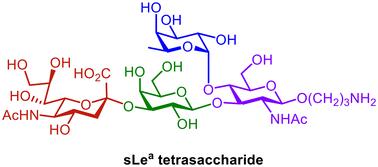
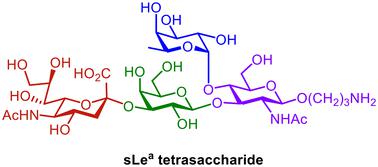
Sialyl Lewisa (sLea), also known as cancer antigen 19-9, is a tumor-associated carbohydrate antigen. In this article, chemical and chemoenzymatic syntheses of a tetrasaccharide glycan 1 structurally derived from sLea are reported. Challenges involved in the chemical synthesis include the highly stereoselective construction of 1,2-cis-α-l-fucoside and α-d-sialoside, as well as the assembly of the 3,4-disubstituted N-acetylglucosamine subunit. Perbenzylated thiofucoside and N-acetyl-5-N,4-O-oxazolidinone protected sialic acid thioglycoside were employed as glycosyl donors, respectively, for the efficient preparation of the desired α-fucoside and α-sialoside. The 3,4-branched glucosamine backbone was established through a 3-O and then 4-O glycosylation sequence in which the 3-hydroxyl group of the glucosamine moiety was glycosylated first and then the 4-hydroxyl. A facile chemoenzymatic approach was also exploited to synthesize the target molecule. The chemically obtained free disaccharide 30 was sequentially sialylated and fucosylated in an enzyme-catalyzed regio- and stereospecific manner to form 1 in high yields. The linker appended 1 can be covalently attached to a carrier protein for further immunological studies.
期刊介绍:
Organic & Biomolecular Chemistry is an international journal using integrated research in chemistry-organic chemistry. Founded in 2003 by the Royal Society of Chemistry, the journal is published in Semimonthly issues and has been indexed by SCIE, a leading international database. The journal focuses on the key research and cutting-edge progress in the field of chemistry-organic chemistry, publishes and reports the research results in this field in a timely manner, and is committed to becoming a window and platform for rapid academic exchanges among peers in this field. The journal's impact factor in 2023 is 2.9, and its CiteScore is 5.5.




 京公网安备 11010802042870号
京ICP备2023020795号-1
京公网安备 11010802042870号
京ICP备2023020795号-1

 分享
分享
 求助内容:
求助内容: 应助结果提醒方式:
 扫码关注我们
