Maud D. M. E. Linssen, Yu-Ting Lin, Sebastian A. H. van den Wildenberg, Marrit M. E. Tholen, Arthur M. de Jong and Menno W. J. Prins*,
{"title":"利用聚糖重塑将定向抗体耦合到防污聚合物上,通过粒子运动进行生物传感。","authors":"Maud D. M. E. Linssen, Yu-Ting Lin, Sebastian A. H. van den Wildenberg, Marrit M. E. Tholen, Arthur M. de Jong and Menno W. J. Prins*, ","doi":"10.1021/acs.bioconjchem.4c00196","DOIUrl":null,"url":null,"abstract":"<p >Biosensors based on immobilized antibodies require molecular strategies that (i) couple the antibodies in a stable fashion while maintaining the conformation and functionality, (ii) give outward orientation of the paratope regions of the antibodies for good accessibility to analyte molecules in the biofluid, and (iii) surround the antibodies by antibiofouling molecules. Here, we demonstrate a method to achieve oriented coupling of antibodies to an antifouling poly(<span>l</span>-lysine)-<i>grafted</i>-poly(ethylene glycol) (PLL-<i>g</i>-PEG) substrate, using glycan remodeling to create antibody–DNA conjugates. The coupling, orientation, and functionality of the antibodies were studied using two analysis methods with single-molecule resolution, namely single-molecule localization microscopy and continuous biosensing by particle motion. The biosensing functionality of the glycan-remodeled antibodies was demonstrated in a sandwich immunosensor for procalcitonin. The results show that glycan-remodeled antibodies enable oriented immobilization and biosensing functionality with low nonspecific binding on antifouling polymer substrates.</p>","PeriodicalId":29,"journal":{"name":"Bioconjugate Chemistry","volume":"35 7","pages":"996–1006"},"PeriodicalIF":3.9000,"publicationDate":"2024-07-01","publicationTypes":"Journal Article","fieldsOfStudy":null,"isOpenAccess":false,"openAccessPdf":"https://pubs.acs.org/doi/epdf/10.1021/acs.bioconjchem.4c00196","citationCount":"0","resultStr":"{\"title\":\"Oriented Antibody Coupling to an Antifouling Polymer Using Glycan Remodeling for Biosensing by Particle Motion\",\"authors\":\"Maud D. M. E. Linssen, Yu-Ting Lin, Sebastian A. H. van den Wildenberg, Marrit M. E. Tholen, Arthur M. de Jong and Menno W. J. Prins*, \",\"doi\":\"10.1021/acs.bioconjchem.4c00196\",\"DOIUrl\":null,\"url\":null,\"abstract\":\"<p >Biosensors based on immobilized antibodies require molecular strategies that (i) couple the antibodies in a stable fashion while maintaining the conformation and functionality, (ii) give outward orientation of the paratope regions of the antibodies for good accessibility to analyte molecules in the biofluid, and (iii) surround the antibodies by antibiofouling molecules. Here, we demonstrate a method to achieve oriented coupling of antibodies to an antifouling poly(<span>l</span>-lysine)-<i>grafted</i>-poly(ethylene glycol) (PLL-<i>g</i>-PEG) substrate, using glycan remodeling to create antibody–DNA conjugates. The coupling, orientation, and functionality of the antibodies were studied using two analysis methods with single-molecule resolution, namely single-molecule localization microscopy and continuous biosensing by particle motion. The biosensing functionality of the glycan-remodeled antibodies was demonstrated in a sandwich immunosensor for procalcitonin. The results show that glycan-remodeled antibodies enable oriented immobilization and biosensing functionality with low nonspecific binding on antifouling polymer substrates.</p>\",\"PeriodicalId\":29,\"journal\":{\"name\":\"Bioconjugate Chemistry\",\"volume\":\"35 7\",\"pages\":\"996–1006\"},\"PeriodicalIF\":3.9000,\"publicationDate\":\"2024-07-01\",\"publicationTypes\":\"Journal Article\",\"fieldsOfStudy\":null,\"isOpenAccess\":false,\"openAccessPdf\":\"https://pubs.acs.org/doi/epdf/10.1021/acs.bioconjchem.4c00196\",\"citationCount\":\"0\",\"resultStr\":null,\"platform\":\"Semanticscholar\",\"paperid\":null,\"PeriodicalName\":\"Bioconjugate Chemistry\",\"FirstCategoryId\":\"1\",\"ListUrlMain\":\"https://pubs.acs.org/doi/10.1021/acs.bioconjchem.4c00196\",\"RegionNum\":2,\"RegionCategory\":\"化学\",\"ArticlePicture\":[],\"TitleCN\":null,\"AbstractTextCN\":null,\"PMCID\":null,\"EPubDate\":\"\",\"PubModel\":\"\",\"JCR\":\"Q1\",\"JCRName\":\"BIOCHEMICAL RESEARCH METHODS\",\"Score\":null,\"Total\":0}","platform":"Semanticscholar","paperid":null,"PeriodicalName":"Bioconjugate Chemistry","FirstCategoryId":"1","ListUrlMain":"https://pubs.acs.org/doi/10.1021/acs.bioconjchem.4c00196","RegionNum":2,"RegionCategory":"化学","ArticlePicture":[],"TitleCN":null,"AbstractTextCN":null,"PMCID":null,"EPubDate":"","PubModel":"","JCR":"Q1","JCRName":"BIOCHEMICAL RESEARCH METHODS","Score":null,"Total":0}
Oriented Antibody Coupling to an Antifouling Polymer Using Glycan Remodeling for Biosensing by Particle Motion
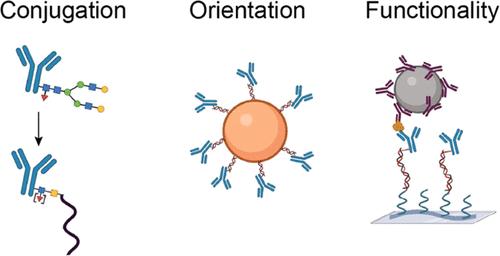
Biosensors based on immobilized antibodies require molecular strategies that (i) couple the antibodies in a stable fashion while maintaining the conformation and functionality, (ii) give outward orientation of the paratope regions of the antibodies for good accessibility to analyte molecules in the biofluid, and (iii) surround the antibodies by antibiofouling molecules. Here, we demonstrate a method to achieve oriented coupling of antibodies to an antifouling poly(l-lysine)-grafted-poly(ethylene glycol) (PLL-g-PEG) substrate, using glycan remodeling to create antibody–DNA conjugates. The coupling, orientation, and functionality of the antibodies were studied using two analysis methods with single-molecule resolution, namely single-molecule localization microscopy and continuous biosensing by particle motion. The biosensing functionality of the glycan-remodeled antibodies was demonstrated in a sandwich immunosensor for procalcitonin. The results show that glycan-remodeled antibodies enable oriented immobilization and biosensing functionality with low nonspecific binding on antifouling polymer substrates.
期刊介绍:
Bioconjugate Chemistry invites original contributions on all research at the interface between man-made and biological materials. The mission of the journal is to communicate to advances in fields including therapeutic delivery, imaging, bionanotechnology, and synthetic biology. Bioconjugate Chemistry is intended to provide a forum for presentation of research relevant to all aspects of bioconjugates, including the preparation, properties and applications of biomolecular conjugates.






 京公网安备 11010802042870号
京ICP备2023020795号-1
京公网安备 11010802042870号
京ICP备2023020795号-1

 分享
分享
 求助内容:
求助内容: 应助结果提醒方式:
 扫码关注我们
