Vu Xuan Quang, Nguyen Thi Hien, Nguyen Thi Luyen, Nguyen Trung Kien, Nguyen Thi Khanh Van, Nguyen Thi Minh Thuy, Phan Van Do and Nguyen Xuan Ca
{"title":"NaGdF4:Dy3+ 纳米晶体:光学特性和能量传递过程的新见解","authors":"Vu Xuan Quang, Nguyen Thi Hien, Nguyen Thi Luyen, Nguyen Trung Kien, Nguyen Thi Khanh Van, Nguyen Thi Minh Thuy, Phan Van Do and Nguyen Xuan Ca","doi":"10.1039/D4CP01334D","DOIUrl":null,"url":null,"abstract":"<p >NaGdF<small><sub>4</sub></small>:Dy<small><sup>3+</sup></small> nanocrystals (NCs) have been synthesized using a precipitation technique. The structural characteristics and morphology of the materials were analyzed using X-ray diffraction patterns and scanning electron microscopy images, respectively. The photoluminescence excitation spectra, emission spectra and decay curves of all samples were recorded at room temperature. The color feature of Dy<small><sup>3+</sup></small> luminescence was estimated using CIE chromaticity coordinates and the correlated color temperature. The radiative properties of the Dy<small><sup>3+</sup></small>:<small><sup>4</sup></small>F<small><sub>9/2</sub></small> level in the material were analyzed within the framework of JO theory. In NaGdF<small><sub>4</sub></small>:Dy<small><sup>3+</sup></small> NCs, the energy transfer from Gd<small><sup>3+</sup></small> to Dy<small><sup>3+</sup></small> causes an enhancement in the luminescence of the Dy<small><sup>3+</sup></small> ions. The rate of the processes taking part in the depopulation of Gd<small><sup>3+</sup></small> ions was estimated. The energy transfer between Dy<small><sup>3+</sup></small> ions leads to the luminescence quenching of NaGdF<small><sub>4</sub></small>:Dy<small><sup>3+</sup></small>. In this process, the dipole–dipole interaction, which is found by using the Inokuti–Hirayama model, is the dominant mechanism. The characteristic parameters of the energy transfer processes between Dy<small><sup>3+</sup></small> ions have also been calculated in detail.</p>","PeriodicalId":99,"journal":{"name":"Physical Chemistry Chemical Physics","volume":" 29","pages":" 20046-20058"},"PeriodicalIF":3.0000,"publicationDate":"2024-07-01","publicationTypes":"Journal Article","fieldsOfStudy":null,"isOpenAccess":false,"openAccessPdf":"","citationCount":"0","resultStr":"{\"title\":\"NaGdF4:Dy3+ nanocrystals: new insights into optical properties and energy transfer processes\",\"authors\":\"Vu Xuan Quang, Nguyen Thi Hien, Nguyen Thi Luyen, Nguyen Trung Kien, Nguyen Thi Khanh Van, Nguyen Thi Minh Thuy, Phan Van Do and Nguyen Xuan Ca\",\"doi\":\"10.1039/D4CP01334D\",\"DOIUrl\":null,\"url\":null,\"abstract\":\"<p >NaGdF<small><sub>4</sub></small>:Dy<small><sup>3+</sup></small> nanocrystals (NCs) have been synthesized using a precipitation technique. The structural characteristics and morphology of the materials were analyzed using X-ray diffraction patterns and scanning electron microscopy images, respectively. The photoluminescence excitation spectra, emission spectra and decay curves of all samples were recorded at room temperature. The color feature of Dy<small><sup>3+</sup></small> luminescence was estimated using CIE chromaticity coordinates and the correlated color temperature. The radiative properties of the Dy<small><sup>3+</sup></small>:<small><sup>4</sup></small>F<small><sub>9/2</sub></small> level in the material were analyzed within the framework of JO theory. In NaGdF<small><sub>4</sub></small>:Dy<small><sup>3+</sup></small> NCs, the energy transfer from Gd<small><sup>3+</sup></small> to Dy<small><sup>3+</sup></small> causes an enhancement in the luminescence of the Dy<small><sup>3+</sup></small> ions. The rate of the processes taking part in the depopulation of Gd<small><sup>3+</sup></small> ions was estimated. The energy transfer between Dy<small><sup>3+</sup></small> ions leads to the luminescence quenching of NaGdF<small><sub>4</sub></small>:Dy<small><sup>3+</sup></small>. In this process, the dipole–dipole interaction, which is found by using the Inokuti–Hirayama model, is the dominant mechanism. The characteristic parameters of the energy transfer processes between Dy<small><sup>3+</sup></small> ions have also been calculated in detail.</p>\",\"PeriodicalId\":99,\"journal\":{\"name\":\"Physical Chemistry Chemical Physics\",\"volume\":\" 29\",\"pages\":\" 20046-20058\"},\"PeriodicalIF\":3.0000,\"publicationDate\":\"2024-07-01\",\"publicationTypes\":\"Journal Article\",\"fieldsOfStudy\":null,\"isOpenAccess\":false,\"openAccessPdf\":\"\",\"citationCount\":\"0\",\"resultStr\":null,\"platform\":\"Semanticscholar\",\"paperid\":null,\"PeriodicalName\":\"Physical Chemistry Chemical Physics\",\"FirstCategoryId\":\"92\",\"ListUrlMain\":\"https://pubs.rsc.org/en/content/articlelanding/2024/cp/d4cp01334d\",\"RegionNum\":3,\"RegionCategory\":\"化学\",\"ArticlePicture\":[],\"TitleCN\":null,\"AbstractTextCN\":null,\"PMCID\":null,\"EPubDate\":\"\",\"PubModel\":\"\",\"JCR\":\"Q3\",\"JCRName\":\"CHEMISTRY, PHYSICAL\",\"Score\":null,\"Total\":0}","platform":"Semanticscholar","paperid":null,"PeriodicalName":"Physical Chemistry Chemical Physics","FirstCategoryId":"92","ListUrlMain":"https://pubs.rsc.org/en/content/articlelanding/2024/cp/d4cp01334d","RegionNum":3,"RegionCategory":"化学","ArticlePicture":[],"TitleCN":null,"AbstractTextCN":null,"PMCID":null,"EPubDate":"","PubModel":"","JCR":"Q3","JCRName":"CHEMISTRY, PHYSICAL","Score":null,"Total":0}
NaGdF4:Dy3+ nanocrystals: new insights into optical properties and energy transfer processes
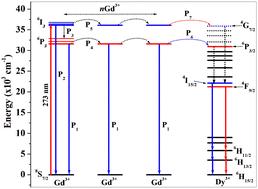
NaGdF4:Dy3+ nanocrystals (NCs) have been synthesized using a precipitation technique. The structural characteristics and morphology of the materials were analyzed using X-ray diffraction patterns and scanning electron microscopy images, respectively. The photoluminescence excitation spectra, emission spectra and decay curves of all samples were recorded at room temperature. The color feature of Dy3+ luminescence was estimated using CIE chromaticity coordinates and the correlated color temperature. The radiative properties of the Dy3+:4F9/2 level in the material were analyzed within the framework of JO theory. In NaGdF4:Dy3+ NCs, the energy transfer from Gd3+ to Dy3+ causes an enhancement in the luminescence of the Dy3+ ions. The rate of the processes taking part in the depopulation of Gd3+ ions was estimated. The energy transfer between Dy3+ ions leads to the luminescence quenching of NaGdF4:Dy3+. In this process, the dipole–dipole interaction, which is found by using the Inokuti–Hirayama model, is the dominant mechanism. The characteristic parameters of the energy transfer processes between Dy3+ ions have also been calculated in detail.
期刊介绍:
Physical Chemistry Chemical Physics (PCCP) is an international journal co-owned by 19 physical chemistry and physics societies from around the world. This journal publishes original, cutting-edge research in physical chemistry, chemical physics and biophysical chemistry. To be suitable for publication in PCCP, articles must include significant innovation and/or insight into physical chemistry; this is the most important criterion that reviewers and Editors will judge against when evaluating submissions.
The journal has a broad scope and welcomes contributions spanning experiment, theory, computation and data science. Topical coverage includes spectroscopy, dynamics, kinetics, statistical mechanics, thermodynamics, electrochemistry, catalysis, surface science, quantum mechanics, quantum computing and machine learning. Interdisciplinary research areas such as polymers and soft matter, materials, nanoscience, energy, surfaces/interfaces, and biophysical chemistry are welcomed if they demonstrate significant innovation and/or insight into physical chemistry. Joined experimental/theoretical studies are particularly appreciated when complementary and based on up-to-date approaches.





 京公网安备 11010802042870号
京ICP备2023020795号-1
京公网安备 11010802042870号
京ICP备2023020795号-1

 分享
分享
 求助内容:
求助内容: 应助结果提醒方式:
 扫码关注我们
