{"title":"需要在医疗机构接受长期护理的老年女性的区域相位角与运动水平之间的关系。","authors":"Akira Kubo, Minami Sato, Akihiro Yakabi, Ayaka Takayama, Masahiro Ishizaka","doi":"10.1589/jpts.36.392","DOIUrl":null,"url":null,"abstract":"<p><p>[Purpose] This study aimed to determine the characteristics of regional phase angles based on locomotion level among older Japanese females requiring long-term care in a health facility. [Participants and Methods] This was a cross-sectional observational study. The participants included 91 residents (mean age ± standard deviation: 90.2 ± 5.6 years) admitted to an older health facility. Based on their indoor locomotion status, the participants were divided into three groups: group I, able to walk with or without walking aids; group II, able to move in a wheelchair without assistance; and group III, able to move in a wheelchair with assistance. The regional phase angle was measured using a bioimpedance device. [Results] Significant differences were observed in the regional phase angle of the upper limbs between groups I and III and between groups II and III; in that of the lower limbs among all groups; and in that of the trunk between groups I and II and between groups I and III. [Conclusion] The level of locomotion may be explained by the regional phase angles of the lower limbs.</p>","PeriodicalId":16834,"journal":{"name":"Journal of Physical Therapy Science","volume":"36 7","pages":"392-395"},"PeriodicalIF":0.0000,"publicationDate":"2024-07-01","publicationTypes":"Journal Article","fieldsOfStudy":null,"isOpenAccess":false,"openAccessPdf":"https://www.ncbi.nlm.nih.gov/pmc/articles/PMC11214818/pdf/","citationCount":"0","resultStr":"{\"title\":\"Association between regional phase angle and level of locomotion among older females requiring long-term care in a health facility.\",\"authors\":\"Akira Kubo, Minami Sato, Akihiro Yakabi, Ayaka Takayama, Masahiro Ishizaka\",\"doi\":\"10.1589/jpts.36.392\",\"DOIUrl\":null,\"url\":null,\"abstract\":\"<p><p>[Purpose] This study aimed to determine the characteristics of regional phase angles based on locomotion level among older Japanese females requiring long-term care in a health facility. [Participants and Methods] This was a cross-sectional observational study. The participants included 91 residents (mean age ± standard deviation: 90.2 ± 5.6 years) admitted to an older health facility. Based on their indoor locomotion status, the participants were divided into three groups: group I, able to walk with or without walking aids; group II, able to move in a wheelchair without assistance; and group III, able to move in a wheelchair with assistance. The regional phase angle was measured using a bioimpedance device. [Results] Significant differences were observed in the regional phase angle of the upper limbs between groups I and III and between groups II and III; in that of the lower limbs among all groups; and in that of the trunk between groups I and II and between groups I and III. [Conclusion] The level of locomotion may be explained by the regional phase angles of the lower limbs.</p>\",\"PeriodicalId\":16834,\"journal\":{\"name\":\"Journal of Physical Therapy Science\",\"volume\":\"36 7\",\"pages\":\"392-395\"},\"PeriodicalIF\":0.0000,\"publicationDate\":\"2024-07-01\",\"publicationTypes\":\"Journal Article\",\"fieldsOfStudy\":null,\"isOpenAccess\":false,\"openAccessPdf\":\"https://www.ncbi.nlm.nih.gov/pmc/articles/PMC11214818/pdf/\",\"citationCount\":\"0\",\"resultStr\":null,\"platform\":\"Semanticscholar\",\"paperid\":null,\"PeriodicalName\":\"Journal of Physical Therapy Science\",\"FirstCategoryId\":\"1085\",\"ListUrlMain\":\"https://doi.org/10.1589/jpts.36.392\",\"RegionNum\":0,\"RegionCategory\":null,\"ArticlePicture\":[],\"TitleCN\":null,\"AbstractTextCN\":null,\"PMCID\":null,\"EPubDate\":\"\",\"PubModel\":\"\",\"JCR\":\"\",\"JCRName\":\"\",\"Score\":null,\"Total\":0}","platform":"Semanticscholar","paperid":null,"PeriodicalName":"Journal of Physical Therapy Science","FirstCategoryId":"1085","ListUrlMain":"https://doi.org/10.1589/jpts.36.392","RegionNum":0,"RegionCategory":null,"ArticlePicture":[],"TitleCN":null,"AbstractTextCN":null,"PMCID":null,"EPubDate":"","PubModel":"","JCR":"","JCRName":"","Score":null,"Total":0}
Association between regional phase angle and level of locomotion among older females requiring long-term care in a health facility.
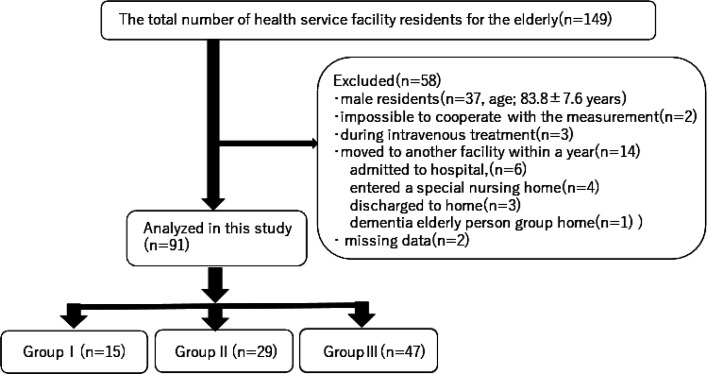
[Purpose] This study aimed to determine the characteristics of regional phase angles based on locomotion level among older Japanese females requiring long-term care in a health facility. [Participants and Methods] This was a cross-sectional observational study. The participants included 91 residents (mean age ± standard deviation: 90.2 ± 5.6 years) admitted to an older health facility. Based on their indoor locomotion status, the participants were divided into three groups: group I, able to walk with or without walking aids; group II, able to move in a wheelchair without assistance; and group III, able to move in a wheelchair with assistance. The regional phase angle was measured using a bioimpedance device. [Results] Significant differences were observed in the regional phase angle of the upper limbs between groups I and III and between groups II and III; in that of the lower limbs among all groups; and in that of the trunk between groups I and II and between groups I and III. [Conclusion] The level of locomotion may be explained by the regional phase angles of the lower limbs.




 京公网安备 11010802042870号
京ICP备2023020795号-1
京公网安备 11010802042870号
京ICP备2023020795号-1

 分享
分享

 求助内容:
求助内容: 应助结果提醒方式:
 扫码关注我们
