Nathan M. Jared, Zachary T. Johnson, Cicero C. Pola, Kristi K. Bez, Krishangee Bez, Shelby L. Hooe, Joyce C. Breger, Emily A. Smith, Igor L. Medintz, Nathan M. Neihart and Jonathan C. Claussen
{"title":"用于农药喷雾收集和监测的仿生激光诱导石墨烯蕨叶和酶生物传感器","authors":"Nathan M. Jared, Zachary T. Johnson, Cicero C. Pola, Kristi K. Bez, Krishangee Bez, Shelby L. Hooe, Joyce C. Breger, Emily A. Smith, Igor L. Medintz, Nathan M. Neihart and Jonathan C. Claussen","doi":"10.1039/D4NH00010B","DOIUrl":null,"url":null,"abstract":"<p >Monitoring of pesticide concentration distribution across farm fields is crucial to ensure precise and efficient application while preventing overuse or untreated areas. Inspired by nature's wettability patterns, we developed a biomimetic fern leaf pesticide collection patch using laser-induced graphene (LIG) alongside an external electrochemical LIG biosensor. This “collect-and-sense” system allows for rapid pesticide spray monitoring in the farm field. The LIG is synthesized and patterned on polyimide through a high-throughput gantry-based CO<small><sub>2</sub></small> laser process, making it amenable to scalable manufacturing. The resulting LIG-based leaf exhibits a remarkable water collection capacity, harvesting spray mist/fog at a rate approximately 11 times greater than a natural ostrich fern leaf when the collection is normalized to surface area. The developed three-electrode LIG pesticide biosensor, featuring a working electrode functionalized with electrodeposited platinum nanoparticles (PtNPs) and the enzyme glycine oxidase, displayed a linear range of 10–260 μM, a detection limit of 1.15 μM, and a sensitivity of 5.64 nA μM<small><sup>−1</sup></small> for the widely used herbicide glyphosate. Also, a portable potentiostat with a user-friendly interface was developed for remote operation, achieving an accuracy of up to 97%, when compared to a standard commercial benchtop potentiostat. The LIG “collect-and-sense” system can consistently collect and monitor glyphosate spray after 24–48 hours of spraying, a time that corresponds to the restricted-entry interval required to enter most farm fields after pesticide spraying. Hence, this innovative “collect-and-sense” system not only advances precision agriculture by enabling monitoring and mapping of pesticide distribution but also holds the potential to significantly reduce environmental impact, enhance crop management practices, and contribute to the sustainable and efficient use of agrochemicals in modern agriculture.</p>","PeriodicalId":93,"journal":{"name":"Nanoscale Horizons","volume":" 9","pages":" 1543-1556"},"PeriodicalIF":6.6000,"publicationDate":"2024-06-19","publicationTypes":"Journal Article","fieldsOfStudy":null,"isOpenAccess":false,"openAccessPdf":"https://pubs.rsc.org/en/content/articlepdf/2024/nh/d4nh00010b?page=search","citationCount":"0","resultStr":"{\"title\":\"Biomimetic laser-induced graphene fern leaf and enzymatic biosensor for pesticide spray collection and monitoring†\",\"authors\":\"Nathan M. Jared, Zachary T. Johnson, Cicero C. Pola, Kristi K. Bez, Krishangee Bez, Shelby L. Hooe, Joyce C. Breger, Emily A. Smith, Igor L. Medintz, Nathan M. Neihart and Jonathan C. Claussen\",\"doi\":\"10.1039/D4NH00010B\",\"DOIUrl\":null,\"url\":null,\"abstract\":\"<p >Monitoring of pesticide concentration distribution across farm fields is crucial to ensure precise and efficient application while preventing overuse or untreated areas. Inspired by nature's wettability patterns, we developed a biomimetic fern leaf pesticide collection patch using laser-induced graphene (LIG) alongside an external electrochemical LIG biosensor. This “collect-and-sense” system allows for rapid pesticide spray monitoring in the farm field. The LIG is synthesized and patterned on polyimide through a high-throughput gantry-based CO<small><sub>2</sub></small> laser process, making it amenable to scalable manufacturing. The resulting LIG-based leaf exhibits a remarkable water collection capacity, harvesting spray mist/fog at a rate approximately 11 times greater than a natural ostrich fern leaf when the collection is normalized to surface area. The developed three-electrode LIG pesticide biosensor, featuring a working electrode functionalized with electrodeposited platinum nanoparticles (PtNPs) and the enzyme glycine oxidase, displayed a linear range of 10–260 μM, a detection limit of 1.15 μM, and a sensitivity of 5.64 nA μM<small><sup>−1</sup></small> for the widely used herbicide glyphosate. Also, a portable potentiostat with a user-friendly interface was developed for remote operation, achieving an accuracy of up to 97%, when compared to a standard commercial benchtop potentiostat. The LIG “collect-and-sense” system can consistently collect and monitor glyphosate spray after 24–48 hours of spraying, a time that corresponds to the restricted-entry interval required to enter most farm fields after pesticide spraying. Hence, this innovative “collect-and-sense” system not only advances precision agriculture by enabling monitoring and mapping of pesticide distribution but also holds the potential to significantly reduce environmental impact, enhance crop management practices, and contribute to the sustainable and efficient use of agrochemicals in modern agriculture.</p>\",\"PeriodicalId\":93,\"journal\":{\"name\":\"Nanoscale Horizons\",\"volume\":\" 9\",\"pages\":\" 1543-1556\"},\"PeriodicalIF\":6.6000,\"publicationDate\":\"2024-06-19\",\"publicationTypes\":\"Journal Article\",\"fieldsOfStudy\":null,\"isOpenAccess\":false,\"openAccessPdf\":\"https://pubs.rsc.org/en/content/articlepdf/2024/nh/d4nh00010b?page=search\",\"citationCount\":\"0\",\"resultStr\":null,\"platform\":\"Semanticscholar\",\"paperid\":null,\"PeriodicalName\":\"Nanoscale Horizons\",\"FirstCategoryId\":\"88\",\"ListUrlMain\":\"https://pubs.rsc.org/en/content/articlelanding/2024/nh/d4nh00010b\",\"RegionNum\":2,\"RegionCategory\":\"材料科学\",\"ArticlePicture\":[],\"TitleCN\":null,\"AbstractTextCN\":null,\"PMCID\":null,\"EPubDate\":\"\",\"PubModel\":\"\",\"JCR\":\"Q1\",\"JCRName\":\"CHEMISTRY, PHYSICAL\",\"Score\":null,\"Total\":0}","platform":"Semanticscholar","paperid":null,"PeriodicalName":"Nanoscale Horizons","FirstCategoryId":"88","ListUrlMain":"https://pubs.rsc.org/en/content/articlelanding/2024/nh/d4nh00010b","RegionNum":2,"RegionCategory":"材料科学","ArticlePicture":[],"TitleCN":null,"AbstractTextCN":null,"PMCID":null,"EPubDate":"","PubModel":"","JCR":"Q1","JCRName":"CHEMISTRY, PHYSICAL","Score":null,"Total":0}
引用次数: 0
摘要
监测农田中农药浓度的分布对于确保精确高效的施用,同时防止过度使用或未处理区域至关重要。受自然界润湿模式的启发,我们利用激光诱导石墨烯(LIG)和外部电化学 LIG 生物传感器,开发了一种仿生蕨类植物叶片农药收集贴片。这种 "收集-感知 "系统可在农田中快速监测农药喷洒情况。石墨烯是通过高通量龙门二氧化碳激光工艺在聚酰亚胺上合成和图案化的,因此可以进行规模化生产。由此产生的基于 LIG 的叶片具有出色的集水能力,当集水量与表面积归一化时,其收集喷雾/雾气的速度约为天然鸵鸟叶片的 11 倍。所开发的三电极 LIG 农药生物传感器的工作电极具有电沉积铂纳米颗粒(PtNPs)和甘氨酸氧化酶功能,对广泛使用的除草剂草甘膦的线性范围为 10-260 µM,检测限为 1.15 µM,灵敏度为 5.64 nA µM-1。此外,还开发了一种带有用户友好界面的便携式恒电位仪,用于远程操作,与标准商用台式恒电位仪相比,准确度高达 97%。LIG 的 "收集和感知 "系统可在喷洒草甘膦 24-48 小时后持续收集和监测草甘膦喷洒情况,这段时间与喷洒农药后进入大多数农田所需的限制进入间隔时间一致。因此,这种创新的 "收集和感知 "系统不仅可以通过监测和绘制农药分布图来推进精准农业,而且还有可能显著减少对环境的影响,加强作物管理实践,促进现代农业中农用化学品的可持续和高效使用。
Biomimetic laser-induced graphene fern leaf and enzymatic biosensor for pesticide spray collection and monitoring†
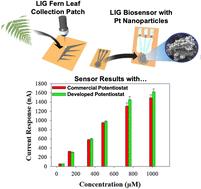
Monitoring of pesticide concentration distribution across farm fields is crucial to ensure precise and efficient application while preventing overuse or untreated areas. Inspired by nature's wettability patterns, we developed a biomimetic fern leaf pesticide collection patch using laser-induced graphene (LIG) alongside an external electrochemical LIG biosensor. This “collect-and-sense” system allows for rapid pesticide spray monitoring in the farm field. The LIG is synthesized and patterned on polyimide through a high-throughput gantry-based CO2 laser process, making it amenable to scalable manufacturing. The resulting LIG-based leaf exhibits a remarkable water collection capacity, harvesting spray mist/fog at a rate approximately 11 times greater than a natural ostrich fern leaf when the collection is normalized to surface area. The developed three-electrode LIG pesticide biosensor, featuring a working electrode functionalized with electrodeposited platinum nanoparticles (PtNPs) and the enzyme glycine oxidase, displayed a linear range of 10–260 μM, a detection limit of 1.15 μM, and a sensitivity of 5.64 nA μM−1 for the widely used herbicide glyphosate. Also, a portable potentiostat with a user-friendly interface was developed for remote operation, achieving an accuracy of up to 97%, when compared to a standard commercial benchtop potentiostat. The LIG “collect-and-sense” system can consistently collect and monitor glyphosate spray after 24–48 hours of spraying, a time that corresponds to the restricted-entry interval required to enter most farm fields after pesticide spraying. Hence, this innovative “collect-and-sense” system not only advances precision agriculture by enabling monitoring and mapping of pesticide distribution but also holds the potential to significantly reduce environmental impact, enhance crop management practices, and contribute to the sustainable and efficient use of agrochemicals in modern agriculture.
期刊介绍:
Nanoscale Horizons stands out as a premier journal for publishing exceptionally high-quality and innovative nanoscience and nanotechnology. The emphasis lies on original research that introduces a new concept or a novel perspective (a conceptual advance), prioritizing this over reporting technological improvements. Nevertheless, outstanding articles showcasing truly groundbreaking developments, including record-breaking performance, may also find a place in the journal. Published work must be of substantial general interest to our broad and diverse readership across the nanoscience and nanotechnology community.




 京公网安备 11010802042870号
京ICP备2023020795号-1
京公网安备 11010802042870号
京ICP备2023020795号-1

 分享
分享
 求助内容:
求助内容: 应助结果提醒方式:
 扫码关注我们
