{"title":"超T2-FLAIR错配征象:IDH突变型非增强型星形细胞瘤的预后成像生物标志物。","authors":"Iori Ozono, Shumpei Onishi, Ushio Yonezawa, Akira Taguchi, Novita Ikbar Khairunnisa, Vishwa Jeet Amatya, Fumiyuki Yamasaki, Yukio Takeshima, Nobutaka Horie","doi":"10.1007/s11060-024-04758-4","DOIUrl":null,"url":null,"abstract":"<p><strong>Purpose: </strong>The T2-FLAIR mismatch sign is a highly specific diagnostic imaging biomarker for astrocytoma, IDH-mutant. However, a definitive prognostic imaging biomarker has yet to be identified. This study investigated imaging prognostic markers, specifically analyzing T2-weighted and FLAIR images of this tumor.</p><p><strong>Methods: </strong>We retrospectively analyzed 31 cases of non-enhancing astrocytoma, IDH-mutant treated at our institution, and 30 cases from The Cancer Genome Atlas (TCGA)/The Cancer Imaging Archive (TCIA). We defined \"super T2-FLAIR mismatch sign\" as having a significantly strong low signal comparable to cerebrospinal fluid at non-cystic lesions rather than just a pale FLAIR low-signal tumor lesion as in conventional T2-FLAIR mismatch sign. Cysts were defined as having a round or oval shape and were excluded from the criteria for the super T2-FLAIR mismatch sign. We evaluated the presence or absence of the T2-FLAIR mismatch sign and super T2-FLAIR mismatch sign using preoperative MRI and analyzed the progression-free survival (PFS) and overall survival (OS) by log-rank test.</p><p><strong>Results: </strong>The T2-FLAIR mismatch sign was present in 17 cases (55%) in our institution and 9 cases (30%) within the TCGA-LGG dataset without any correlation with PFS or OS. However, the super T2-FLAIR mismatch sign was detected in 8 cases (26%) at our institution and 13 cases (43%) in the TCGA-LGG dataset. At our institution, patients displaying the super T2-FLAIR mismatch sign showed significantly extended PFS (122.7 vs. 35.9 months, p = 0.0491) and OS (not reached vs. 116.7 months, p = 0.0232). Similarly, in the TCGA-LGG dataset, those with the super T2-FLAIR mismatch sign exhibited notably longer OS (not reached vs. 44.0 months, p = 0.0177).</p><p><strong>Conclusion: </strong>The super T2-FLAIR mismatch is a promising prognostic imaging biomarker for non-enhancing astrocytoma, IDH-mutant.</p>","PeriodicalId":16425,"journal":{"name":"Journal of Neuro-Oncology","volume":" ","pages":"571-579"},"PeriodicalIF":3.1000,"publicationDate":"2024-09-01","publicationTypes":"Journal Article","fieldsOfStudy":null,"isOpenAccess":false,"openAccessPdf":"https://www.ncbi.nlm.nih.gov/pmc/articles/PMC11341624/pdf/","citationCount":"0","resultStr":"{\"title\":\"Super T2-FLAIR mismatch sign: a prognostic imaging biomarker for non-enhancing astrocytoma, IDH-mutant.\",\"authors\":\"Iori Ozono, Shumpei Onishi, Ushio Yonezawa, Akira Taguchi, Novita Ikbar Khairunnisa, Vishwa Jeet Amatya, Fumiyuki Yamasaki, Yukio Takeshima, Nobutaka Horie\",\"doi\":\"10.1007/s11060-024-04758-4\",\"DOIUrl\":null,\"url\":null,\"abstract\":\"<p><strong>Purpose: </strong>The T2-FLAIR mismatch sign is a highly specific diagnostic imaging biomarker for astrocytoma, IDH-mutant. However, a definitive prognostic imaging biomarker has yet to be identified. This study investigated imaging prognostic markers, specifically analyzing T2-weighted and FLAIR images of this tumor.</p><p><strong>Methods: </strong>We retrospectively analyzed 31 cases of non-enhancing astrocytoma, IDH-mutant treated at our institution, and 30 cases from The Cancer Genome Atlas (TCGA)/The Cancer Imaging Archive (TCIA). We defined \\\"super T2-FLAIR mismatch sign\\\" as having a significantly strong low signal comparable to cerebrospinal fluid at non-cystic lesions rather than just a pale FLAIR low-signal tumor lesion as in conventional T2-FLAIR mismatch sign. Cysts were defined as having a round or oval shape and were excluded from the criteria for the super T2-FLAIR mismatch sign. We evaluated the presence or absence of the T2-FLAIR mismatch sign and super T2-FLAIR mismatch sign using preoperative MRI and analyzed the progression-free survival (PFS) and overall survival (OS) by log-rank test.</p><p><strong>Results: </strong>The T2-FLAIR mismatch sign was present in 17 cases (55%) in our institution and 9 cases (30%) within the TCGA-LGG dataset without any correlation with PFS or OS. However, the super T2-FLAIR mismatch sign was detected in 8 cases (26%) at our institution and 13 cases (43%) in the TCGA-LGG dataset. At our institution, patients displaying the super T2-FLAIR mismatch sign showed significantly extended PFS (122.7 vs. 35.9 months, p = 0.0491) and OS (not reached vs. 116.7 months, p = 0.0232). Similarly, in the TCGA-LGG dataset, those with the super T2-FLAIR mismatch sign exhibited notably longer OS (not reached vs. 44.0 months, p = 0.0177).</p><p><strong>Conclusion: </strong>The super T2-FLAIR mismatch is a promising prognostic imaging biomarker for non-enhancing astrocytoma, IDH-mutant.</p>\",\"PeriodicalId\":16425,\"journal\":{\"name\":\"Journal of Neuro-Oncology\",\"volume\":\" \",\"pages\":\"571-579\"},\"PeriodicalIF\":3.1000,\"publicationDate\":\"2024-09-01\",\"publicationTypes\":\"Journal Article\",\"fieldsOfStudy\":null,\"isOpenAccess\":false,\"openAccessPdf\":\"https://www.ncbi.nlm.nih.gov/pmc/articles/PMC11341624/pdf/\",\"citationCount\":\"0\",\"resultStr\":null,\"platform\":\"Semanticscholar\",\"paperid\":null,\"PeriodicalName\":\"Journal of Neuro-Oncology\",\"FirstCategoryId\":\"3\",\"ListUrlMain\":\"https://doi.org/10.1007/s11060-024-04758-4\",\"RegionNum\":2,\"RegionCategory\":\"医学\",\"ArticlePicture\":[],\"TitleCN\":null,\"AbstractTextCN\":null,\"PMCID\":null,\"EPubDate\":\"2024/7/12 0:00:00\",\"PubModel\":\"Epub\",\"JCR\":\"Q2\",\"JCRName\":\"CLINICAL NEUROLOGY\",\"Score\":null,\"Total\":0}","platform":"Semanticscholar","paperid":null,"PeriodicalName":"Journal of Neuro-Oncology","FirstCategoryId":"3","ListUrlMain":"https://doi.org/10.1007/s11060-024-04758-4","RegionNum":2,"RegionCategory":"医学","ArticlePicture":[],"TitleCN":null,"AbstractTextCN":null,"PMCID":null,"EPubDate":"2024/7/12 0:00:00","PubModel":"Epub","JCR":"Q2","JCRName":"CLINICAL NEUROLOGY","Score":null,"Total":0}
引用次数: 0
摘要
目的:T2-FLAIR错配征是IDH突变型星形细胞瘤的高度特异性诊断成像生物标志物。然而,明确的预后成像生物标志物尚未确定。本研究通过分析该肿瘤的T2加权和FLAIR图像,对影像学预后标志物进行了研究:我们回顾性分析了本院治疗的31例IDH突变的非增强型星形细胞瘤病例,以及癌症基因组图谱(TCGA)/癌症影像档案(TCIA)中的30例病例。我们将 "超T2-FLAIR错配征 "定义为在非囊肿病灶处出现与脑脊液相当的明显强低信号,而非传统T2-FLAIR错配征中的淡FLAIR低信号肿瘤病灶。囊肿被定义为圆形或椭圆形,不包括在超 T2-FLAIR 不匹配征的标准中。我们利用术前磁共振成像评估了T2-FLAIR错配征和超T2-FLAIR错配征的存在与否,并通过对数秩检验分析了无进展生存期(PFS)和总生存期(OS):我院有17例(55%)患者存在T2-FLAIR错配征,TCGA-LGG数据集中有9例(30%)患者存在T2-FLAIR错配征,但与PFS或OS无任何相关性。然而,我院有8例(26%)和TCGA-LGG数据集中的13例(43%)患者检测到超T2-FLAIR错配征。在我院,显示超T2-FLAIR错配征的患者的PFS(122.7个月 vs. 35.9个月,p = 0.0491)和OS(未达到 vs. 116.7个月,p = 0.0232)明显延长。同样,在TCGA-LGG数据集中,具有超T2-FLAIR错配征的患者的OS明显更长(未达到vs.44.0个月,p = 0.0177):结论:超T2-FLAIR错配是IDH突变的非增强型星形细胞瘤的一种有前景的预后成像生物标志物。
Super T2-FLAIR mismatch sign: a prognostic imaging biomarker for non-enhancing astrocytoma, IDH-mutant.
Purpose: The T2-FLAIR mismatch sign is a highly specific diagnostic imaging biomarker for astrocytoma, IDH-mutant. However, a definitive prognostic imaging biomarker has yet to be identified. This study investigated imaging prognostic markers, specifically analyzing T2-weighted and FLAIR images of this tumor.
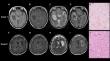
Methods: We retrospectively analyzed 31 cases of non-enhancing astrocytoma, IDH-mutant treated at our institution, and 30 cases from The Cancer Genome Atlas (TCGA)/The Cancer Imaging Archive (TCIA). We defined "super T2-FLAIR mismatch sign" as having a significantly strong low signal comparable to cerebrospinal fluid at non-cystic lesions rather than just a pale FLAIR low-signal tumor lesion as in conventional T2-FLAIR mismatch sign. Cysts were defined as having a round or oval shape and were excluded from the criteria for the super T2-FLAIR mismatch sign. We evaluated the presence or absence of the T2-FLAIR mismatch sign and super T2-FLAIR mismatch sign using preoperative MRI and analyzed the progression-free survival (PFS) and overall survival (OS) by log-rank test.
Results: The T2-FLAIR mismatch sign was present in 17 cases (55%) in our institution and 9 cases (30%) within the TCGA-LGG dataset without any correlation with PFS or OS. However, the super T2-FLAIR mismatch sign was detected in 8 cases (26%) at our institution and 13 cases (43%) in the TCGA-LGG dataset. At our institution, patients displaying the super T2-FLAIR mismatch sign showed significantly extended PFS (122.7 vs. 35.9 months, p = 0.0491) and OS (not reached vs. 116.7 months, p = 0.0232). Similarly, in the TCGA-LGG dataset, those with the super T2-FLAIR mismatch sign exhibited notably longer OS (not reached vs. 44.0 months, p = 0.0177).
Conclusion: The super T2-FLAIR mismatch is a promising prognostic imaging biomarker for non-enhancing astrocytoma, IDH-mutant.
期刊介绍:
The Journal of Neuro-Oncology is a multi-disciplinary journal encompassing basic, applied, and clinical investigations in all research areas as they relate to cancer and the central nervous system. It provides a single forum for communication among neurologists, neurosurgeons, radiotherapists, medical oncologists, neuropathologists, neurodiagnosticians, and laboratory-based oncologists conducting relevant research. The Journal of Neuro-Oncology does not seek to isolate the field, but rather to focus the efforts of many disciplines in one publication through a format which pulls together these diverse interests. More than any other field of oncology, cancer of the central nervous system requires multi-disciplinary approaches. To alleviate having to scan dozens of journals of cell biology, pathology, laboratory and clinical endeavours, JNO is a periodical in which current, high-quality, relevant research in all aspects of neuro-oncology may be found.




 京公网安备 11010802042870号
京ICP备2023020795号-1
京公网安备 11010802042870号
京ICP备2023020795号-1

 分享
分享
 求助内容:
求助内容: 应助结果提醒方式:
 扫码关注我们
