Rachel Dankner, Angela Chetrit, Sivan Ben Avraham, Nirit Agay, Ofra Kalter-Leibovici, Uri Goldbourt, Walid Saliba, Lital Keinan-Boker, Danit Shahar, Laurence S. Freedman
{"title":"一项由 27 754 人参与的历史队列研究,探讨了肉类消费与胃肠道和大肠癌发病率之间的关系。","authors":"Rachel Dankner, Angela Chetrit, Sivan Ben Avraham, Nirit Agay, Ofra Kalter-Leibovici, Uri Goldbourt, Walid Saliba, Lital Keinan-Boker, Danit Shahar, Laurence S. Freedman","doi":"10.1002/ijc.35084","DOIUrl":null,"url":null,"abstract":"<p>In order to explore the association between meat consumption and gastrointestinal/colorectal cancer (CRC) risk and to estimate the Israeli population attributable fraction (PAF), we conducted a collaborative historical cohort study using the individual participant data of seven nutritional studies from the past 6 decades. We included healthy adult men and women who underwent a nutritional interview. Dietary assessment data, using food-frequency or 24-h recall questionnaires, were harmonized. The study file was linked to the National Cancer and death registries. Among 27,754 participants, 1216 (4.4%) were diagnosed with gastrointestinal cancers and 839 (3.0%) with CRC by the end of 2016. Using meta-analysis methods applied to Cox proportional hazard models (adjusted for daily energy intake, sex, age, ethnic origin, education and smoking),100 g/day increments in beef, red meat and poultry consumption, and 50 g/day increment in processed meat consumption were associated with hazard ratios (HRs) and 95% confidence intervals of 1.46 (1.06–2.02), 1.15 (0.87–1.52), 1.06 (0.89–1.26), and 0.93 (0.76–1.12), respectively, for CRC. Similar results were obtained for gastrointestinal cancer, although red meat consumption reached statistical significance (HR = 1.27; 95%CI: 1.02–1.58). The PAFs associated with a reduction to a maximum of 50 g/day in the consumption of red meat were 2.7% (95%CI: −1.9 to 12.0) and 5.2% (0.3–13.9) for CRC and gastrointestinal cancers, respectively. Reduction of beef consumption to a maximum of 50 g/day will result in a CRC PAF reduction of 7.5% (0.7%–24.3%). While beef consumption was associated with gastrointestinal/CRC excess risk, poultry consumption was not. A substantial part of processed meat consumption in Israel is processed poultry, perhaps explaining the lack of association with CRC.</p>","PeriodicalId":180,"journal":{"name":"International Journal of Cancer","volume":"155 11","pages":"2009-2020"},"PeriodicalIF":4.7000,"publicationDate":"2024-07-19","publicationTypes":"Journal Article","fieldsOfStudy":null,"isOpenAccess":false,"openAccessPdf":"https://onlinelibrary.wiley.com/doi/epdf/10.1002/ijc.35084","citationCount":"0","resultStr":"{\"title\":\"A historical cohort study with 27,754 individuals on the association between meat consumption and gastrointestinal tract and colorectal cancer incidence\",\"authors\":\"Rachel Dankner, Angela Chetrit, Sivan Ben Avraham, Nirit Agay, Ofra Kalter-Leibovici, Uri Goldbourt, Walid Saliba, Lital Keinan-Boker, Danit Shahar, Laurence S. Freedman\",\"doi\":\"10.1002/ijc.35084\",\"DOIUrl\":null,\"url\":null,\"abstract\":\"<p>In order to explore the association between meat consumption and gastrointestinal/colorectal cancer (CRC) risk and to estimate the Israeli population attributable fraction (PAF), we conducted a collaborative historical cohort study using the individual participant data of seven nutritional studies from the past 6 decades. We included healthy adult men and women who underwent a nutritional interview. Dietary assessment data, using food-frequency or 24-h recall questionnaires, were harmonized. The study file was linked to the National Cancer and death registries. Among 27,754 participants, 1216 (4.4%) were diagnosed with gastrointestinal cancers and 839 (3.0%) with CRC by the end of 2016. Using meta-analysis methods applied to Cox proportional hazard models (adjusted for daily energy intake, sex, age, ethnic origin, education and smoking),100 g/day increments in beef, red meat and poultry consumption, and 50 g/day increment in processed meat consumption were associated with hazard ratios (HRs) and 95% confidence intervals of 1.46 (1.06–2.02), 1.15 (0.87–1.52), 1.06 (0.89–1.26), and 0.93 (0.76–1.12), respectively, for CRC. Similar results were obtained for gastrointestinal cancer, although red meat consumption reached statistical significance (HR = 1.27; 95%CI: 1.02–1.58). The PAFs associated with a reduction to a maximum of 50 g/day in the consumption of red meat were 2.7% (95%CI: −1.9 to 12.0) and 5.2% (0.3–13.9) for CRC and gastrointestinal cancers, respectively. Reduction of beef consumption to a maximum of 50 g/day will result in a CRC PAF reduction of 7.5% (0.7%–24.3%). While beef consumption was associated with gastrointestinal/CRC excess risk, poultry consumption was not. A substantial part of processed meat consumption in Israel is processed poultry, perhaps explaining the lack of association with CRC.</p>\",\"PeriodicalId\":180,\"journal\":{\"name\":\"International Journal of Cancer\",\"volume\":\"155 11\",\"pages\":\"2009-2020\"},\"PeriodicalIF\":4.7000,\"publicationDate\":\"2024-07-19\",\"publicationTypes\":\"Journal Article\",\"fieldsOfStudy\":null,\"isOpenAccess\":false,\"openAccessPdf\":\"https://onlinelibrary.wiley.com/doi/epdf/10.1002/ijc.35084\",\"citationCount\":\"0\",\"resultStr\":null,\"platform\":\"Semanticscholar\",\"paperid\":null,\"PeriodicalName\":\"International Journal of Cancer\",\"FirstCategoryId\":\"3\",\"ListUrlMain\":\"https://onlinelibrary.wiley.com/doi/10.1002/ijc.35084\",\"RegionNum\":2,\"RegionCategory\":\"医学\",\"ArticlePicture\":[],\"TitleCN\":null,\"AbstractTextCN\":null,\"PMCID\":null,\"EPubDate\":\"\",\"PubModel\":\"\",\"JCR\":\"Q1\",\"JCRName\":\"ONCOLOGY\",\"Score\":null,\"Total\":0}","platform":"Semanticscholar","paperid":null,"PeriodicalName":"International Journal of Cancer","FirstCategoryId":"3","ListUrlMain":"https://onlinelibrary.wiley.com/doi/10.1002/ijc.35084","RegionNum":2,"RegionCategory":"医学","ArticlePicture":[],"TitleCN":null,"AbstractTextCN":null,"PMCID":null,"EPubDate":"","PubModel":"","JCR":"Q1","JCRName":"ONCOLOGY","Score":null,"Total":0}
A historical cohort study with 27,754 individuals on the association between meat consumption and gastrointestinal tract and colorectal cancer incidence
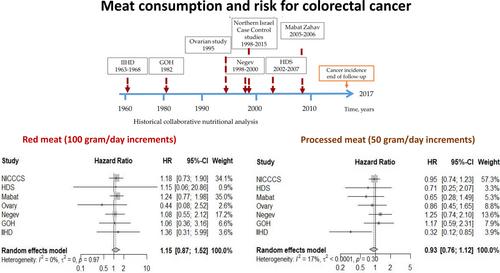
In order to explore the association between meat consumption and gastrointestinal/colorectal cancer (CRC) risk and to estimate the Israeli population attributable fraction (PAF), we conducted a collaborative historical cohort study using the individual participant data of seven nutritional studies from the past 6 decades. We included healthy adult men and women who underwent a nutritional interview. Dietary assessment data, using food-frequency or 24-h recall questionnaires, were harmonized. The study file was linked to the National Cancer and death registries. Among 27,754 participants, 1216 (4.4%) were diagnosed with gastrointestinal cancers and 839 (3.0%) with CRC by the end of 2016. Using meta-analysis methods applied to Cox proportional hazard models (adjusted for daily energy intake, sex, age, ethnic origin, education and smoking),100 g/day increments in beef, red meat and poultry consumption, and 50 g/day increment in processed meat consumption were associated with hazard ratios (HRs) and 95% confidence intervals of 1.46 (1.06–2.02), 1.15 (0.87–1.52), 1.06 (0.89–1.26), and 0.93 (0.76–1.12), respectively, for CRC. Similar results were obtained for gastrointestinal cancer, although red meat consumption reached statistical significance (HR = 1.27; 95%CI: 1.02–1.58). The PAFs associated with a reduction to a maximum of 50 g/day in the consumption of red meat were 2.7% (95%CI: −1.9 to 12.0) and 5.2% (0.3–13.9) for CRC and gastrointestinal cancers, respectively. Reduction of beef consumption to a maximum of 50 g/day will result in a CRC PAF reduction of 7.5% (0.7%–24.3%). While beef consumption was associated with gastrointestinal/CRC excess risk, poultry consumption was not. A substantial part of processed meat consumption in Israel is processed poultry, perhaps explaining the lack of association with CRC.
期刊介绍:
The International Journal of Cancer (IJC) is the official journal of the Union for International Cancer Control—UICC; it appears twice a month. IJC invites submission of manuscripts under a broad scope of topics relevant to experimental and clinical cancer research and publishes original Research Articles and Short Reports under the following categories:
-Cancer Epidemiology-
Cancer Genetics and Epigenetics-
Infectious Causes of Cancer-
Innovative Tools and Methods-
Molecular Cancer Biology-
Tumor Immunology and Microenvironment-
Tumor Markers and Signatures-
Cancer Therapy and Prevention




 京公网安备 11010802042870号
京ICP备2023020795号-1
京公网安备 11010802042870号
京ICP备2023020795号-1

 分享
分享
 求助内容:
求助内容: 应助结果提醒方式:
 扫码关注我们
