Miaomiao Xue, Lei Zhang, Xin Meng, Jinglun Yang, Yanping He, Prof. Chun-Sing Lee, Prof. Jian Zhang, Prof. Qichun Zhang
{"title":"含 Te-O-B-O 键的三维手性共价框架的紫外非线性光学单晶。","authors":"Miaomiao Xue, Lei Zhang, Xin Meng, Jinglun Yang, Yanping He, Prof. Chun-Sing Lee, Prof. Jian Zhang, Prof. Qichun Zhang","doi":"10.1002/anie.202412289","DOIUrl":null,"url":null,"abstract":"<p>Extending covalent organic frameworks (COFs) into crystalline carbon-free covalent backbones is an important strategy to endow these materials with more exotic functions. Integrating metal-free inorganic and organic components into one covalent framework is an effective way to address the issue of poor thermal/solvent stability in the field of nonlinear optics (NLO). However, constructing such structures is very challenging. Here, we linked 3-connected nods (BO<sub>3</sub>) and 2-connected organic building blocks (Te(Ph)<sub>2</sub>) together to produce colorless single crystals (size up to 400 μm) of a three-dimensional (3D) chiral covalent framework (<b>CityU-22</b>). The single-crystal X-ray diffraction (SCXRD) analysis reveals that <b>CityU-22</b> has a non-carbon Te−O−B−O bond-based network with the <i>srs</i> topology. The chiral <b>CityU-22</b> displays good stability under the treatment of different common solvents or heat (the decomposition temperature above 300 °C). Due to its non-π-conjugated backbone (−Te−O−B−O−), <b>CityU-22</b> shows an ultraviolet NLO behavior with a second-harmonic generation (SHG) response similar to KH<sub>2</sub>PO<sub>4</sub> (KDP).</p>","PeriodicalId":125,"journal":{"name":"Angewandte Chemie International Edition","volume":"63 46","pages":""},"PeriodicalIF":17.6000,"publicationDate":"2024-07-22","publicationTypes":"Journal Article","fieldsOfStudy":null,"isOpenAccess":false,"openAccessPdf":"https://onlinelibrary.wiley.com/doi/epdf/10.1002/anie.202412289","citationCount":"0","resultStr":"{\"title\":\"Ultraviolet Nonlinear Optical Single Crystals of A Three-Dimensional Chiral Covalent Framework Containing Te−O−B−O Bonds\",\"authors\":\"Miaomiao Xue, Lei Zhang, Xin Meng, Jinglun Yang, Yanping He, Prof. Chun-Sing Lee, Prof. Jian Zhang, Prof. Qichun Zhang\",\"doi\":\"10.1002/anie.202412289\",\"DOIUrl\":null,\"url\":null,\"abstract\":\"<p>Extending covalent organic frameworks (COFs) into crystalline carbon-free covalent backbones is an important strategy to endow these materials with more exotic functions. Integrating metal-free inorganic and organic components into one covalent framework is an effective way to address the issue of poor thermal/solvent stability in the field of nonlinear optics (NLO). However, constructing such structures is very challenging. Here, we linked 3-connected nods (BO<sub>3</sub>) and 2-connected organic building blocks (Te(Ph)<sub>2</sub>) together to produce colorless single crystals (size up to 400 μm) of a three-dimensional (3D) chiral covalent framework (<b>CityU-22</b>). The single-crystal X-ray diffraction (SCXRD) analysis reveals that <b>CityU-22</b> has a non-carbon Te−O−B−O bond-based network with the <i>srs</i> topology. The chiral <b>CityU-22</b> displays good stability under the treatment of different common solvents or heat (the decomposition temperature above 300 °C). Due to its non-π-conjugated backbone (−Te−O−B−O−), <b>CityU-22</b> shows an ultraviolet NLO behavior with a second-harmonic generation (SHG) response similar to KH<sub>2</sub>PO<sub>4</sub> (KDP).</p>\",\"PeriodicalId\":125,\"journal\":{\"name\":\"Angewandte Chemie International Edition\",\"volume\":\"63 46\",\"pages\":\"\"},\"PeriodicalIF\":17.6000,\"publicationDate\":\"2024-07-22\",\"publicationTypes\":\"Journal Article\",\"fieldsOfStudy\":null,\"isOpenAccess\":false,\"openAccessPdf\":\"https://onlinelibrary.wiley.com/doi/epdf/10.1002/anie.202412289\",\"citationCount\":\"0\",\"resultStr\":null,\"platform\":\"Semanticscholar\",\"paperid\":null,\"PeriodicalName\":\"Angewandte Chemie International Edition\",\"FirstCategoryId\":\"92\",\"ListUrlMain\":\"https://onlinelibrary.wiley.com/doi/10.1002/anie.202412289\",\"RegionNum\":1,\"RegionCategory\":\"化学\",\"ArticlePicture\":[],\"TitleCN\":null,\"AbstractTextCN\":null,\"PMCID\":null,\"EPubDate\":\"\",\"PubModel\":\"\",\"JCR\":\"Q1\",\"JCRName\":\"CHEMISTRY, MULTIDISCIPLINARY\",\"Score\":null,\"Total\":0}","platform":"Semanticscholar","paperid":null,"PeriodicalName":"Angewandte Chemie International Edition","FirstCategoryId":"92","ListUrlMain":"https://onlinelibrary.wiley.com/doi/10.1002/anie.202412289","RegionNum":1,"RegionCategory":"化学","ArticlePicture":[],"TitleCN":null,"AbstractTextCN":null,"PMCID":null,"EPubDate":"","PubModel":"","JCR":"Q1","JCRName":"CHEMISTRY, MULTIDISCIPLINARY","Score":null,"Total":0}
Ultraviolet Nonlinear Optical Single Crystals of A Three-Dimensional Chiral Covalent Framework Containing Te−O−B−O Bonds
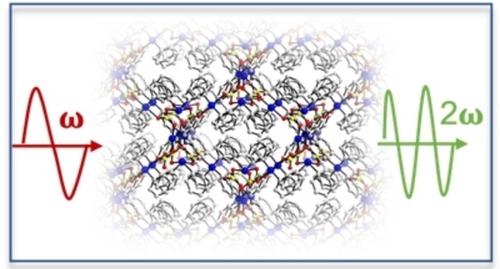
Extending covalent organic frameworks (COFs) into crystalline carbon-free covalent backbones is an important strategy to endow these materials with more exotic functions. Integrating metal-free inorganic and organic components into one covalent framework is an effective way to address the issue of poor thermal/solvent stability in the field of nonlinear optics (NLO). However, constructing such structures is very challenging. Here, we linked 3-connected nods (BO3) and 2-connected organic building blocks (Te(Ph)2) together to produce colorless single crystals (size up to 400 μm) of a three-dimensional (3D) chiral covalent framework (CityU-22). The single-crystal X-ray diffraction (SCXRD) analysis reveals that CityU-22 has a non-carbon Te−O−B−O bond-based network with the srs topology. The chiral CityU-22 displays good stability under the treatment of different common solvents or heat (the decomposition temperature above 300 °C). Due to its non-π-conjugated backbone (−Te−O−B−O−), CityU-22 shows an ultraviolet NLO behavior with a second-harmonic generation (SHG) response similar to KH2PO4 (KDP).
期刊介绍:
Angewandte Chemie, a journal of the German Chemical Society (GDCh), maintains a leading position among scholarly journals in general chemistry with an impressive Impact Factor of 16.6 (2022 Journal Citation Reports, Clarivate, 2023). Published weekly in a reader-friendly format, it features new articles almost every day. Established in 1887, Angewandte Chemie is a prominent chemistry journal, offering a dynamic blend of Review-type articles, Highlights, Communications, and Research Articles on a weekly basis, making it unique in the field.




 京公网安备 11010802042870号
京ICP备2023020795号-1
京公网安备 11010802042870号
京ICP备2023020795号-1

 分享
分享
 求助内容:
求助内容: 应助结果提醒方式:
 扫码关注我们
