{"title":"靶向糖皮质激素受体-CCR8轴介导的骨髓T细胞螯合可增强颅内癌中抗肿瘤T细胞的浸润。","authors":"Jia Zhang, Yuzhu Shi, Xiaotong Xue, Wenqing Bu, Yanan Li, Tingting Yang, Lijuan Cao, Jiankai Fang, Peishan Li, Yongjing Chen, Zhen Li, Changshun Shao, Yufang Shi","doi":"10.1038/s41423-024-01202-5","DOIUrl":null,"url":null,"abstract":"Brain tumors such as glioblastomas are resistant to immune checkpoint blockade therapy, largely due to limited T cell infiltration in the tumors. Here, we show that mice bearing intracranial tumors exhibit systemic immunosuppression and T cell sequestration in bone marrow, leading to reduced T cell infiltration in brain tumors. Elevated plasma corticosterone drives the T cell sequestration via glucocorticoid receptors in tumor-bearing mice. Immunosuppression mediated by glucocorticoid-induced T cell dynamics and the subsequent tumor growth promotion can be abrogated by adrenalectomy, the administration of glucocorticoid activation inhibitors or glucocorticoid receptor antagonists, and in mice with T cell-specific deletion of glucocorticoid receptor. CCR8 expression in T cells is increased in tumor-bearing mice in a glucocorticoid receptor-dependent manner. Additionally, chemokines CCL1 and CCL8, the ligands for CCR8, are highly expressed in bone marrow immune cells in tumor-bearing mice to recruit T cells. These findings suggested that brain tumor-induced glucocorticoid surge and CCR8 upregulation in T cells lead to T cell sequestration in bone marrow, impairing the anti-tumor immune response. Targeting the glucocorticoid receptor-CCR8 axis may offer a promising immunotherapeutic approach for the treatment of intracranial tumors.","PeriodicalId":9950,"journal":{"name":"Cellular &Molecular Immunology","volume":"21 10","pages":"1145-1157"},"PeriodicalIF":19.8000,"publicationDate":"2024-07-23","publicationTypes":"Journal Article","fieldsOfStudy":null,"isOpenAccess":false,"openAccessPdf":"","citationCount":"0","resultStr":"{\"title\":\"Targeting the glucocorticoid receptor-CCR8 axis mediated bone marrow T cell sequestration enhances infiltration of anti-tumor T cells in intracranial cancers\",\"authors\":\"Jia Zhang, Yuzhu Shi, Xiaotong Xue, Wenqing Bu, Yanan Li, Tingting Yang, Lijuan Cao, Jiankai Fang, Peishan Li, Yongjing Chen, Zhen Li, Changshun Shao, Yufang Shi\",\"doi\":\"10.1038/s41423-024-01202-5\",\"DOIUrl\":null,\"url\":null,\"abstract\":\"Brain tumors such as glioblastomas are resistant to immune checkpoint blockade therapy, largely due to limited T cell infiltration in the tumors. Here, we show that mice bearing intracranial tumors exhibit systemic immunosuppression and T cell sequestration in bone marrow, leading to reduced T cell infiltration in brain tumors. Elevated plasma corticosterone drives the T cell sequestration via glucocorticoid receptors in tumor-bearing mice. Immunosuppression mediated by glucocorticoid-induced T cell dynamics and the subsequent tumor growth promotion can be abrogated by adrenalectomy, the administration of glucocorticoid activation inhibitors or glucocorticoid receptor antagonists, and in mice with T cell-specific deletion of glucocorticoid receptor. CCR8 expression in T cells is increased in tumor-bearing mice in a glucocorticoid receptor-dependent manner. Additionally, chemokines CCL1 and CCL8, the ligands for CCR8, are highly expressed in bone marrow immune cells in tumor-bearing mice to recruit T cells. These findings suggested that brain tumor-induced glucocorticoid surge and CCR8 upregulation in T cells lead to T cell sequestration in bone marrow, impairing the anti-tumor immune response. Targeting the glucocorticoid receptor-CCR8 axis may offer a promising immunotherapeutic approach for the treatment of intracranial tumors.\",\"PeriodicalId\":9950,\"journal\":{\"name\":\"Cellular &Molecular Immunology\",\"volume\":\"21 10\",\"pages\":\"1145-1157\"},\"PeriodicalIF\":19.8000,\"publicationDate\":\"2024-07-23\",\"publicationTypes\":\"Journal Article\",\"fieldsOfStudy\":null,\"isOpenAccess\":false,\"openAccessPdf\":\"\",\"citationCount\":\"0\",\"resultStr\":null,\"platform\":\"Semanticscholar\",\"paperid\":null,\"PeriodicalName\":\"Cellular &Molecular Immunology\",\"FirstCategoryId\":\"3\",\"ListUrlMain\":\"https://www.nature.com/articles/s41423-024-01202-5\",\"RegionNum\":1,\"RegionCategory\":\"医学\",\"ArticlePicture\":[],\"TitleCN\":null,\"AbstractTextCN\":null,\"PMCID\":null,\"EPubDate\":\"\",\"PubModel\":\"\",\"JCR\":\"Q1\",\"JCRName\":\"IMMUNOLOGY\",\"Score\":null,\"Total\":0}","platform":"Semanticscholar","paperid":null,"PeriodicalName":"Cellular &Molecular Immunology","FirstCategoryId":"3","ListUrlMain":"https://www.nature.com/articles/s41423-024-01202-5","RegionNum":1,"RegionCategory":"医学","ArticlePicture":[],"TitleCN":null,"AbstractTextCN":null,"PMCID":null,"EPubDate":"","PubModel":"","JCR":"Q1","JCRName":"IMMUNOLOGY","Score":null,"Total":0}
引用次数: 0
摘要
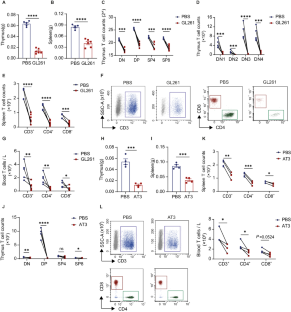
胶质母细胞瘤等脑肿瘤对免疫检查点阻断疗法具有抗药性,这主要是由于肿瘤中的 T 细胞浸润有限。在这里,我们发现颅内肿瘤小鼠表现出全身免疫抑制和骨髓中的T细胞封存,导致脑肿瘤中的T细胞浸润减少。血浆中皮质酮的升高通过糖皮质激素受体驱动肿瘤小鼠的T细胞封存。肾上腺切除术、糖皮质激素活化抑制剂或糖皮质激素受体拮抗剂以及T细胞特异性糖皮质激素受体缺失的小鼠均可减轻糖皮质激素诱导的T细胞动力学介导的免疫抑制以及随后的肿瘤生长促进作用。肿瘤小鼠 T 细胞中 CCR8 的表达以糖皮质激素受体依赖的方式增加。此外,CCR8 的配体趋化因子 CCL1 和 CCL8 在肿瘤小鼠骨髓免疫细胞中高表达,以招募 T 细胞。这些研究结果表明,脑肿瘤诱导的糖皮质激素激增和T细胞中CCR8的上调会导致T细胞在骨髓中固着,从而损害抗肿瘤免疫反应。以糖皮质激素受体-CCR8轴为靶点可能为治疗颅内肿瘤提供一种前景广阔的免疫治疗方法。
Targeting the glucocorticoid receptor-CCR8 axis mediated bone marrow T cell sequestration enhances infiltration of anti-tumor T cells in intracranial cancers
Brain tumors such as glioblastomas are resistant to immune checkpoint blockade therapy, largely due to limited T cell infiltration in the tumors. Here, we show that mice bearing intracranial tumors exhibit systemic immunosuppression and T cell sequestration in bone marrow, leading to reduced T cell infiltration in brain tumors. Elevated plasma corticosterone drives the T cell sequestration via glucocorticoid receptors in tumor-bearing mice. Immunosuppression mediated by glucocorticoid-induced T cell dynamics and the subsequent tumor growth promotion can be abrogated by adrenalectomy, the administration of glucocorticoid activation inhibitors or glucocorticoid receptor antagonists, and in mice with T cell-specific deletion of glucocorticoid receptor. CCR8 expression in T cells is increased in tumor-bearing mice in a glucocorticoid receptor-dependent manner. Additionally, chemokines CCL1 and CCL8, the ligands for CCR8, are highly expressed in bone marrow immune cells in tumor-bearing mice to recruit T cells. These findings suggested that brain tumor-induced glucocorticoid surge and CCR8 upregulation in T cells lead to T cell sequestration in bone marrow, impairing the anti-tumor immune response. Targeting the glucocorticoid receptor-CCR8 axis may offer a promising immunotherapeutic approach for the treatment of intracranial tumors.
期刊介绍:
Cellular & Molecular Immunology, a monthly journal from the Chinese Society of Immunology and the University of Science and Technology of China, serves as a comprehensive platform covering both basic immunology research and clinical applications. The journal publishes a variety of article types, including Articles, Review Articles, Mini Reviews, and Short Communications, focusing on diverse aspects of cellular and molecular immunology.





 京公网安备 11010802042870号
京ICP备2023020795号-1
京公网安备 11010802042870号
京ICP备2023020795号-1

 分享
分享
 求助内容:
求助内容: 应助结果提醒方式:
 扫码关注我们
