Zhijuan Niu, Shihao Han, Weihua Qin, Pan Gao, Feng Xiao, Shaoxia Yang
{"title":"利用锰基催化剂臭氧工艺对工业园区二级污水进行有效的预处理","authors":"Zhijuan Niu, Shihao Han, Weihua Qin, Pan Gao, Feng Xiao, Shaoxia Yang","doi":"10.1007/s11783-024-1884-4","DOIUrl":null,"url":null,"abstract":"<p>Catalytic ozonation is a potential technology to eliminate refractory organic contaminants with the low concentration in secondary effluent from industrial park wastewater treatment plants (IPWWTPs). In this study, the catalytic ozonation over the Mn-based catalyst significantly improved the chemical oxygen demand (COD), total organic carbon (TOC), and UV<sub>254</sub> removals of secondary effluent from IPWWTPs. The Mn-based catalyst/O<sub>3</sub> system achieved 84.8%, 69.8%, and 86.4% removals of COD, TOC, and UV<sub>254</sub>, which were 3.3, 5.7, and 1.1 times that in ozonation alone, respectively. Moreover, the Mn-based catalytic ozonation process exhibited excellent pH tolerance ranging from pH 4.0 to 9.0. Additionally, the depth analysis based on fluorescence excitation-emission matrix (EEM) confirmed that the catalytic ozonation process preferred to degrade toxic aromatic hydrocarbons. The existence of the Mn-based catalyst/O<sub>3</sub> system enhanced 21.4%–38.3% more fluorescent organic matters removal, compared to that in ozonation alone. Mechanistic studies proved that the abundant Lewis acid sites (Mn<sup><i>n</i>+</sup>/Mn<sup>(<i>n</i>+1)+</sup> and adsorbed oxygen) on the surface of the Mn-based catalyst effectively promoted O<sub>3</sub> decomposition into reactive oxygen species (ROS), and ·O<sub>2</sub><sup>−</sup>/HO<sub>2</sub>· and <sup>1</sup>O<sub>2</sub> were the main ROS for degrading refractory organic contaminants. The contributions of ROS oxidation (91.2%) was much higher than that of direct O<sub>3</sub> oxidation (8.8%). Thus, this work provides an effective advanced treatment process for purifying secondary effluent from IPWWTPs.\n</p>","PeriodicalId":12720,"journal":{"name":"Frontiers of Environmental Science & Engineering","volume":"19 1","pages":""},"PeriodicalIF":7.1000,"publicationDate":"2024-07-17","publicationTypes":"Journal Article","fieldsOfStudy":null,"isOpenAccess":false,"openAccessPdf":"","citationCount":"0","resultStr":"{\"title\":\"Effective advance treatment of secondary effluent from industrial parks by the Mn-based catalyst ozonation process\",\"authors\":\"Zhijuan Niu, Shihao Han, Weihua Qin, Pan Gao, Feng Xiao, Shaoxia Yang\",\"doi\":\"10.1007/s11783-024-1884-4\",\"DOIUrl\":null,\"url\":null,\"abstract\":\"<p>Catalytic ozonation is a potential technology to eliminate refractory organic contaminants with the low concentration in secondary effluent from industrial park wastewater treatment plants (IPWWTPs). In this study, the catalytic ozonation over the Mn-based catalyst significantly improved the chemical oxygen demand (COD), total organic carbon (TOC), and UV<sub>254</sub> removals of secondary effluent from IPWWTPs. The Mn-based catalyst/O<sub>3</sub> system achieved 84.8%, 69.8%, and 86.4% removals of COD, TOC, and UV<sub>254</sub>, which were 3.3, 5.7, and 1.1 times that in ozonation alone, respectively. Moreover, the Mn-based catalytic ozonation process exhibited excellent pH tolerance ranging from pH 4.0 to 9.0. Additionally, the depth analysis based on fluorescence excitation-emission matrix (EEM) confirmed that the catalytic ozonation process preferred to degrade toxic aromatic hydrocarbons. The existence of the Mn-based catalyst/O<sub>3</sub> system enhanced 21.4%–38.3% more fluorescent organic matters removal, compared to that in ozonation alone. Mechanistic studies proved that the abundant Lewis acid sites (Mn<sup><i>n</i>+</sup>/Mn<sup>(<i>n</i>+1)+</sup> and adsorbed oxygen) on the surface of the Mn-based catalyst effectively promoted O<sub>3</sub> decomposition into reactive oxygen species (ROS), and ·O<sub>2</sub><sup>−</sup>/HO<sub>2</sub>· and <sup>1</sup>O<sub>2</sub> were the main ROS for degrading refractory organic contaminants. The contributions of ROS oxidation (91.2%) was much higher than that of direct O<sub>3</sub> oxidation (8.8%). Thus, this work provides an effective advanced treatment process for purifying secondary effluent from IPWWTPs.\\n</p>\",\"PeriodicalId\":12720,\"journal\":{\"name\":\"Frontiers of Environmental Science & Engineering\",\"volume\":\"19 1\",\"pages\":\"\"},\"PeriodicalIF\":7.1000,\"publicationDate\":\"2024-07-17\",\"publicationTypes\":\"Journal Article\",\"fieldsOfStudy\":null,\"isOpenAccess\":false,\"openAccessPdf\":\"\",\"citationCount\":\"0\",\"resultStr\":null,\"platform\":\"Semanticscholar\",\"paperid\":null,\"PeriodicalName\":\"Frontiers of Environmental Science & Engineering\",\"FirstCategoryId\":\"93\",\"ListUrlMain\":\"https://doi.org/10.1007/s11783-024-1884-4\",\"RegionNum\":2,\"RegionCategory\":\"环境科学与生态学\",\"ArticlePicture\":[],\"TitleCN\":null,\"AbstractTextCN\":null,\"PMCID\":null,\"EPubDate\":\"\",\"PubModel\":\"\",\"JCR\":\"Q2\",\"JCRName\":\"ENGINEERING, ENVIRONMENTAL\",\"Score\":null,\"Total\":0}","platform":"Semanticscholar","paperid":null,"PeriodicalName":"Frontiers of Environmental Science & Engineering","FirstCategoryId":"93","ListUrlMain":"https://doi.org/10.1007/s11783-024-1884-4","RegionNum":2,"RegionCategory":"环境科学与生态学","ArticlePicture":[],"TitleCN":null,"AbstractTextCN":null,"PMCID":null,"EPubDate":"","PubModel":"","JCR":"Q2","JCRName":"ENGINEERING, ENVIRONMENTAL","Score":null,"Total":0}
Effective advance treatment of secondary effluent from industrial parks by the Mn-based catalyst ozonation process
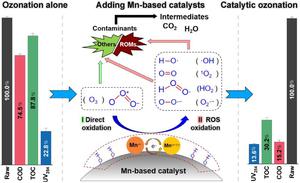
Catalytic ozonation is a potential technology to eliminate refractory organic contaminants with the low concentration in secondary effluent from industrial park wastewater treatment plants (IPWWTPs). In this study, the catalytic ozonation over the Mn-based catalyst significantly improved the chemical oxygen demand (COD), total organic carbon (TOC), and UV254 removals of secondary effluent from IPWWTPs. The Mn-based catalyst/O3 system achieved 84.8%, 69.8%, and 86.4% removals of COD, TOC, and UV254, which were 3.3, 5.7, and 1.1 times that in ozonation alone, respectively. Moreover, the Mn-based catalytic ozonation process exhibited excellent pH tolerance ranging from pH 4.0 to 9.0. Additionally, the depth analysis based on fluorescence excitation-emission matrix (EEM) confirmed that the catalytic ozonation process preferred to degrade toxic aromatic hydrocarbons. The existence of the Mn-based catalyst/O3 system enhanced 21.4%–38.3% more fluorescent organic matters removal, compared to that in ozonation alone. Mechanistic studies proved that the abundant Lewis acid sites (Mnn+/Mn(n+1)+ and adsorbed oxygen) on the surface of the Mn-based catalyst effectively promoted O3 decomposition into reactive oxygen species (ROS), and ·O2−/HO2· and 1O2 were the main ROS for degrading refractory organic contaminants. The contributions of ROS oxidation (91.2%) was much higher than that of direct O3 oxidation (8.8%). Thus, this work provides an effective advanced treatment process for purifying secondary effluent from IPWWTPs.
期刊介绍:
Frontiers of Environmental Science & Engineering (FESE) is an international journal for researchers interested in a wide range of environmental disciplines. The journal''s aim is to advance and disseminate knowledge in all main branches of environmental science & engineering. The journal emphasizes papers in developing fields, as well as papers showing the interaction between environmental disciplines and other disciplines.
FESE is a bi-monthly journal. Its peer-reviewed contents consist of a broad blend of reviews, research papers, policy analyses, short communications, and opinions. Nonscheduled “special issue” and "hot topic", including a review article followed by a couple of related research articles, are organized to publish novel contributions and breaking results on all aspects of environmental field.




 京公网安备 11010802042870号
京ICP备2023020795号-1
京公网安备 11010802042870号
京ICP备2023020795号-1

 分享
分享
 求助内容:
求助内容: 应助结果提醒方式:
 扫码关注我们
