Xiaolei Wang, Xiaoyan Qi, Ruijun Liu, Ting Cai, Zihan Huang, Sen Wang, Xia Wang
{"title":"利用基于纳米多孔金的多分析物电化学传感器快速可靠地测定食品中的硫化物和亚硫酸盐","authors":"Xiaolei Wang, Xiaoyan Qi, Ruijun Liu, Ting Cai, Zihan Huang, Sen Wang, Xia Wang","doi":"10.1002/elan.202400213","DOIUrl":null,"url":null,"abstract":"<p>Given the increasing food safety problems caused by sulfide and sulfite, there is an urgent need to develop a rapid and accurate method for the detection of sulfide and sulfite in food. In this study, a multianalyte electrochemical sensor was successfully fabricated based on glassy carbon electrode (GCE) modified by nanoporous gold (NPG) for the detection of sulfide and sulfite. Owing to the exceptional oxidation activity of NPG towards sulfite and sulfide, the constructed multianalyte NPG/GCE electrochemical sensor achieved highly sensitive detection of sulfide in the concentration range of 50 μM–5 mM with a sensitivity of 21.33 μA mM<sup>−1</sup>cm<sup>−2</sup> and a limit of detection (LOD) as low as 37.53 μM. For the detection of sulfite, the multianalyte NPG/GCE electrochemical sensor exhibited good linearity in the concentration range of 50 μM–5 mM with a sensitivity of 71.76 μA mM<sup>−1</sup>cm<sup>−2</sup> and a LOD of 5.12 μM. In addition, the multianalyte NPG/GCE electrochemical sensor realized the reliable detection of sulfide and sulfite in complex real food samples (such as milk, pickles, red wine, and tap water) with high sensitivity and anti-interference ability. The multianalyte NPG/GCE electrochemical sensor exhibited many advantageous properties in practical applications, including easy fabrication, sensitivity, rapidity, cost-efficient, and flexible adaptability, which made it a promising candidate for the rapid and reliable detection of sulfide and sulfite in food.</p>","PeriodicalId":162,"journal":{"name":"Electroanalysis","volume":"36 12","pages":""},"PeriodicalIF":2.3000,"publicationDate":"2024-07-28","publicationTypes":"Journal Article","fieldsOfStudy":null,"isOpenAccess":false,"openAccessPdf":"","citationCount":"0","resultStr":"{\"title\":\"Rapid and reliable determination of sulfide and sulfite in food by a multianalyte electrochemical sensor based on nanoporous gold\",\"authors\":\"Xiaolei Wang, Xiaoyan Qi, Ruijun Liu, Ting Cai, Zihan Huang, Sen Wang, Xia Wang\",\"doi\":\"10.1002/elan.202400213\",\"DOIUrl\":null,\"url\":null,\"abstract\":\"<p>Given the increasing food safety problems caused by sulfide and sulfite, there is an urgent need to develop a rapid and accurate method for the detection of sulfide and sulfite in food. In this study, a multianalyte electrochemical sensor was successfully fabricated based on glassy carbon electrode (GCE) modified by nanoporous gold (NPG) for the detection of sulfide and sulfite. Owing to the exceptional oxidation activity of NPG towards sulfite and sulfide, the constructed multianalyte NPG/GCE electrochemical sensor achieved highly sensitive detection of sulfide in the concentration range of 50 μM–5 mM with a sensitivity of 21.33 μA mM<sup>−1</sup>cm<sup>−2</sup> and a limit of detection (LOD) as low as 37.53 μM. For the detection of sulfite, the multianalyte NPG/GCE electrochemical sensor exhibited good linearity in the concentration range of 50 μM–5 mM with a sensitivity of 71.76 μA mM<sup>−1</sup>cm<sup>−2</sup> and a LOD of 5.12 μM. In addition, the multianalyte NPG/GCE electrochemical sensor realized the reliable detection of sulfide and sulfite in complex real food samples (such as milk, pickles, red wine, and tap water) with high sensitivity and anti-interference ability. The multianalyte NPG/GCE electrochemical sensor exhibited many advantageous properties in practical applications, including easy fabrication, sensitivity, rapidity, cost-efficient, and flexible adaptability, which made it a promising candidate for the rapid and reliable detection of sulfide and sulfite in food.</p>\",\"PeriodicalId\":162,\"journal\":{\"name\":\"Electroanalysis\",\"volume\":\"36 12\",\"pages\":\"\"},\"PeriodicalIF\":2.3000,\"publicationDate\":\"2024-07-28\",\"publicationTypes\":\"Journal Article\",\"fieldsOfStudy\":null,\"isOpenAccess\":false,\"openAccessPdf\":\"\",\"citationCount\":\"0\",\"resultStr\":null,\"platform\":\"Semanticscholar\",\"paperid\":null,\"PeriodicalName\":\"Electroanalysis\",\"FirstCategoryId\":\"92\",\"ListUrlMain\":\"https://analyticalsciencejournals.onlinelibrary.wiley.com/doi/10.1002/elan.202400213\",\"RegionNum\":3,\"RegionCategory\":\"化学\",\"ArticlePicture\":[],\"TitleCN\":null,\"AbstractTextCN\":null,\"PMCID\":null,\"EPubDate\":\"\",\"PubModel\":\"\",\"JCR\":\"Q2\",\"JCRName\":\"CHEMISTRY, ANALYTICAL\",\"Score\":null,\"Total\":0}","platform":"Semanticscholar","paperid":null,"PeriodicalName":"Electroanalysis","FirstCategoryId":"92","ListUrlMain":"https://analyticalsciencejournals.onlinelibrary.wiley.com/doi/10.1002/elan.202400213","RegionNum":3,"RegionCategory":"化学","ArticlePicture":[],"TitleCN":null,"AbstractTextCN":null,"PMCID":null,"EPubDate":"","PubModel":"","JCR":"Q2","JCRName":"CHEMISTRY, ANALYTICAL","Score":null,"Total":0}
Rapid and reliable determination of sulfide and sulfite in food by a multianalyte electrochemical sensor based on nanoporous gold
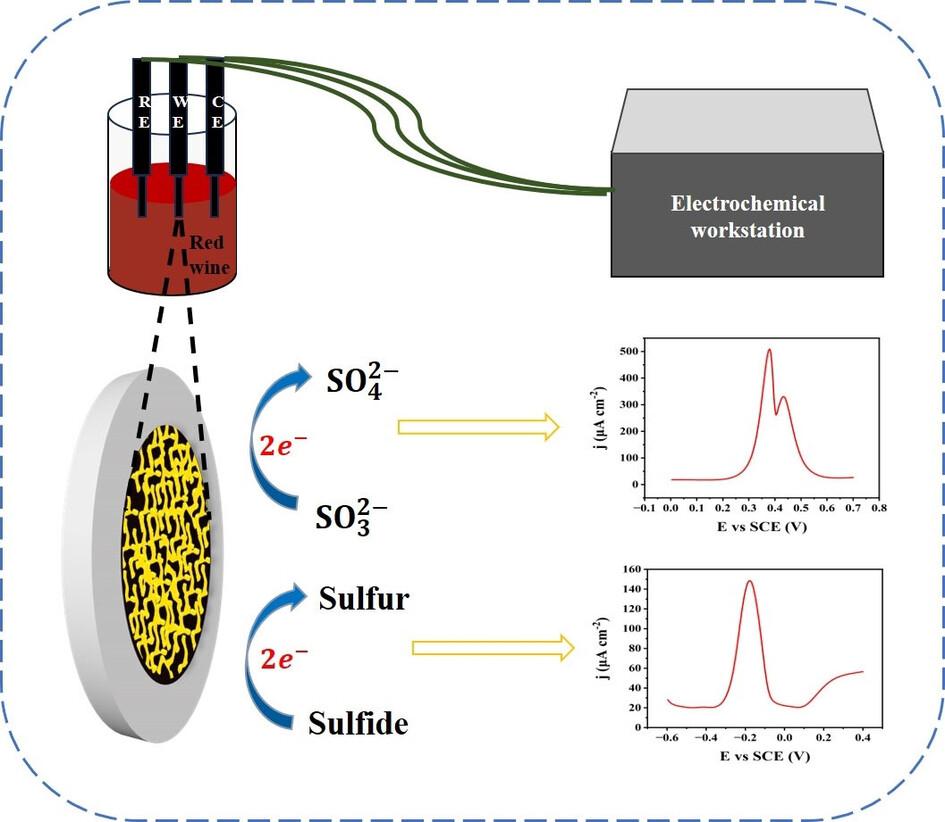
Given the increasing food safety problems caused by sulfide and sulfite, there is an urgent need to develop a rapid and accurate method for the detection of sulfide and sulfite in food. In this study, a multianalyte electrochemical sensor was successfully fabricated based on glassy carbon electrode (GCE) modified by nanoporous gold (NPG) for the detection of sulfide and sulfite. Owing to the exceptional oxidation activity of NPG towards sulfite and sulfide, the constructed multianalyte NPG/GCE electrochemical sensor achieved highly sensitive detection of sulfide in the concentration range of 50 μM–5 mM with a sensitivity of 21.33 μA mM−1cm−2 and a limit of detection (LOD) as low as 37.53 μM. For the detection of sulfite, the multianalyte NPG/GCE electrochemical sensor exhibited good linearity in the concentration range of 50 μM–5 mM with a sensitivity of 71.76 μA mM−1cm−2 and a LOD of 5.12 μM. In addition, the multianalyte NPG/GCE electrochemical sensor realized the reliable detection of sulfide and sulfite in complex real food samples (such as milk, pickles, red wine, and tap water) with high sensitivity and anti-interference ability. The multianalyte NPG/GCE electrochemical sensor exhibited many advantageous properties in practical applications, including easy fabrication, sensitivity, rapidity, cost-efficient, and flexible adaptability, which made it a promising candidate for the rapid and reliable detection of sulfide and sulfite in food.
期刊介绍:
Electroanalysis is an international, peer-reviewed journal covering all branches of electroanalytical chemistry, including both fundamental and application papers as well as reviews dealing with new electrochemical sensors and biosensors, nanobioelectronics devices, analytical voltammetry, potentiometry, new electrochemical detection schemes based on novel nanomaterials, fuel cells and biofuel cells, and important practical applications.
Serving as a vital communication link between the research labs and the field, Electroanalysis helps you to quickly adapt the latest innovations into practical clinical, environmental, food analysis, industrial and energy-related applications. Electroanalysis provides the most comprehensive coverage of the field and is the number one source for information on electroanalytical chemistry, electrochemical sensors and biosensors and fuel/biofuel cells.





 京公网安备 11010802042870号
京ICP备2023020795号-1
京公网安备 11010802042870号
京ICP备2023020795号-1

 分享
分享
 求助内容:
求助内容: 应助结果提醒方式:
 扫码关注我们
