Belén Morón-Conejo DDS, MSc, Santiago Berrendero DDS, PhD, Shizhu Bai DDS, PhD, Francisco Martínez-Rus DDS, PhD, Guillermo Pradies DDS, PhD
{"title":"采用开放式和专有 3D 打印模式制造的临时牙冠与铣削技术的密合度比较:体外研究。","authors":"Belén Morón-Conejo DDS, MSc, Santiago Berrendero DDS, PhD, Shizhu Bai DDS, PhD, Francisco Martínez-Rus DDS, PhD, Guillermo Pradies DDS, PhD","doi":"10.1111/jerd.13295","DOIUrl":null,"url":null,"abstract":"<div>\n \n \n <section>\n \n <h3> Objectives</h3>\n \n <p>This study aimed to assess the fit of interim crowns produced using DLP-based 3D printing with different manufacturing workflows—open and proprietary—versus milling technology.</p>\n </section>\n \n <section>\n \n <h3> Methods</h3>\n \n <p>A total of 120 crowns were evaluated using the replica technique. The control group (Mill, <i>n</i> = 30) was manufactured via subtractive technology. Experimental groups were printed using a DLP printer (SprintRay Pro95). In the proprietary mode (SR100, <i>n</i> = 30), manufacturer resin was used with a 100-μm layer thickness (LT) and a splashing cleaning postprocessing. In the open mode, validated resin was used. Group B100 (<i>n</i> = 30) had a 100-μm LT, and group B50 (<i>n</i> = 30) had a 50-μm followed by postprocessing in an ultrasonic bath with full immersion in isopropyl alcohol. Kruskal–Wallis tests with Bonferroni correction was applied after normal analysis (<i>α</i> = 0.05).</p>\n </section>\n \n <section>\n \n <h3> Results</h3>\n \n <p>Group B50 exhibited the best overall fit (123.87 ± 67.42 μm), which was comparable to the gold standard Milling group, which demonstrated the lowest marginal fit (<i>p</i> = 0.760). SR100 showed significantly poorer performance compared to Mill, B50, and B100 (<i>p</i> < 0.001).</p>\n </section>\n \n <section>\n \n <h3> Conclusions</h3>\n \n <p>3D printed and milled interim crowns generally demonstrated clinically acceptable fit, with the exception of the SR100 group. Postprocessing notably influenced crown fit, with the open mode with total immersion in isopropyl alcohol being superior.</p>\n </section>\n \n <section>\n \n <h3> Clinical Significance</h3>\n \n <p>The present study demonstrates that the selection of an optimal manufacturing and postprocessing workflow results in superior fit for interim crowns. This enables dental professionals to evaluate protocols and ensure reliable outcomes with improved clinical outcomes in interim crown fabrication.</p>\n </section>\n </div>","PeriodicalId":15988,"journal":{"name":"Journal of Esthetic and Restorative Dentistry","volume":"36 12","pages":"1693-1703"},"PeriodicalIF":4.6000,"publicationDate":"2024-08-09","publicationTypes":"Journal Article","fieldsOfStudy":null,"isOpenAccess":false,"openAccessPdf":"https://onlinelibrary.wiley.com/doi/epdf/10.1111/jerd.13295","citationCount":"0","resultStr":"{\"title\":\"Fit comparison of interim crowns manufactured with open and proprietary 3D printing modes versus milling technology: An in vitro study\",\"authors\":\"Belén Morón-Conejo DDS, MSc, Santiago Berrendero DDS, PhD, Shizhu Bai DDS, PhD, Francisco Martínez-Rus DDS, PhD, Guillermo Pradies DDS, PhD\",\"doi\":\"10.1111/jerd.13295\",\"DOIUrl\":null,\"url\":null,\"abstract\":\"<div>\\n \\n \\n <section>\\n \\n <h3> Objectives</h3>\\n \\n <p>This study aimed to assess the fit of interim crowns produced using DLP-based 3D printing with different manufacturing workflows—open and proprietary—versus milling technology.</p>\\n </section>\\n \\n <section>\\n \\n <h3> Methods</h3>\\n \\n <p>A total of 120 crowns were evaluated using the replica technique. The control group (Mill, <i>n</i> = 30) was manufactured via subtractive technology. Experimental groups were printed using a DLP printer (SprintRay Pro95). In the proprietary mode (SR100, <i>n</i> = 30), manufacturer resin was used with a 100-μm layer thickness (LT) and a splashing cleaning postprocessing. In the open mode, validated resin was used. Group B100 (<i>n</i> = 30) had a 100-μm LT, and group B50 (<i>n</i> = 30) had a 50-μm followed by postprocessing in an ultrasonic bath with full immersion in isopropyl alcohol. Kruskal–Wallis tests with Bonferroni correction was applied after normal analysis (<i>α</i> = 0.05).</p>\\n </section>\\n \\n <section>\\n \\n <h3> Results</h3>\\n \\n <p>Group B50 exhibited the best overall fit (123.87 ± 67.42 μm), which was comparable to the gold standard Milling group, which demonstrated the lowest marginal fit (<i>p</i> = 0.760). SR100 showed significantly poorer performance compared to Mill, B50, and B100 (<i>p</i> < 0.001).</p>\\n </section>\\n \\n <section>\\n \\n <h3> Conclusions</h3>\\n \\n <p>3D printed and milled interim crowns generally demonstrated clinically acceptable fit, with the exception of the SR100 group. Postprocessing notably influenced crown fit, with the open mode with total immersion in isopropyl alcohol being superior.</p>\\n </section>\\n \\n <section>\\n \\n <h3> Clinical Significance</h3>\\n \\n <p>The present study demonstrates that the selection of an optimal manufacturing and postprocessing workflow results in superior fit for interim crowns. This enables dental professionals to evaluate protocols and ensure reliable outcomes with improved clinical outcomes in interim crown fabrication.</p>\\n </section>\\n </div>\",\"PeriodicalId\":15988,\"journal\":{\"name\":\"Journal of Esthetic and Restorative Dentistry\",\"volume\":\"36 12\",\"pages\":\"1693-1703\"},\"PeriodicalIF\":4.6000,\"publicationDate\":\"2024-08-09\",\"publicationTypes\":\"Journal Article\",\"fieldsOfStudy\":null,\"isOpenAccess\":false,\"openAccessPdf\":\"https://onlinelibrary.wiley.com/doi/epdf/10.1111/jerd.13295\",\"citationCount\":\"0\",\"resultStr\":null,\"platform\":\"Semanticscholar\",\"paperid\":null,\"PeriodicalName\":\"Journal of Esthetic and Restorative Dentistry\",\"FirstCategoryId\":\"3\",\"ListUrlMain\":\"https://onlinelibrary.wiley.com/doi/10.1111/jerd.13295\",\"RegionNum\":3,\"RegionCategory\":\"医学\",\"ArticlePicture\":[],\"TitleCN\":null,\"AbstractTextCN\":null,\"PMCID\":null,\"EPubDate\":\"\",\"PubModel\":\"\",\"JCR\":\"Q1\",\"JCRName\":\"DENTISTRY, ORAL SURGERY & MEDICINE\",\"Score\":null,\"Total\":0}","platform":"Semanticscholar","paperid":null,"PeriodicalName":"Journal of Esthetic and Restorative Dentistry","FirstCategoryId":"3","ListUrlMain":"https://onlinelibrary.wiley.com/doi/10.1111/jerd.13295","RegionNum":3,"RegionCategory":"医学","ArticlePicture":[],"TitleCN":null,"AbstractTextCN":null,"PMCID":null,"EPubDate":"","PubModel":"","JCR":"Q1","JCRName":"DENTISTRY, ORAL SURGERY & MEDICINE","Score":null,"Total":0}
Fit comparison of interim crowns manufactured with open and proprietary 3D printing modes versus milling technology: An in vitro study
Objectives
This study aimed to assess the fit of interim crowns produced using DLP-based 3D printing with different manufacturing workflows—open and proprietary—versus milling technology.
Methods
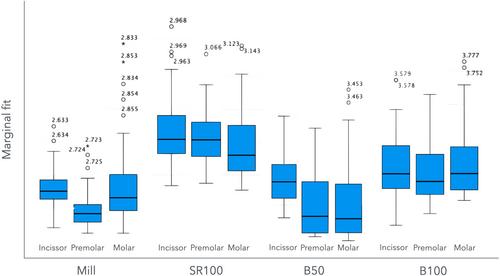
A total of 120 crowns were evaluated using the replica technique. The control group (Mill, n = 30) was manufactured via subtractive technology. Experimental groups were printed using a DLP printer (SprintRay Pro95). In the proprietary mode (SR100, n = 30), manufacturer resin was used with a 100-μm layer thickness (LT) and a splashing cleaning postprocessing. In the open mode, validated resin was used. Group B100 (n = 30) had a 100-μm LT, and group B50 (n = 30) had a 50-μm followed by postprocessing in an ultrasonic bath with full immersion in isopropyl alcohol. Kruskal–Wallis tests with Bonferroni correction was applied after normal analysis (α = 0.05).
Results
Group B50 exhibited the best overall fit (123.87 ± 67.42 μm), which was comparable to the gold standard Milling group, which demonstrated the lowest marginal fit (p = 0.760). SR100 showed significantly poorer performance compared to Mill, B50, and B100 (p < 0.001).
Conclusions
3D printed and milled interim crowns generally demonstrated clinically acceptable fit, with the exception of the SR100 group. Postprocessing notably influenced crown fit, with the open mode with total immersion in isopropyl alcohol being superior.
Clinical Significance
The present study demonstrates that the selection of an optimal manufacturing and postprocessing workflow results in superior fit for interim crowns. This enables dental professionals to evaluate protocols and ensure reliable outcomes with improved clinical outcomes in interim crown fabrication.
期刊介绍:
The Journal of Esthetic and Restorative Dentistry (JERD) is the longest standing peer-reviewed journal devoted solely to advancing the knowledge and practice of esthetic dentistry. Its goal is to provide the very latest evidence-based information in the realm of contemporary interdisciplinary esthetic dentistry through high quality clinical papers, sound research reports and educational features.
The range of topics covered in the journal includes:
- Interdisciplinary esthetic concepts
- Implants
- Conservative adhesive restorations
- Tooth Whitening
- Prosthodontic materials and techniques
- Dental materials
- Orthodontic, periodontal and endodontic esthetics
- Esthetics related research
- Innovations in esthetics




 京公网安备 11010802042870号
京ICP备2023020795号-1
京公网安备 11010802042870号
京ICP备2023020795号-1

 分享
分享
 求助内容:
求助内容: 应助结果提醒方式:
 扫码关注我们
