Yanxia Guo, Yujie Sun, Zhongying Li, Chaohui Zuo, Xiaoqing Liu, Yu Chen, Zhen Xun, Jinling Liu, Yang Mei, Jung-Joon Min, Min Wen, Jin Hai Zheng, Wenzhi Tan
{"title":"由 LPS/TLR4 轴调控的 S100a8/a9 在基于沙门氏菌的肿瘤治疗和宿主防御中发挥着重要作用。","authors":"Yanxia Guo, Yujie Sun, Zhongying Li, Chaohui Zuo, Xiaoqing Liu, Yu Chen, Zhen Xun, Jinling Liu, Yang Mei, Jung-Joon Min, Min Wen, Jin Hai Zheng, Wenzhi Tan","doi":"10.1002/ijc.35128","DOIUrl":null,"url":null,"abstract":"<p>Bacteria are ideal anticancer agents and carriers due to their unique capabilities that are convenient in genetic manipulation, tumor-specific targeting, and deep-tissue penetration. However, the specific molecular mechanisms of bacteria-mediated cancer therapy (BMCT) have not been clarified. In this study, we found that TLR4 signaling pathway is critical for <i>Salmonella</i>-mediated tumor targeting, tumor suppression, and liver and spleen protection. TLR4 knockout in mice decreased the levels of cytokines and chemokines, such as S100a8, S100a9, TNF-α, and IL-1β, in tumor microenvironments (TMEs) after <i>Salmonella</i> treatment, which inhibited tumor cell death and nutrient release, led to reduced bacterial contents in tumors and attenuated antitumor efficacy in a negative feedback manner. Importantly, we found that S100a8 and S100a9 played a leading role in <i>Salmonella</i>-mediated cancer therapy (SMCT). The antitumor efficacy was abrogated and liver damage was prominent when blocked with a specific inhibitor. These findings elucidated the mechanism of <i>Salmonella</i>-mediated tumor targeting, suppression, and host antibacterial defense, providing insights into clinical cancer therapeutics.</p>","PeriodicalId":180,"journal":{"name":"International Journal of Cancer","volume":"155 11","pages":"2080-2093"},"PeriodicalIF":4.9000,"publicationDate":"2024-08-11","publicationTypes":"Journal Article","fieldsOfStudy":null,"isOpenAccess":false,"openAccessPdf":"","citationCount":"0","resultStr":"{\"title\":\"S100a8/a9 regulated by LPS/TLR4 axis plays an important role in Salmonella-based tumor therapy and host defense\",\"authors\":\"Yanxia Guo, Yujie Sun, Zhongying Li, Chaohui Zuo, Xiaoqing Liu, Yu Chen, Zhen Xun, Jinling Liu, Yang Mei, Jung-Joon Min, Min Wen, Jin Hai Zheng, Wenzhi Tan\",\"doi\":\"10.1002/ijc.35128\",\"DOIUrl\":null,\"url\":null,\"abstract\":\"<p>Bacteria are ideal anticancer agents and carriers due to their unique capabilities that are convenient in genetic manipulation, tumor-specific targeting, and deep-tissue penetration. However, the specific molecular mechanisms of bacteria-mediated cancer therapy (BMCT) have not been clarified. In this study, we found that TLR4 signaling pathway is critical for <i>Salmonella</i>-mediated tumor targeting, tumor suppression, and liver and spleen protection. TLR4 knockout in mice decreased the levels of cytokines and chemokines, such as S100a8, S100a9, TNF-α, and IL-1β, in tumor microenvironments (TMEs) after <i>Salmonella</i> treatment, which inhibited tumor cell death and nutrient release, led to reduced bacterial contents in tumors and attenuated antitumor efficacy in a negative feedback manner. Importantly, we found that S100a8 and S100a9 played a leading role in <i>Salmonella</i>-mediated cancer therapy (SMCT). The antitumor efficacy was abrogated and liver damage was prominent when blocked with a specific inhibitor. These findings elucidated the mechanism of <i>Salmonella</i>-mediated tumor targeting, suppression, and host antibacterial defense, providing insights into clinical cancer therapeutics.</p>\",\"PeriodicalId\":180,\"journal\":{\"name\":\"International Journal of Cancer\",\"volume\":\"155 11\",\"pages\":\"2080-2093\"},\"PeriodicalIF\":4.9000,\"publicationDate\":\"2024-08-11\",\"publicationTypes\":\"Journal Article\",\"fieldsOfStudy\":null,\"isOpenAccess\":false,\"openAccessPdf\":\"\",\"citationCount\":\"0\",\"resultStr\":null,\"platform\":\"Semanticscholar\",\"paperid\":null,\"PeriodicalName\":\"International Journal of Cancer\",\"FirstCategoryId\":\"3\",\"ListUrlMain\":\"https://onlinelibrary.wiley.com/doi/10.1002/ijc.35128\",\"RegionNum\":2,\"RegionCategory\":\"医学\",\"ArticlePicture\":[],\"TitleCN\":null,\"AbstractTextCN\":null,\"PMCID\":null,\"EPubDate\":\"\",\"PubModel\":\"\",\"JCR\":\"Q1\",\"JCRName\":\"ONCOLOGY\",\"Score\":null,\"Total\":0}","platform":"Semanticscholar","paperid":null,"PeriodicalName":"International Journal of Cancer","FirstCategoryId":"3","ListUrlMain":"https://onlinelibrary.wiley.com/doi/10.1002/ijc.35128","RegionNum":2,"RegionCategory":"医学","ArticlePicture":[],"TitleCN":null,"AbstractTextCN":null,"PMCID":null,"EPubDate":"","PubModel":"","JCR":"Q1","JCRName":"ONCOLOGY","Score":null,"Total":0}
S100a8/a9 regulated by LPS/TLR4 axis plays an important role in Salmonella-based tumor therapy and host defense
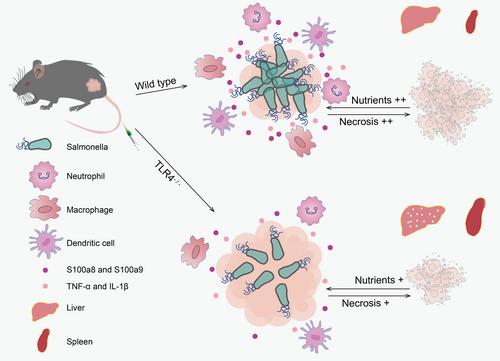
Bacteria are ideal anticancer agents and carriers due to their unique capabilities that are convenient in genetic manipulation, tumor-specific targeting, and deep-tissue penetration. However, the specific molecular mechanisms of bacteria-mediated cancer therapy (BMCT) have not been clarified. In this study, we found that TLR4 signaling pathway is critical for Salmonella-mediated tumor targeting, tumor suppression, and liver and spleen protection. TLR4 knockout in mice decreased the levels of cytokines and chemokines, such as S100a8, S100a9, TNF-α, and IL-1β, in tumor microenvironments (TMEs) after Salmonella treatment, which inhibited tumor cell death and nutrient release, led to reduced bacterial contents in tumors and attenuated antitumor efficacy in a negative feedback manner. Importantly, we found that S100a8 and S100a9 played a leading role in Salmonella-mediated cancer therapy (SMCT). The antitumor efficacy was abrogated and liver damage was prominent when blocked with a specific inhibitor. These findings elucidated the mechanism of Salmonella-mediated tumor targeting, suppression, and host antibacterial defense, providing insights into clinical cancer therapeutics.
期刊介绍:
The International Journal of Cancer (IJC) is the official journal of the Union for International Cancer Control—UICC; it appears twice a month. IJC invites submission of manuscripts under a broad scope of topics relevant to experimental and clinical cancer research and publishes original Research Articles and Short Reports under the following categories:
-Cancer Epidemiology-
Cancer Genetics and Epigenetics-
Infectious Causes of Cancer-
Innovative Tools and Methods-
Molecular Cancer Biology-
Tumor Immunology and Microenvironment-
Tumor Markers and Signatures-
Cancer Therapy and Prevention




 京公网安备 11010802042870号
京ICP备2023020795号-1
京公网安备 11010802042870号
京ICP备2023020795号-1

 分享
分享
 求助内容:
求助内容: 应助结果提醒方式:
 扫码关注我们
