Pan Huang, Xiaonan Liu, Xiao Liu, Jing Wei, Fangze Liu, Hongbo Li
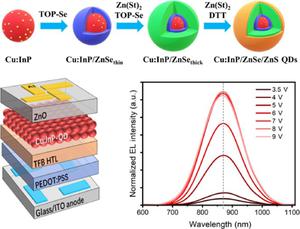
{"title":"单锅合成用于近红外发光器件的 Cu:InP 多壳量子点","authors":"Pan Huang, Xiaonan Liu, Xiao Liu, Jing Wei, Fangze Liu, Hongbo Li","doi":"10.1007/s12274-024-6906-0","DOIUrl":null,"url":null,"abstract":"<div><p>InP quantum dots (QDs) are promising heavy-metal-free materials for next-generation solid-state lighting, covering from visible to near-infrared (NIR) range. Compared with the rapid development of visible InP QDs, the synthesis of high-performance NIR InP QDs remains to be solved. In this work, we report a simple one-pot synthesis of NIR InP QDs by controlling the Cu doping and designing a multishell structure. By replacing the conventional highly reactive phosphorus precursor with a slightly less reactive and low-cost ammonia phosphorus precursor, the nucleation process is effectively regulated for efficient Cu doping. In addition, the epitaxial growth of the ZnSe/ZnS shell further improves the stability and optical properties of InP QDs. Therefore, the synthesized Cu:InP/ZnSe/ZnS QDs have a photoluminescence quantum yield of 70% centered at 833 nm. The NIR InP light-emitting diodes exhibit a maximum radiance of 3.1 W·sr<sup>−1</sup>·m<sup>−2</sup> and a peak external quantum efficiency of 2.71% centered at 864 nm.\n</p><div><figure><div><div><picture><source><img></source></picture></div></div></figure></div></div>","PeriodicalId":713,"journal":{"name":"Nano Research","volume":"17 :","pages":"10655 - 10660"},"PeriodicalIF":9.0000,"publicationDate":"2024-08-10","publicationTypes":"Journal Article","fieldsOfStudy":null,"isOpenAccess":false,"openAccessPdf":"","citationCount":"0","resultStr":"{\"title\":\"One-pot synthesis of Cu:InP multishell quantum dots for near-infrared light-emitting devices\",\"authors\":\"Pan Huang, Xiaonan Liu, Xiao Liu, Jing Wei, Fangze Liu, Hongbo Li\",\"doi\":\"10.1007/s12274-024-6906-0\",\"DOIUrl\":null,\"url\":null,\"abstract\":\"<div><p>InP quantum dots (QDs) are promising heavy-metal-free materials for next-generation solid-state lighting, covering from visible to near-infrared (NIR) range. Compared with the rapid development of visible InP QDs, the synthesis of high-performance NIR InP QDs remains to be solved. In this work, we report a simple one-pot synthesis of NIR InP QDs by controlling the Cu doping and designing a multishell structure. By replacing the conventional highly reactive phosphorus precursor with a slightly less reactive and low-cost ammonia phosphorus precursor, the nucleation process is effectively regulated for efficient Cu doping. In addition, the epitaxial growth of the ZnSe/ZnS shell further improves the stability and optical properties of InP QDs. Therefore, the synthesized Cu:InP/ZnSe/ZnS QDs have a photoluminescence quantum yield of 70% centered at 833 nm. The NIR InP light-emitting diodes exhibit a maximum radiance of 3.1 W·sr<sup>−1</sup>·m<sup>−2</sup> and a peak external quantum efficiency of 2.71% centered at 864 nm.\\n</p><div><figure><div><div><picture><source><img></source></picture></div></div></figure></div></div>\",\"PeriodicalId\":713,\"journal\":{\"name\":\"Nano Research\",\"volume\":\"17 :\",\"pages\":\"10655 - 10660\"},\"PeriodicalIF\":9.0000,\"publicationDate\":\"2024-08-10\",\"publicationTypes\":\"Journal Article\",\"fieldsOfStudy\":null,\"isOpenAccess\":false,\"openAccessPdf\":\"\",\"citationCount\":\"0\",\"resultStr\":null,\"platform\":\"Semanticscholar\",\"paperid\":null,\"PeriodicalName\":\"Nano Research\",\"FirstCategoryId\":\"88\",\"ListUrlMain\":\"https://link.springer.com/article/10.1007/s12274-024-6906-0\",\"RegionNum\":2,\"RegionCategory\":\"材料科学\",\"ArticlePicture\":[],\"TitleCN\":null,\"AbstractTextCN\":null,\"PMCID\":null,\"EPubDate\":\"\",\"PubModel\":\"\",\"JCR\":\"Q1\",\"JCRName\":\"CHEMISTRY, PHYSICAL\",\"Score\":null,\"Total\":0}","platform":"Semanticscholar","paperid":null,"PeriodicalName":"Nano Research","FirstCategoryId":"88","ListUrlMain":"https://link.springer.com/article/10.1007/s12274-024-6906-0","RegionNum":2,"RegionCategory":"材料科学","ArticlePicture":[],"TitleCN":null,"AbstractTextCN":null,"PMCID":null,"EPubDate":"","PubModel":"","JCR":"Q1","JCRName":"CHEMISTRY, PHYSICAL","Score":null,"Total":0}
One-pot synthesis of Cu:InP multishell quantum dots for near-infrared light-emitting devices
InP quantum dots (QDs) are promising heavy-metal-free materials for next-generation solid-state lighting, covering from visible to near-infrared (NIR) range. Compared with the rapid development of visible InP QDs, the synthesis of high-performance NIR InP QDs remains to be solved. In this work, we report a simple one-pot synthesis of NIR InP QDs by controlling the Cu doping and designing a multishell structure. By replacing the conventional highly reactive phosphorus precursor with a slightly less reactive and low-cost ammonia phosphorus precursor, the nucleation process is effectively regulated for efficient Cu doping. In addition, the epitaxial growth of the ZnSe/ZnS shell further improves the stability and optical properties of InP QDs. Therefore, the synthesized Cu:InP/ZnSe/ZnS QDs have a photoluminescence quantum yield of 70% centered at 833 nm. The NIR InP light-emitting diodes exhibit a maximum radiance of 3.1 W·sr−1·m−2 and a peak external quantum efficiency of 2.71% centered at 864 nm.
期刊介绍:
Nano Research is a peer-reviewed, international and interdisciplinary research journal that focuses on all aspects of nanoscience and nanotechnology. It solicits submissions in various topical areas, from basic aspects of nanoscale materials to practical applications. The journal publishes articles on synthesis, characterization, and manipulation of nanomaterials; nanoscale physics, electrical transport, and quantum physics; scanning probe microscopy and spectroscopy; nanofluidics; nanosensors; nanoelectronics and molecular electronics; nano-optics, nano-optoelectronics, and nano-photonics; nanomagnetics; nanobiotechnology and nanomedicine; and nanoscale modeling and simulations. Nano Research offers readers a combination of authoritative and comprehensive Reviews, original cutting-edge research in Communication and Full Paper formats. The journal also prioritizes rapid review to ensure prompt publication.




 京公网安备 11010802042870号
京ICP备2023020795号-1
京公网安备 11010802042870号
京ICP备2023020795号-1

 分享
分享
 求助内容:
求助内容: 应助结果提醒方式:
 扫码关注我们
