{"title":"锌和银硫化物 (ZnS)(Ag_2S)_x 异构体的热稳定性","authors":"S. I. Sadovnikov, S. V. Sergeeva, A. I. Gusev","doi":"10.1134/S0036023624600096","DOIUrl":null,"url":null,"abstract":"<p>Heteronanostructures (ZnS)(Ag<sub>2</sub>S)<sub><i>x</i></sub>, where <i>x</i> = 0.002–0.50, are synthesized by hydrochemical coprecipitation. The ZnS nanoparticle size in the resulting heteronanostructures is 2–4 nm. Annealing of the synthesized (ZnS)(Ag<sub>2</sub>S)<sub><i>x</i></sub> heteronanostructures in air at temperatures of 25–530°C and above leads to a change in their phase composition due to the oxidation of cubic zinc sulfide to hexagonal zinc oxide. Oxidation begins at a temperature of ~250°C; the zinc oxide content in the heteronanostructures after annealing at 530°C achieves ~26–30 wt %. The nanoparticle size of the resulting ZnO varies in a range of 12 to 17–25 nm. Studies of the oxidation of (ZnS)(Ag<sub>2</sub>S)<sub><i>x</i></sub> heteronanostructures in air show that the initial weight loss observed upon heating to ~120°C is attributed to the removal of adsorbed moisture. The subsequent weight loss that occurs upon heating from ~250 to ~430–450°C is associated with the onset of oxidation of the ZnS sulfide and the formation of the ZnO oxide. The most significant weight loss is observed upon heating from ~450 to ~580°C; it is attributed to an increase in the ZnO content, partial oxidation of sulfur, and the removal of sulfur in the form of SO<sub>2</sub>. The occurrence of oxidation stages is confirmed by the presence of maxima in the temperature dependences of ion currents corresponding to H<sub>2</sub>O, CO<sub>2</sub>, and SO<sub>2</sub>. The studied heteronanostructures are thermally stable under heating to ~200–250°C.</p>","PeriodicalId":762,"journal":{"name":"Russian Journal of Inorganic Chemistry","volume":"69 5","pages":"785 - 793"},"PeriodicalIF":1.5000,"publicationDate":"2024-08-09","publicationTypes":"Journal Article","fieldsOfStudy":null,"isOpenAccess":false,"openAccessPdf":"","citationCount":"0","resultStr":"{\"title\":\"Thermal Stability of (ZnS)(Ag2S)x Heteronanostructures of Zinc and Silver Sulfides\",\"authors\":\"S. I. Sadovnikov, S. V. Sergeeva, A. I. Gusev\",\"doi\":\"10.1134/S0036023624600096\",\"DOIUrl\":null,\"url\":null,\"abstract\":\"<p>Heteronanostructures (ZnS)(Ag<sub>2</sub>S)<sub><i>x</i></sub>, where <i>x</i> = 0.002–0.50, are synthesized by hydrochemical coprecipitation. The ZnS nanoparticle size in the resulting heteronanostructures is 2–4 nm. Annealing of the synthesized (ZnS)(Ag<sub>2</sub>S)<sub><i>x</i></sub> heteronanostructures in air at temperatures of 25–530°C and above leads to a change in their phase composition due to the oxidation of cubic zinc sulfide to hexagonal zinc oxide. Oxidation begins at a temperature of ~250°C; the zinc oxide content in the heteronanostructures after annealing at 530°C achieves ~26–30 wt %. The nanoparticle size of the resulting ZnO varies in a range of 12 to 17–25 nm. Studies of the oxidation of (ZnS)(Ag<sub>2</sub>S)<sub><i>x</i></sub> heteronanostructures in air show that the initial weight loss observed upon heating to ~120°C is attributed to the removal of adsorbed moisture. The subsequent weight loss that occurs upon heating from ~250 to ~430–450°C is associated with the onset of oxidation of the ZnS sulfide and the formation of the ZnO oxide. The most significant weight loss is observed upon heating from ~450 to ~580°C; it is attributed to an increase in the ZnO content, partial oxidation of sulfur, and the removal of sulfur in the form of SO<sub>2</sub>. The occurrence of oxidation stages is confirmed by the presence of maxima in the temperature dependences of ion currents corresponding to H<sub>2</sub>O, CO<sub>2</sub>, and SO<sub>2</sub>. The studied heteronanostructures are thermally stable under heating to ~200–250°C.</p>\",\"PeriodicalId\":762,\"journal\":{\"name\":\"Russian Journal of Inorganic Chemistry\",\"volume\":\"69 5\",\"pages\":\"785 - 793\"},\"PeriodicalIF\":1.5000,\"publicationDate\":\"2024-08-09\",\"publicationTypes\":\"Journal Article\",\"fieldsOfStudy\":null,\"isOpenAccess\":false,\"openAccessPdf\":\"\",\"citationCount\":\"0\",\"resultStr\":null,\"platform\":\"Semanticscholar\",\"paperid\":null,\"PeriodicalName\":\"Russian Journal of Inorganic Chemistry\",\"FirstCategoryId\":\"92\",\"ListUrlMain\":\"https://link.springer.com/article/10.1134/S0036023624600096\",\"RegionNum\":3,\"RegionCategory\":\"化学\",\"ArticlePicture\":[],\"TitleCN\":null,\"AbstractTextCN\":null,\"PMCID\":null,\"EPubDate\":\"\",\"PubModel\":\"\",\"JCR\":\"Q3\",\"JCRName\":\"CHEMISTRY, INORGANIC & NUCLEAR\",\"Score\":null,\"Total\":0}","platform":"Semanticscholar","paperid":null,"PeriodicalName":"Russian Journal of Inorganic Chemistry","FirstCategoryId":"92","ListUrlMain":"https://link.springer.com/article/10.1134/S0036023624600096","RegionNum":3,"RegionCategory":"化学","ArticlePicture":[],"TitleCN":null,"AbstractTextCN":null,"PMCID":null,"EPubDate":"","PubModel":"","JCR":"Q3","JCRName":"CHEMISTRY, INORGANIC & NUCLEAR","Score":null,"Total":0}
Thermal Stability of (ZnS)(Ag2S)x Heteronanostructures of Zinc and Silver Sulfides
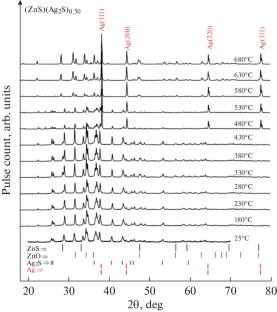
Heteronanostructures (ZnS)(Ag2S)x, where x = 0.002–0.50, are synthesized by hydrochemical coprecipitation. The ZnS nanoparticle size in the resulting heteronanostructures is 2–4 nm. Annealing of the synthesized (ZnS)(Ag2S)x heteronanostructures in air at temperatures of 25–530°C and above leads to a change in their phase composition due to the oxidation of cubic zinc sulfide to hexagonal zinc oxide. Oxidation begins at a temperature of ~250°C; the zinc oxide content in the heteronanostructures after annealing at 530°C achieves ~26–30 wt %. The nanoparticle size of the resulting ZnO varies in a range of 12 to 17–25 nm. Studies of the oxidation of (ZnS)(Ag2S)x heteronanostructures in air show that the initial weight loss observed upon heating to ~120°C is attributed to the removal of adsorbed moisture. The subsequent weight loss that occurs upon heating from ~250 to ~430–450°C is associated with the onset of oxidation of the ZnS sulfide and the formation of the ZnO oxide. The most significant weight loss is observed upon heating from ~450 to ~580°C; it is attributed to an increase in the ZnO content, partial oxidation of sulfur, and the removal of sulfur in the form of SO2. The occurrence of oxidation stages is confirmed by the presence of maxima in the temperature dependences of ion currents corresponding to H2O, CO2, and SO2. The studied heteronanostructures are thermally stable under heating to ~200–250°C.
期刊介绍:
Russian Journal of Inorganic Chemistry is a monthly periodical that covers the following topics of research: the synthesis and properties of inorganic compounds, coordination compounds, physicochemical analysis of inorganic systems, theoretical inorganic chemistry, physical methods of investigation, chemistry of solutions, inorganic materials, and nanomaterials.





 京公网安备 11010802042870号
京ICP备2023020795号-1
京公网安备 11010802042870号
京ICP备2023020795号-1

 分享
分享
 求助内容:
求助内容: 应助结果提醒方式:
 扫码关注我们
