Iain M. Johnstone, Yegor Klochkov, Alexei Onatski, Damian Pavlyshyn
{"title":"球形 SK 模型中的自旋玻璃到顺磁转变和三重点","authors":"Iain M. Johnstone, Yegor Klochkov, Alexei Onatski, Damian Pavlyshyn","doi":"10.1007/s10955-024-03296-7","DOIUrl":null,"url":null,"abstract":"<div><p>This paper studies spin glass to paramagnetic transition in the Spherical Sherrington–Kirkpatrick model with ferromagnetic Curie-Weiss interaction with coupling constant <i>J</i> and inverse temperature <span>\\(\\beta \\)</span>. The disorder of the system is represented by a general Wigner matrix. We confirm a conjecture of Baik and Lee (Stat Phys 165(2):185–224, 2016; Ann Henri Poincaré 18(6):1867–1917, 2017), that the critical window of temperatures for this transition is <span>\\(\\beta = 1 + bN^{-1/3} \\sqrt{\\log N}\\)</span> with <span>\\(b\\in \\mathbb {R}\\)</span>. The limiting distribution of the scaled free energy is Gaussian for negative <i>b</i> and a weighted linear combination of independent Gaussian and Tracy–Widom components for positive <i>b</i>. In the special case where the Wigner matrix is from the Gaussian Orthogonal or Unitary Ensemble, we describe the triple point transition between spin glass, paramagnetic, and ferromagnetic regimes in a critical window for <span>\\((\\beta , J)\\)</span> around the triple point (1, 1): the Tracy–Widom component is replaced by the one parameter family of deformations described by Bloemendal and Virág [9].</p></div>","PeriodicalId":667,"journal":{"name":"Journal of Statistical Physics","volume":"191 8","pages":""},"PeriodicalIF":1.2000,"publicationDate":"2024-08-08","publicationTypes":"Journal Article","fieldsOfStudy":null,"isOpenAccess":false,"openAccessPdf":"","citationCount":"0","resultStr":"{\"title\":\"Spin Glass to Paramagnetic Transition and Triple Point in Spherical SK Model\",\"authors\":\"Iain M. Johnstone, Yegor Klochkov, Alexei Onatski, Damian Pavlyshyn\",\"doi\":\"10.1007/s10955-024-03296-7\",\"DOIUrl\":null,\"url\":null,\"abstract\":\"<div><p>This paper studies spin glass to paramagnetic transition in the Spherical Sherrington–Kirkpatrick model with ferromagnetic Curie-Weiss interaction with coupling constant <i>J</i> and inverse temperature <span>\\\\(\\\\beta \\\\)</span>. The disorder of the system is represented by a general Wigner matrix. We confirm a conjecture of Baik and Lee (Stat Phys 165(2):185–224, 2016; Ann Henri Poincaré 18(6):1867–1917, 2017), that the critical window of temperatures for this transition is <span>\\\\(\\\\beta = 1 + bN^{-1/3} \\\\sqrt{\\\\log N}\\\\)</span> with <span>\\\\(b\\\\in \\\\mathbb {R}\\\\)</span>. The limiting distribution of the scaled free energy is Gaussian for negative <i>b</i> and a weighted linear combination of independent Gaussian and Tracy–Widom components for positive <i>b</i>. In the special case where the Wigner matrix is from the Gaussian Orthogonal or Unitary Ensemble, we describe the triple point transition between spin glass, paramagnetic, and ferromagnetic regimes in a critical window for <span>\\\\((\\\\beta , J)\\\\)</span> around the triple point (1, 1): the Tracy–Widom component is replaced by the one parameter family of deformations described by Bloemendal and Virág [9].</p></div>\",\"PeriodicalId\":667,\"journal\":{\"name\":\"Journal of Statistical Physics\",\"volume\":\"191 8\",\"pages\":\"\"},\"PeriodicalIF\":1.2000,\"publicationDate\":\"2024-08-08\",\"publicationTypes\":\"Journal Article\",\"fieldsOfStudy\":null,\"isOpenAccess\":false,\"openAccessPdf\":\"\",\"citationCount\":\"0\",\"resultStr\":null,\"platform\":\"Semanticscholar\",\"paperid\":null,\"PeriodicalName\":\"Journal of Statistical Physics\",\"FirstCategoryId\":\"101\",\"ListUrlMain\":\"https://link.springer.com/article/10.1007/s10955-024-03296-7\",\"RegionNum\":3,\"RegionCategory\":\"物理与天体物理\",\"ArticlePicture\":[],\"TitleCN\":null,\"AbstractTextCN\":null,\"PMCID\":null,\"EPubDate\":\"\",\"PubModel\":\"\",\"JCR\":\"Q3\",\"JCRName\":\"PHYSICS, MATHEMATICAL\",\"Score\":null,\"Total\":0}","platform":"Semanticscholar","paperid":null,"PeriodicalName":"Journal of Statistical Physics","FirstCategoryId":"101","ListUrlMain":"https://link.springer.com/article/10.1007/s10955-024-03296-7","RegionNum":3,"RegionCategory":"物理与天体物理","ArticlePicture":[],"TitleCN":null,"AbstractTextCN":null,"PMCID":null,"EPubDate":"","PubModel":"","JCR":"Q3","JCRName":"PHYSICS, MATHEMATICAL","Score":null,"Total":0}
引用次数: 0
摘要
本文研究了球形谢林顿-柯克帕特里克(Sherrington-Kirkpatrick)模型中的自旋玻璃到顺磁转变,该模型具有铁磁居里-魏斯(Curie-Weiss)相互作用,耦合常数为 J,反温度为(\beta \)。系统的无序性由一般维格纳矩阵表示。我们证实了Baik和Lee的猜想(Stat Phys 165(2):185-224, 2016; Ann Henri Poincaré 18(6):1867-1917, 2017),即这一转变的临界温度窗口是\(\beta = 1 + bN^{-1/3} \sqrt\log N}\) with \(b\in \mathbb {R}\)。对于负 b,标度自由能的极限分布是高斯分布,而对于正 b,则是独立高斯和特雷西-维多姆成分的加权线性组合。在维格纳矩阵来自高斯正交或单元集合的特殊情况下,我们在三重点(1,1)附近的临界窗口中描述了自旋玻璃、顺磁性和铁磁性状态之间的三重点转变:Tracy-Widom分量被Bloemendal和Virág[9]描述的变形的单参数族所取代。
Spin Glass to Paramagnetic Transition and Triple Point in Spherical SK Model
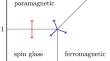
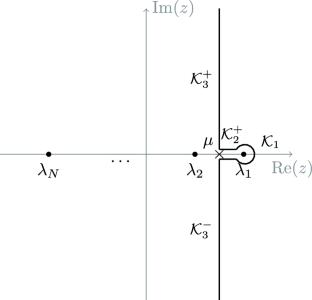
This paper studies spin glass to paramagnetic transition in the Spherical Sherrington–Kirkpatrick model with ferromagnetic Curie-Weiss interaction with coupling constant J and inverse temperature \(\beta \). The disorder of the system is represented by a general Wigner matrix. We confirm a conjecture of Baik and Lee (Stat Phys 165(2):185–224, 2016; Ann Henri Poincaré 18(6):1867–1917, 2017), that the critical window of temperatures for this transition is \(\beta = 1 + bN^{-1/3} \sqrt{\log N}\) with \(b\in \mathbb {R}\). The limiting distribution of the scaled free energy is Gaussian for negative b and a weighted linear combination of independent Gaussian and Tracy–Widom components for positive b. In the special case where the Wigner matrix is from the Gaussian Orthogonal or Unitary Ensemble, we describe the triple point transition between spin glass, paramagnetic, and ferromagnetic regimes in a critical window for \((\beta , J)\) around the triple point (1, 1): the Tracy–Widom component is replaced by the one parameter family of deformations described by Bloemendal and Virág [9].
期刊介绍:
The Journal of Statistical Physics publishes original and invited review papers in all areas of statistical physics as well as in related fields concerned with collective phenomena in physical systems.




 京公网安备 11010802042870号
京ICP备2023020795号-1
京公网安备 11010802042870号
京ICP备2023020795号-1

 分享
分享
 求助内容:
求助内容: 应助结果提醒方式:
 扫码关注我们
