Eric S. Chen, Alaleh Ahmadianshalchi, Sonja S. Sparks, Chuchu Chen, Aryan Deshwal, Janardhan R. Doppa, Kaiyan Qiu
{"title":"机器学习支持高保真术前器官模型 3D 打印的设计与优化","authors":"Eric S. Chen, Alaleh Ahmadianshalchi, Sonja S. Sparks, Chuchu Chen, Aryan Deshwal, Janardhan R. Doppa, Kaiyan Qiu","doi":"10.1002/admt.202400037","DOIUrl":null,"url":null,"abstract":"<p>The development of a general-purpose machine learning algorithm capable of quickly identifying optimal 3D-printing settings can save manufacturing time and cost, reduce labor intensity, and improve the quality of 3D-printed objects. Existing methods have limitations which focus on overall performance or one specific aspect of 3D-printing quality. Here, for addressing the limitations, a multi-objective Bayesian Optimization (BO) approach which uses a general-purpose algorithm to optimize the black-box functions is demonstrated and identifies the optimal input parameters of direct ink writing for 3D-printing different presurgical organ models with intricate geometry. The BO approach enhances the 3D-printing efficiency to achieve the best possible printed object quality while simultaneously addressing the inherent trade-offs from the process of pursuing ideal outcomes relevant to requirements from practitioners. The BO approach also enables us to effectively explore 3D-printing inputs inclusive of layer height, nozzle travel speed, and dispensing pressure, as well as visualize the trade-offs between each set of 3D-printing inputs in terms of the output objectives which consist of time, porosity, and geometry precisions through the Pareto front.</p>","PeriodicalId":7292,"journal":{"name":"Advanced Materials Technologies","volume":"10 1","pages":""},"PeriodicalIF":6.4000,"publicationDate":"2024-08-06","publicationTypes":"Journal Article","fieldsOfStudy":null,"isOpenAccess":false,"openAccessPdf":"https://onlinelibrary.wiley.com/doi/epdf/10.1002/admt.202400037","citationCount":"0","resultStr":"{\"title\":\"Machine Learning Enabled Design and Optimization for 3D-Printing of High-Fidelity Presurgical Organ Models\",\"authors\":\"Eric S. Chen, Alaleh Ahmadianshalchi, Sonja S. Sparks, Chuchu Chen, Aryan Deshwal, Janardhan R. Doppa, Kaiyan Qiu\",\"doi\":\"10.1002/admt.202400037\",\"DOIUrl\":null,\"url\":null,\"abstract\":\"<p>The development of a general-purpose machine learning algorithm capable of quickly identifying optimal 3D-printing settings can save manufacturing time and cost, reduce labor intensity, and improve the quality of 3D-printed objects. Existing methods have limitations which focus on overall performance or one specific aspect of 3D-printing quality. Here, for addressing the limitations, a multi-objective Bayesian Optimization (BO) approach which uses a general-purpose algorithm to optimize the black-box functions is demonstrated and identifies the optimal input parameters of direct ink writing for 3D-printing different presurgical organ models with intricate geometry. The BO approach enhances the 3D-printing efficiency to achieve the best possible printed object quality while simultaneously addressing the inherent trade-offs from the process of pursuing ideal outcomes relevant to requirements from practitioners. The BO approach also enables us to effectively explore 3D-printing inputs inclusive of layer height, nozzle travel speed, and dispensing pressure, as well as visualize the trade-offs between each set of 3D-printing inputs in terms of the output objectives which consist of time, porosity, and geometry precisions through the Pareto front.</p>\",\"PeriodicalId\":7292,\"journal\":{\"name\":\"Advanced Materials Technologies\",\"volume\":\"10 1\",\"pages\":\"\"},\"PeriodicalIF\":6.4000,\"publicationDate\":\"2024-08-06\",\"publicationTypes\":\"Journal Article\",\"fieldsOfStudy\":null,\"isOpenAccess\":false,\"openAccessPdf\":\"https://onlinelibrary.wiley.com/doi/epdf/10.1002/admt.202400037\",\"citationCount\":\"0\",\"resultStr\":null,\"platform\":\"Semanticscholar\",\"paperid\":null,\"PeriodicalName\":\"Advanced Materials Technologies\",\"FirstCategoryId\":\"88\",\"ListUrlMain\":\"https://advanced.onlinelibrary.wiley.com/doi/10.1002/admt.202400037\",\"RegionNum\":3,\"RegionCategory\":\"材料科学\",\"ArticlePicture\":[],\"TitleCN\":null,\"AbstractTextCN\":null,\"PMCID\":null,\"EPubDate\":\"\",\"PubModel\":\"\",\"JCR\":\"Q1\",\"JCRName\":\"MATERIALS SCIENCE, MULTIDISCIPLINARY\",\"Score\":null,\"Total\":0}","platform":"Semanticscholar","paperid":null,"PeriodicalName":"Advanced Materials Technologies","FirstCategoryId":"88","ListUrlMain":"https://advanced.onlinelibrary.wiley.com/doi/10.1002/admt.202400037","RegionNum":3,"RegionCategory":"材料科学","ArticlePicture":[],"TitleCN":null,"AbstractTextCN":null,"PMCID":null,"EPubDate":"","PubModel":"","JCR":"Q1","JCRName":"MATERIALS SCIENCE, MULTIDISCIPLINARY","Score":null,"Total":0}
Machine Learning Enabled Design and Optimization for 3D-Printing of High-Fidelity Presurgical Organ Models
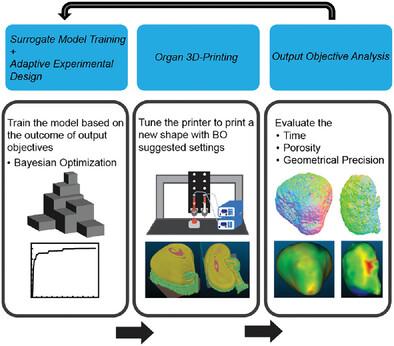
The development of a general-purpose machine learning algorithm capable of quickly identifying optimal 3D-printing settings can save manufacturing time and cost, reduce labor intensity, and improve the quality of 3D-printed objects. Existing methods have limitations which focus on overall performance or one specific aspect of 3D-printing quality. Here, for addressing the limitations, a multi-objective Bayesian Optimization (BO) approach which uses a general-purpose algorithm to optimize the black-box functions is demonstrated and identifies the optimal input parameters of direct ink writing for 3D-printing different presurgical organ models with intricate geometry. The BO approach enhances the 3D-printing efficiency to achieve the best possible printed object quality while simultaneously addressing the inherent trade-offs from the process of pursuing ideal outcomes relevant to requirements from practitioners. The BO approach also enables us to effectively explore 3D-printing inputs inclusive of layer height, nozzle travel speed, and dispensing pressure, as well as visualize the trade-offs between each set of 3D-printing inputs in terms of the output objectives which consist of time, porosity, and geometry precisions through the Pareto front.
期刊介绍:
Advanced Materials Technologies Advanced Materials Technologies is the new home for all technology-related materials applications research, with particular focus on advanced device design, fabrication and integration, as well as new technologies based on novel materials. It bridges the gap between fundamental laboratory research and industry.







 京公网安备 11010802042870号
京ICP备2023020795号-1
京公网安备 11010802042870号
京ICP备2023020795号-1

 分享
分享
 求助内容:
求助内容: 应助结果提醒方式:
 扫码关注我们
