Zhishan Chen, Shaoan Zhang, Zhenzhang Li, Huacong Ye, Haoran Yan, Jialong Xu, Ling Gao, Yang Li and Shizhen Zhang
{"title":"具有高近红外输出功率的 Cr3+ 掺杂荧光粉的热稳定近红外宽发射率","authors":"Zhishan Chen, Shaoan Zhang, Zhenzhang Li, Huacong Ye, Haoran Yan, Jialong Xu, Ling Gao, Yang Li and Shizhen Zhang","doi":"10.1039/D4QI01728E","DOIUrl":null,"url":null,"abstract":"<p >The development of high-performance near-infrared (NIR) luminescent materials remains a significant challenge, particularly in enhancing thermal stability. Herein, we observed an anti-thermal quenching effect in the YGa<small><sub>1.5</sub></small>Al<small><sub>1.5</sub></small>(BO<small><sub>3</sub></small>)<small><sub>4</sub></small>:Cr<small><sup>3+</sup></small> phosphor, with its emission intensity reaching 104% at 423 K and 101% at 483 K compared to room temperature. This anti-thermal quenching is mainly attributed to thermal-induced emission compensation resulting from excited electrons trapped at crystal defects, as confirmed by density functional theory computation. Additionally, YGa<small><sub>1.5</sub></small>Al<small><sub>1.5</sub></small>(BO<small><sub>3</sub></small>)<small><sub>4</sub></small>:Cr<small><sup>3+</sup></small> exhibits a broad NIR emission peaking at 760 nm with a full width at half maximum of 135 nm and a high photoluminescence quantum yield (86%). As a proof-of-concept, we fabricated an NIR phosphor-converted light-emitting diode device that achieves an NIR output power of 59.67 mW with an input working current of 150 mA, demonstrating a photoelectric conversion efficiency of 13.6%. The utilization of this high-power NIR light-emitting diode device as a lighting source enables a penetration depth of up to 15 mm, demonstrating the potential applications of Cr<small><sup>3+</sup></small>-doped YGa<small><sub>1.5</sub></small>Al<small><sub>1.5</sub></small>(BO<small><sub>3</sub></small>)<small><sub>4</sub></small>:Cr<small><sup>3+</sup></small> phosphors for non-invasive detection of biological tissue.</p>","PeriodicalId":79,"journal":{"name":"Inorganic Chemistry Frontiers","volume":" 20","pages":" 6898-6908"},"PeriodicalIF":6.4000,"publicationDate":"2024-08-22","publicationTypes":"Journal Article","fieldsOfStudy":null,"isOpenAccess":false,"openAccessPdf":"","citationCount":"0","resultStr":"{\"title\":\"Thermally stable NIR broad emission of Cr3+ doping phosphor with a high output power†\",\"authors\":\"Zhishan Chen, Shaoan Zhang, Zhenzhang Li, Huacong Ye, Haoran Yan, Jialong Xu, Ling Gao, Yang Li and Shizhen Zhang\",\"doi\":\"10.1039/D4QI01728E\",\"DOIUrl\":null,\"url\":null,\"abstract\":\"<p >The development of high-performance near-infrared (NIR) luminescent materials remains a significant challenge, particularly in enhancing thermal stability. Herein, we observed an anti-thermal quenching effect in the YGa<small><sub>1.5</sub></small>Al<small><sub>1.5</sub></small>(BO<small><sub>3</sub></small>)<small><sub>4</sub></small>:Cr<small><sup>3+</sup></small> phosphor, with its emission intensity reaching 104% at 423 K and 101% at 483 K compared to room temperature. This anti-thermal quenching is mainly attributed to thermal-induced emission compensation resulting from excited electrons trapped at crystal defects, as confirmed by density functional theory computation. Additionally, YGa<small><sub>1.5</sub></small>Al<small><sub>1.5</sub></small>(BO<small><sub>3</sub></small>)<small><sub>4</sub></small>:Cr<small><sup>3+</sup></small> exhibits a broad NIR emission peaking at 760 nm with a full width at half maximum of 135 nm and a high photoluminescence quantum yield (86%). As a proof-of-concept, we fabricated an NIR phosphor-converted light-emitting diode device that achieves an NIR output power of 59.67 mW with an input working current of 150 mA, demonstrating a photoelectric conversion efficiency of 13.6%. The utilization of this high-power NIR light-emitting diode device as a lighting source enables a penetration depth of up to 15 mm, demonstrating the potential applications of Cr<small><sup>3+</sup></small>-doped YGa<small><sub>1.5</sub></small>Al<small><sub>1.5</sub></small>(BO<small><sub>3</sub></small>)<small><sub>4</sub></small>:Cr<small><sup>3+</sup></small> phosphors for non-invasive detection of biological tissue.</p>\",\"PeriodicalId\":79,\"journal\":{\"name\":\"Inorganic Chemistry Frontiers\",\"volume\":\" 20\",\"pages\":\" 6898-6908\"},\"PeriodicalIF\":6.4000,\"publicationDate\":\"2024-08-22\",\"publicationTypes\":\"Journal Article\",\"fieldsOfStudy\":null,\"isOpenAccess\":false,\"openAccessPdf\":\"\",\"citationCount\":\"0\",\"resultStr\":null,\"platform\":\"Semanticscholar\",\"paperid\":null,\"PeriodicalName\":\"Inorganic Chemistry Frontiers\",\"FirstCategoryId\":\"92\",\"ListUrlMain\":\"https://pubs.rsc.org/en/content/articlelanding/2024/qi/d4qi01728e\",\"RegionNum\":1,\"RegionCategory\":\"化学\",\"ArticlePicture\":[],\"TitleCN\":null,\"AbstractTextCN\":null,\"PMCID\":null,\"EPubDate\":\"\",\"PubModel\":\"\",\"JCR\":\"Q1\",\"JCRName\":\"CHEMISTRY, INORGANIC & NUCLEAR\",\"Score\":null,\"Total\":0}","platform":"Semanticscholar","paperid":null,"PeriodicalName":"Inorganic Chemistry Frontiers","FirstCategoryId":"92","ListUrlMain":"https://pubs.rsc.org/en/content/articlelanding/2024/qi/d4qi01728e","RegionNum":1,"RegionCategory":"化学","ArticlePicture":[],"TitleCN":null,"AbstractTextCN":null,"PMCID":null,"EPubDate":"","PubModel":"","JCR":"Q1","JCRName":"CHEMISTRY, INORGANIC & NUCLEAR","Score":null,"Total":0}
引用次数: 0
摘要
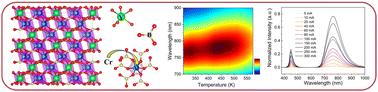
开发高性能近红外(NIR)发光材料仍然是一项重大挑战,尤其是在提高热稳定性方面。在这里,我们观察到了 YGa1.5Al1.5(BO3)4:Cr3+ 荧光粉中的抗热淬效应,与室温相比,它在 423 K 和 483 K 时的发射强度分别达到 104% 和 101%。密度泛函理论计算证实,这种抗热淬火主要归因于热诱导的发射补偿,其原因是晶体缺陷处捕获了激发电子。此外,YGa1.5Al1.5(BO3)4:Cr3+ 在 750 纳米波长处显示出宽广的近红外发射峰值,半最大值全宽为 135 纳米波长,并具有很高的光致发光量子产率(86%)。作为概念验证,我们制作了一个近红外荧光粉转换发光二极管器件,在输入 150 mA 工作电流的情况下,其近红外输出功率达到 59.67 mW,光电转换效率为 13.6%。利用这种高功率近红外发光二极管器件作为照明光源,其穿透深度可达 15 毫米,这证明了掺杂 Cr3+ 的 YGa1.5Al1.5(BO3)4:Cr3+ 荧光粉在生物组织无创检测方面的潜在应用。
Thermally stable NIR broad emission of Cr3+ doping phosphor with a high output power†
The development of high-performance near-infrared (NIR) luminescent materials remains a significant challenge, particularly in enhancing thermal stability. Herein, we observed an anti-thermal quenching effect in the YGa1.5Al1.5(BO3)4:Cr3+ phosphor, with its emission intensity reaching 104% at 423 K and 101% at 483 K compared to room temperature. This anti-thermal quenching is mainly attributed to thermal-induced emission compensation resulting from excited electrons trapped at crystal defects, as confirmed by density functional theory computation. Additionally, YGa1.5Al1.5(BO3)4:Cr3+ exhibits a broad NIR emission peaking at 760 nm with a full width at half maximum of 135 nm and a high photoluminescence quantum yield (86%). As a proof-of-concept, we fabricated an NIR phosphor-converted light-emitting diode device that achieves an NIR output power of 59.67 mW with an input working current of 150 mA, demonstrating a photoelectric conversion efficiency of 13.6%. The utilization of this high-power NIR light-emitting diode device as a lighting source enables a penetration depth of up to 15 mm, demonstrating the potential applications of Cr3+-doped YGa1.5Al1.5(BO3)4:Cr3+ phosphors for non-invasive detection of biological tissue.




 京公网安备 11010802042870号
京ICP备2023020795号-1
京公网安备 11010802042870号
京ICP备2023020795号-1

 分享
分享
 求助内容:
求助内容: 应助结果提醒方式:
 扫码关注我们
