{"title":"铜纳米线通过特殊的细胞内分布和过量的铜离子释放引发高效的铜突变。","authors":"Zihan Chen, Yue Li, Yongguang Yin, Maoyong Song, Fengbang Wang, Guibin Jiang","doi":"10.1021/acs.nanolett.4c02503","DOIUrl":null,"url":null,"abstract":"<p><p>Cuproptosis, dependent on Cu overload, presents novel opportunities for cancer therapy. Cu-based nanomaterials have shown excellent advantages for the intracellular delivery of Cu. However, the biological process of Cu nanomaterials transporting Cu ions into cancer cells remains unclear. In this study, we tracked the Cu ion release process of copper nanowires (CuNWs) and copper nanoparticles (CuNPs) at the single-cell level. CuNWs with 5-μm length and CuNPs were found to be completely internalized by cancer cells. Interestingly, CuNWs escaped from the endolysosomal system, whereas CuNPs were mainly trapped in the lysosomes. This specific intracellular distribution of CuNWs led to cytoplasmic Cu ion overload, directly damaging mitochondria and inducing dihydrolipoamide S-acetyltransferase (DLAT) protein aggregation. Through these excessive Cu ions, CuNWs triggered more efficient cuproptosis than CuNPs to further increase cell death. Thus, CuNWs are more effective in delivering Cu ions than CuNPs, providing a novel perspective for designing cuproptosis-based functional nanomaterials for cancer therapy.</p>","PeriodicalId":53,"journal":{"name":"Nano Letters","volume":" ","pages":"11446-11453"},"PeriodicalIF":9.1000,"publicationDate":"2024-09-18","publicationTypes":"Journal Article","fieldsOfStudy":null,"isOpenAccess":false,"openAccessPdf":"","citationCount":"0","resultStr":"{\"title\":\"Cu Nanowires Trigger Efficient Cuproptosis <i>via</i> Special Intracellular Distribution and Excessive Cu Ion Release.\",\"authors\":\"Zihan Chen, Yue Li, Yongguang Yin, Maoyong Song, Fengbang Wang, Guibin Jiang\",\"doi\":\"10.1021/acs.nanolett.4c02503\",\"DOIUrl\":null,\"url\":null,\"abstract\":\"<p><p>Cuproptosis, dependent on Cu overload, presents novel opportunities for cancer therapy. Cu-based nanomaterials have shown excellent advantages for the intracellular delivery of Cu. However, the biological process of Cu nanomaterials transporting Cu ions into cancer cells remains unclear. In this study, we tracked the Cu ion release process of copper nanowires (CuNWs) and copper nanoparticles (CuNPs) at the single-cell level. CuNWs with 5-μm length and CuNPs were found to be completely internalized by cancer cells. Interestingly, CuNWs escaped from the endolysosomal system, whereas CuNPs were mainly trapped in the lysosomes. This specific intracellular distribution of CuNWs led to cytoplasmic Cu ion overload, directly damaging mitochondria and inducing dihydrolipoamide S-acetyltransferase (DLAT) protein aggregation. Through these excessive Cu ions, CuNWs triggered more efficient cuproptosis than CuNPs to further increase cell death. Thus, CuNWs are more effective in delivering Cu ions than CuNPs, providing a novel perspective for designing cuproptosis-based functional nanomaterials for cancer therapy.</p>\",\"PeriodicalId\":53,\"journal\":{\"name\":\"Nano Letters\",\"volume\":\" \",\"pages\":\"11446-11453\"},\"PeriodicalIF\":9.1000,\"publicationDate\":\"2024-09-18\",\"publicationTypes\":\"Journal Article\",\"fieldsOfStudy\":null,\"isOpenAccess\":false,\"openAccessPdf\":\"\",\"citationCount\":\"0\",\"resultStr\":null,\"platform\":\"Semanticscholar\",\"paperid\":null,\"PeriodicalName\":\"Nano Letters\",\"FirstCategoryId\":\"88\",\"ListUrlMain\":\"https://doi.org/10.1021/acs.nanolett.4c02503\",\"RegionNum\":1,\"RegionCategory\":\"材料科学\",\"ArticlePicture\":[],\"TitleCN\":null,\"AbstractTextCN\":null,\"PMCID\":null,\"EPubDate\":\"2024/9/3 0:00:00\",\"PubModel\":\"Epub\",\"JCR\":\"Q1\",\"JCRName\":\"CHEMISTRY, MULTIDISCIPLINARY\",\"Score\":null,\"Total\":0}","platform":"Semanticscholar","paperid":null,"PeriodicalName":"Nano Letters","FirstCategoryId":"88","ListUrlMain":"https://doi.org/10.1021/acs.nanolett.4c02503","RegionNum":1,"RegionCategory":"材料科学","ArticlePicture":[],"TitleCN":null,"AbstractTextCN":null,"PMCID":null,"EPubDate":"2024/9/3 0:00:00","PubModel":"Epub","JCR":"Q1","JCRName":"CHEMISTRY, MULTIDISCIPLINARY","Score":null,"Total":0}
引用次数: 0
摘要
铜中毒依赖于铜超载,为癌症治疗提供了新的机遇。铜基纳米材料在细胞内输送铜方面显示出卓越的优势。然而,铜纳米材料将铜离子运入癌细胞的生物学过程仍不清楚。在这项研究中,我们在单细胞水平上跟踪了铜纳米线(CuNWs)和铜纳米颗粒(CuNPs)的铜离子释放过程。结果发现,长度为 5-μm 的铜纳米线和铜纳米粒子能被癌细胞完全内化。有趣的是,CuNWs 逃出了溶酶体内系统,而 CuNPs 则主要被困在溶酶体内。CuNWs 在细胞内的这种特殊分布导致细胞质中的 Cu 离子超载,直接损害线粒体并诱导二氢脂酰胺 S-乙酰转移酶(DLAT)蛋白聚集。通过这些过量的 Cu 离子,CuNWs 比 CuNPs 更有效地触发了杯突症,进一步加剧了细胞死亡。因此,CuNWs 比 CuNPs 能更有效地传递铜离子,为设计基于杯突酶作用的癌症治疗功能纳米材料提供了一个新的视角。
Cu Nanowires Trigger Efficient Cuproptosis via Special Intracellular Distribution and Excessive Cu Ion Release.
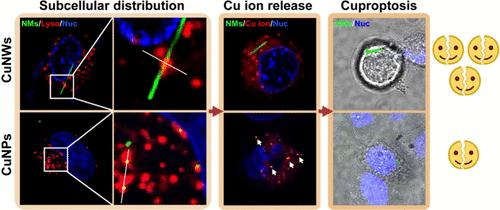
Cuproptosis, dependent on Cu overload, presents novel opportunities for cancer therapy. Cu-based nanomaterials have shown excellent advantages for the intracellular delivery of Cu. However, the biological process of Cu nanomaterials transporting Cu ions into cancer cells remains unclear. In this study, we tracked the Cu ion release process of copper nanowires (CuNWs) and copper nanoparticles (CuNPs) at the single-cell level. CuNWs with 5-μm length and CuNPs were found to be completely internalized by cancer cells. Interestingly, CuNWs escaped from the endolysosomal system, whereas CuNPs were mainly trapped in the lysosomes. This specific intracellular distribution of CuNWs led to cytoplasmic Cu ion overload, directly damaging mitochondria and inducing dihydrolipoamide S-acetyltransferase (DLAT) protein aggregation. Through these excessive Cu ions, CuNWs triggered more efficient cuproptosis than CuNPs to further increase cell death. Thus, CuNWs are more effective in delivering Cu ions than CuNPs, providing a novel perspective for designing cuproptosis-based functional nanomaterials for cancer therapy.
期刊介绍:
Nano Letters serves as a dynamic platform for promptly disseminating original results in fundamental, applied, and emerging research across all facets of nanoscience and nanotechnology. A pivotal criterion for inclusion within Nano Letters is the convergence of at least two different areas or disciplines, ensuring a rich interdisciplinary scope. The journal is dedicated to fostering exploration in diverse areas, including:
- Experimental and theoretical findings on physical, chemical, and biological phenomena at the nanoscale
- Synthesis, characterization, and processing of organic, inorganic, polymer, and hybrid nanomaterials through physical, chemical, and biological methodologies
- Modeling and simulation of synthetic, assembly, and interaction processes
- Realization of integrated nanostructures and nano-engineered devices exhibiting advanced performance
- Applications of nanoscale materials in living and environmental systems
Nano Letters is committed to advancing and showcasing groundbreaking research that intersects various domains, fostering innovation and collaboration in the ever-evolving field of nanoscience and nanotechnology.




 京公网安备 11010802042870号
京ICP备2023020795号-1
京公网安备 11010802042870号
京ICP备2023020795号-1

 分享
分享
 求助内容:
求助内容: 应助结果提醒方式:
 扫码关注我们
