Xiao-Ping Wei , Jiang-Liu Meng , Hao-Kai Sun , Ya-Ling Zhang , Xiaoma Tao
{"title":"三维过渡金属原子及其二聚体对单层五硒化镉的吸附:第一原理研究","authors":"Xiao-Ping Wei , Jiang-Liu Meng , Hao-Kai Sun , Ya-Ling Zhang , Xiaoma Tao","doi":"10.1016/j.surfin.2024.105055","DOIUrl":null,"url":null,"abstract":"<div><p>Materials with high magnetic anisotropy are widely used in magnetic storage. In this work, we systematically investigated the structural stability, electronic structure and magnetic properties of the CdSe<span><math><msub><mrow></mrow><mrow><mn>2</mn></mrow></msub></math></span> monolayer adsorbed by Cr, Mn, Fe and Co atoms and their dimers by first-principles calculations. It is shown that the most stable adsorption sites are located at the positions of bridge bonds formed by Se–Se atoms, the adsorption of atoms and dimers on the CdSe<span><math><msub><mrow></mrow><mrow><mn>2</mn></mrow></msub></math></span> monolayer is chemisorbed. All adsorption systems are magnetic semiconductors, and the system adsorbed Ir–Co dimer is a magnetic metal. The total magnetic moments of the systems adsorbed by the Cr, Mn, Ir and Co atoms are 4.00 <span><math><msub><mrow><mi>μ</mi></mrow><mrow><mi>B</mi></mrow></msub></math></span>, 5.00 <span><math><msub><mrow><mi>μ</mi></mrow><mrow><mi>B</mi></mrow></msub></math></span>, 4.00 <span><math><msub><mrow><mi>μ</mi></mrow><mrow><mi>B</mi></mrow></msub></math></span> and 3.00 <span><math><msub><mrow><mi>μ</mi></mrow><mrow><mi>B</mi></mrow></msub></math></span>, respectively, the mechanisms of forming integer total magnetic moments and magnetic semiconductor band gaps are discussed by the hybridization, occupation and distribution of electronic states in the crystal field. The CdSe<span><math><msub><mrow></mrow><mrow><mn>2</mn></mrow></msub></math></span> adsorbed by Ir–Cr, Ir–Mn, Ir–Fe and Ir–Co dimers exhibit large magnetic anisotropy energies (MAEs) of 27.15 meV, -49.29 meV, 29.24 meV and 27.90 meV, respectively, and the origin of the MAEs is explained by the second-order perturbation theory of magnetic anisotropy. In addition, the largest MAE of the adsorbed systems reaches 33.28 meV by applying -4%<span><math><mo>∼</mo></math></span>4% biaxial strain. In conclusion, our research provides a valuable exploration for the design of materials with larger magnetic anisotropy by the 2D materials adsorbed by atoms or dimers.</p></div>","PeriodicalId":22081,"journal":{"name":"Surfaces and Interfaces","volume":"53 ","pages":"Article 105055"},"PeriodicalIF":6.0000,"publicationDate":"2024-10-01","publicationTypes":"Journal Article","fieldsOfStudy":null,"isOpenAccess":false,"openAccessPdf":"","citationCount":"0","resultStr":"{\"title\":\"Adsorption of monolayer penta-CdSe2 by 3d transition-metal atoms and their dimers: A first-principles study\",\"authors\":\"Xiao-Ping Wei , Jiang-Liu Meng , Hao-Kai Sun , Ya-Ling Zhang , Xiaoma Tao\",\"doi\":\"10.1016/j.surfin.2024.105055\",\"DOIUrl\":null,\"url\":null,\"abstract\":\"<div><p>Materials with high magnetic anisotropy are widely used in magnetic storage. In this work, we systematically investigated the structural stability, electronic structure and magnetic properties of the CdSe<span><math><msub><mrow></mrow><mrow><mn>2</mn></mrow></msub></math></span> monolayer adsorbed by Cr, Mn, Fe and Co atoms and their dimers by first-principles calculations. It is shown that the most stable adsorption sites are located at the positions of bridge bonds formed by Se–Se atoms, the adsorption of atoms and dimers on the CdSe<span><math><msub><mrow></mrow><mrow><mn>2</mn></mrow></msub></math></span> monolayer is chemisorbed. All adsorption systems are magnetic semiconductors, and the system adsorbed Ir–Co dimer is a magnetic metal. The total magnetic moments of the systems adsorbed by the Cr, Mn, Ir and Co atoms are 4.00 <span><math><msub><mrow><mi>μ</mi></mrow><mrow><mi>B</mi></mrow></msub></math></span>, 5.00 <span><math><msub><mrow><mi>μ</mi></mrow><mrow><mi>B</mi></mrow></msub></math></span>, 4.00 <span><math><msub><mrow><mi>μ</mi></mrow><mrow><mi>B</mi></mrow></msub></math></span> and 3.00 <span><math><msub><mrow><mi>μ</mi></mrow><mrow><mi>B</mi></mrow></msub></math></span>, respectively, the mechanisms of forming integer total magnetic moments and magnetic semiconductor band gaps are discussed by the hybridization, occupation and distribution of electronic states in the crystal field. The CdSe<span><math><msub><mrow></mrow><mrow><mn>2</mn></mrow></msub></math></span> adsorbed by Ir–Cr, Ir–Mn, Ir–Fe and Ir–Co dimers exhibit large magnetic anisotropy energies (MAEs) of 27.15 meV, -49.29 meV, 29.24 meV and 27.90 meV, respectively, and the origin of the MAEs is explained by the second-order perturbation theory of magnetic anisotropy. In addition, the largest MAE of the adsorbed systems reaches 33.28 meV by applying -4%<span><math><mo>∼</mo></math></span>4% biaxial strain. In conclusion, our research provides a valuable exploration for the design of materials with larger magnetic anisotropy by the 2D materials adsorbed by atoms or dimers.</p></div>\",\"PeriodicalId\":22081,\"journal\":{\"name\":\"Surfaces and Interfaces\",\"volume\":\"53 \",\"pages\":\"Article 105055\"},\"PeriodicalIF\":6.0000,\"publicationDate\":\"2024-10-01\",\"publicationTypes\":\"Journal Article\",\"fieldsOfStudy\":null,\"isOpenAccess\":false,\"openAccessPdf\":\"\",\"citationCount\":\"0\",\"resultStr\":null,\"platform\":\"Semanticscholar\",\"paperid\":null,\"PeriodicalName\":\"Surfaces and Interfaces\",\"FirstCategoryId\":\"88\",\"ListUrlMain\":\"https://www.sciencedirect.com/science/article/pii/S2468023024012112\",\"RegionNum\":2,\"RegionCategory\":\"材料科学\",\"ArticlePicture\":[],\"TitleCN\":null,\"AbstractTextCN\":null,\"PMCID\":null,\"EPubDate\":\"2024/9/6 0:00:00\",\"PubModel\":\"Epub\",\"JCR\":\"Q2\",\"JCRName\":\"CHEMISTRY, PHYSICAL\",\"Score\":null,\"Total\":0}","platform":"Semanticscholar","paperid":null,"PeriodicalName":"Surfaces and Interfaces","FirstCategoryId":"88","ListUrlMain":"https://www.sciencedirect.com/science/article/pii/S2468023024012112","RegionNum":2,"RegionCategory":"材料科学","ArticlePicture":[],"TitleCN":null,"AbstractTextCN":null,"PMCID":null,"EPubDate":"2024/9/6 0:00:00","PubModel":"Epub","JCR":"Q2","JCRName":"CHEMISTRY, PHYSICAL","Score":null,"Total":0}
Adsorption of monolayer penta-CdSe2 by 3d transition-metal atoms and their dimers: A first-principles study
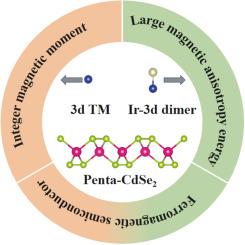
Materials with high magnetic anisotropy are widely used in magnetic storage. In this work, we systematically investigated the structural stability, electronic structure and magnetic properties of the CdSe monolayer adsorbed by Cr, Mn, Fe and Co atoms and their dimers by first-principles calculations. It is shown that the most stable adsorption sites are located at the positions of bridge bonds formed by Se–Se atoms, the adsorption of atoms and dimers on the CdSe monolayer is chemisorbed. All adsorption systems are magnetic semiconductors, and the system adsorbed Ir–Co dimer is a magnetic metal. The total magnetic moments of the systems adsorbed by the Cr, Mn, Ir and Co atoms are 4.00 , 5.00 , 4.00 and 3.00 , respectively, the mechanisms of forming integer total magnetic moments and magnetic semiconductor band gaps are discussed by the hybridization, occupation and distribution of electronic states in the crystal field. The CdSe adsorbed by Ir–Cr, Ir–Mn, Ir–Fe and Ir–Co dimers exhibit large magnetic anisotropy energies (MAEs) of 27.15 meV, -49.29 meV, 29.24 meV and 27.90 meV, respectively, and the origin of the MAEs is explained by the second-order perturbation theory of magnetic anisotropy. In addition, the largest MAE of the adsorbed systems reaches 33.28 meV by applying -4%4% biaxial strain. In conclusion, our research provides a valuable exploration for the design of materials with larger magnetic anisotropy by the 2D materials adsorbed by atoms or dimers.
期刊介绍:
The aim of the journal is to provide a respectful outlet for ''sound science'' papers in all research areas on surfaces and interfaces. We define sound science papers as papers that describe new and well-executed research, but that do not necessarily provide brand new insights or are merely a description of research results.
Surfaces and Interfaces publishes research papers in all fields of surface science which may not always find the right home on first submission to our Elsevier sister journals (Applied Surface, Surface and Coatings Technology, Thin Solid Films)




 京公网安备 11010802042870号
京ICP备2023020795号-1
京公网安备 11010802042870号
京ICP备2023020795号-1

 分享
分享
 求助内容:
求助内容: 应助结果提醒方式:
 扫码关注我们
