Yan Li, Yingnan Liu, Xianyun Peng, Zilin Zhao, Zhongjian Li, Bin Yang, Qinghua Zhang, Lecheng Lei, Liming Dai, Yang Hou
{"title":"通过工程钯亚纳米团簇加速质子耦合电子转移,实现过氧化氢的规模化电合成","authors":"Yan Li, Yingnan Liu, Xianyun Peng, Zilin Zhao, Zhongjian Li, Bin Yang, Qinghua Zhang, Lecheng Lei, Liming Dai, Yang Hou","doi":"10.1002/anie.202413159","DOIUrl":null,"url":null,"abstract":"<p>Electrosynthesis of H<sub>2</sub>O<sub>2</sub> from oxygen reduction reaction via a two-electron pathway is vital as an alternative for the energy-intensive anthraquinone process. However, this process is largely hindered in neutral and alkaline conditions due to sluggish kinetics associated with the transformation of intermediate O<sub>2</sub>* into OOH* via proton-coupled electron transfer sourced from slow water dissociation. Herein, we developed Pd sub-nanoclusters on the nickel ditelluride nanosheets (Pd SNCs/NiTe<sub>2</sub>) to enhance the performance of H<sub>2</sub>O<sub>2</sub> electrosynthesis. The newly-developed Pd SNCs/NiTe<sub>2</sub> exhibited a H<sub>2</sub>O<sub>2</sub> selectivity of as high as 99 % and a positive shift of onset potential up to 0.81 V. Combined theoretical calculations and experimental studies (e.g., X-ray absorption and attenuated total reflectance-Fourier transform infrared spectra measurements) revealed that the Pd sub-nanoclusters supported by NiTe<sub>2</sub> nanosheets efficiently reduced the energy barrier of water dissociation to generate more protons, facilitating the proton feeding kinetics. When used in a flow cell, Pd SNCs/NiTe<sub>2</sub> cathode efficiently produced H<sub>2</sub>O<sub>2</sub> with a maximum yield rate of 1.75 mmol h<sup>−1</sup> cm<sup>−2</sup> and a current efficiency of 95 % at 100 mA cm<sup>−2</sup>. Further, an accumulated H<sub>2</sub>O<sub>2</sub> concentration of 1.43 mol L<sup>−1</sup> was reached after 10 hours of continuous electrolysis, showing the potential for practical H<sub>2</sub>O<sub>2</sub> electrosynthesis.</p>","PeriodicalId":125,"journal":{"name":"Angewandte Chemie International Edition","volume":"64 1","pages":""},"PeriodicalIF":17.6000,"publicationDate":"2024-09-10","publicationTypes":"Journal Article","fieldsOfStudy":null,"isOpenAccess":false,"openAccessPdf":"","citationCount":"0","resultStr":"{\"title\":\"Accelerated Proton-Coupled Electron Transfer via Engineering Palladium Sub-Nanoclusters for Scalable Electrosynthesis of Hydrogen Peroxide\",\"authors\":\"Yan Li, Yingnan Liu, Xianyun Peng, Zilin Zhao, Zhongjian Li, Bin Yang, Qinghua Zhang, Lecheng Lei, Liming Dai, Yang Hou\",\"doi\":\"10.1002/anie.202413159\",\"DOIUrl\":null,\"url\":null,\"abstract\":\"<p>Electrosynthesis of H<sub>2</sub>O<sub>2</sub> from oxygen reduction reaction via a two-electron pathway is vital as an alternative for the energy-intensive anthraquinone process. However, this process is largely hindered in neutral and alkaline conditions due to sluggish kinetics associated with the transformation of intermediate O<sub>2</sub>* into OOH* via proton-coupled electron transfer sourced from slow water dissociation. Herein, we developed Pd sub-nanoclusters on the nickel ditelluride nanosheets (Pd SNCs/NiTe<sub>2</sub>) to enhance the performance of H<sub>2</sub>O<sub>2</sub> electrosynthesis. The newly-developed Pd SNCs/NiTe<sub>2</sub> exhibited a H<sub>2</sub>O<sub>2</sub> selectivity of as high as 99 % and a positive shift of onset potential up to 0.81 V. Combined theoretical calculations and experimental studies (e.g., X-ray absorption and attenuated total reflectance-Fourier transform infrared spectra measurements) revealed that the Pd sub-nanoclusters supported by NiTe<sub>2</sub> nanosheets efficiently reduced the energy barrier of water dissociation to generate more protons, facilitating the proton feeding kinetics. When used in a flow cell, Pd SNCs/NiTe<sub>2</sub> cathode efficiently produced H<sub>2</sub>O<sub>2</sub> with a maximum yield rate of 1.75 mmol h<sup>−1</sup> cm<sup>−2</sup> and a current efficiency of 95 % at 100 mA cm<sup>−2</sup>. Further, an accumulated H<sub>2</sub>O<sub>2</sub> concentration of 1.43 mol L<sup>−1</sup> was reached after 10 hours of continuous electrolysis, showing the potential for practical H<sub>2</sub>O<sub>2</sub> electrosynthesis.</p>\",\"PeriodicalId\":125,\"journal\":{\"name\":\"Angewandte Chemie International Edition\",\"volume\":\"64 1\",\"pages\":\"\"},\"PeriodicalIF\":17.6000,\"publicationDate\":\"2024-09-10\",\"publicationTypes\":\"Journal Article\",\"fieldsOfStudy\":null,\"isOpenAccess\":false,\"openAccessPdf\":\"\",\"citationCount\":\"0\",\"resultStr\":null,\"platform\":\"Semanticscholar\",\"paperid\":null,\"PeriodicalName\":\"Angewandte Chemie International Edition\",\"FirstCategoryId\":\"92\",\"ListUrlMain\":\"https://onlinelibrary.wiley.com/doi/10.1002/anie.202413159\",\"RegionNum\":1,\"RegionCategory\":\"化学\",\"ArticlePicture\":[],\"TitleCN\":null,\"AbstractTextCN\":null,\"PMCID\":null,\"EPubDate\":\"\",\"PubModel\":\"\",\"JCR\":\"Q1\",\"JCRName\":\"CHEMISTRY, MULTIDISCIPLINARY\",\"Score\":null,\"Total\":0}","platform":"Semanticscholar","paperid":null,"PeriodicalName":"Angewandte Chemie International Edition","FirstCategoryId":"92","ListUrlMain":"https://onlinelibrary.wiley.com/doi/10.1002/anie.202413159","RegionNum":1,"RegionCategory":"化学","ArticlePicture":[],"TitleCN":null,"AbstractTextCN":null,"PMCID":null,"EPubDate":"","PubModel":"","JCR":"Q1","JCRName":"CHEMISTRY, MULTIDISCIPLINARY","Score":null,"Total":0}
Accelerated Proton-Coupled Electron Transfer via Engineering Palladium Sub-Nanoclusters for Scalable Electrosynthesis of Hydrogen Peroxide
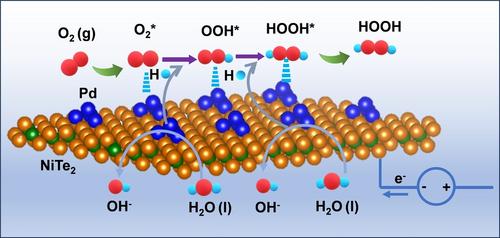
Electrosynthesis of H2O2 from oxygen reduction reaction via a two-electron pathway is vital as an alternative for the energy-intensive anthraquinone process. However, this process is largely hindered in neutral and alkaline conditions due to sluggish kinetics associated with the transformation of intermediate O2* into OOH* via proton-coupled electron transfer sourced from slow water dissociation. Herein, we developed Pd sub-nanoclusters on the nickel ditelluride nanosheets (Pd SNCs/NiTe2) to enhance the performance of H2O2 electrosynthesis. The newly-developed Pd SNCs/NiTe2 exhibited a H2O2 selectivity of as high as 99 % and a positive shift of onset potential up to 0.81 V. Combined theoretical calculations and experimental studies (e.g., X-ray absorption and attenuated total reflectance-Fourier transform infrared spectra measurements) revealed that the Pd sub-nanoclusters supported by NiTe2 nanosheets efficiently reduced the energy barrier of water dissociation to generate more protons, facilitating the proton feeding kinetics. When used in a flow cell, Pd SNCs/NiTe2 cathode efficiently produced H2O2 with a maximum yield rate of 1.75 mmol h−1 cm−2 and a current efficiency of 95 % at 100 mA cm−2. Further, an accumulated H2O2 concentration of 1.43 mol L−1 was reached after 10 hours of continuous electrolysis, showing the potential for practical H2O2 electrosynthesis.
期刊介绍:
Angewandte Chemie, a journal of the German Chemical Society (GDCh), maintains a leading position among scholarly journals in general chemistry with an impressive Impact Factor of 16.6 (2022 Journal Citation Reports, Clarivate, 2023). Published weekly in a reader-friendly format, it features new articles almost every day. Established in 1887, Angewandte Chemie is a prominent chemistry journal, offering a dynamic blend of Review-type articles, Highlights, Communications, and Research Articles on a weekly basis, making it unique in the field.




 京公网安备 11010802042870号
京ICP备2023020795号-1
京公网安备 11010802042870号
京ICP备2023020795号-1

 分享
分享
 求助内容:
求助内容: 应助结果提醒方式:
 扫码关注我们
