{"title":"在 Sillén-Aurivillius Hybrid Perovskites 中合成强制阳离子迁移可促进光催化氢气转化","authors":"Shubham Kumar, Jaideep Malik, Anil Kumar, Parul Yadav, Tapas Kumar Mandal","doi":"10.1021/acsaem.4c01669","DOIUrl":null,"url":null,"abstract":"Sillén–Aurivillius (S–A) hybrid layered perovskites constitute an important class of intergrowth compounds that have been recently demonstrated as high-performing semiconductor photocatalysts. The present study reports the synthesis of a series of three-layer S–A perovskites (A3X1 hybrids), Bi<sub>4</sub>AA′Ti<sub>2</sub>NbO<sub>14</sub>Cl (A, A′ = Sr and Ba), by an innovative approach involving interchange of Sr and Ba between the starting Sillén and Aurivillius blocks to examine the cation redistribution in the resulting intergrowth phases. Rietveld structure refinements reveal the preferred occupation of Sr in the perovskite block, while the larger Ba is grounded in the Sillén block. Due to cation migration between the fluorite-like [Bi<sub>2</sub>O<sub>2</sub>] layer and the perovskite block during intergrowth formation, the projected composition Bi<sub>4</sub>Ba<sub>[P]</sub>Sr<sub>[S]</sub>Ti<sub>2</sub>NbO<sub>14</sub>Cl (where [P] indicates the perovskite block, while [S] indicates the fluorite block) evolves into the phase with a mixed cation distribution, Bi<sub>4</sub>Ba<sub>0.1[P]</sub>Sr<sub>0.9[P]</sub>Ba<sub>0.9[S]</sub>Sr<sub>0.1[S]</sub>Ti<sub>2</sub>NbO<sub>14</sub>Cl. The cation migration appears to improve the packing by simultaneously reducing the height of the perovskite block and decreasing the divergence in the Bi–O bond lengths of the fluorite block simultaneously. This leads to greater mixing of Ti-3d, Nb-4d, and Bi6p states contributing near the conduction band minima. The cation-migrated S–A hybrid shows enhanced photocatalytic hydrogen evolution (PHE) as compared to the hybrid perovskites with nonmigrated or unmixed cation distribution. The present investigation discusses the innovative synthesis, cation migration, site disorder, and first-principles electronic structure calculations to unveil their role in enhanced PHE.","PeriodicalId":4,"journal":{"name":"ACS Applied Energy Materials","volume":"51 1","pages":""},"PeriodicalIF":5.5000,"publicationDate":"2024-09-11","publicationTypes":"Journal Article","fieldsOfStudy":null,"isOpenAccess":false,"openAccessPdf":"","citationCount":"0","resultStr":"{\"title\":\"Synthetically Enforced Cation Migration in Sillén–Aurivillius Hybrid Perovskites Boosts Photocatalytic Hydrogen Evolution\",\"authors\":\"Shubham Kumar, Jaideep Malik, Anil Kumar, Parul Yadav, Tapas Kumar Mandal\",\"doi\":\"10.1021/acsaem.4c01669\",\"DOIUrl\":null,\"url\":null,\"abstract\":\"Sillén–Aurivillius (S–A) hybrid layered perovskites constitute an important class of intergrowth compounds that have been recently demonstrated as high-performing semiconductor photocatalysts. The present study reports the synthesis of a series of three-layer S–A perovskites (A3X1 hybrids), Bi<sub>4</sub>AA′Ti<sub>2</sub>NbO<sub>14</sub>Cl (A, A′ = Sr and Ba), by an innovative approach involving interchange of Sr and Ba between the starting Sillén and Aurivillius blocks to examine the cation redistribution in the resulting intergrowth phases. Rietveld structure refinements reveal the preferred occupation of Sr in the perovskite block, while the larger Ba is grounded in the Sillén block. Due to cation migration between the fluorite-like [Bi<sub>2</sub>O<sub>2</sub>] layer and the perovskite block during intergrowth formation, the projected composition Bi<sub>4</sub>Ba<sub>[P]</sub>Sr<sub>[S]</sub>Ti<sub>2</sub>NbO<sub>14</sub>Cl (where [P] indicates the perovskite block, while [S] indicates the fluorite block) evolves into the phase with a mixed cation distribution, Bi<sub>4</sub>Ba<sub>0.1[P]</sub>Sr<sub>0.9[P]</sub>Ba<sub>0.9[S]</sub>Sr<sub>0.1[S]</sub>Ti<sub>2</sub>NbO<sub>14</sub>Cl. The cation migration appears to improve the packing by simultaneously reducing the height of the perovskite block and decreasing the divergence in the Bi–O bond lengths of the fluorite block simultaneously. This leads to greater mixing of Ti-3d, Nb-4d, and Bi6p states contributing near the conduction band minima. The cation-migrated S–A hybrid shows enhanced photocatalytic hydrogen evolution (PHE) as compared to the hybrid perovskites with nonmigrated or unmixed cation distribution. The present investigation discusses the innovative synthesis, cation migration, site disorder, and first-principles electronic structure calculations to unveil their role in enhanced PHE.\",\"PeriodicalId\":4,\"journal\":{\"name\":\"ACS Applied Energy Materials\",\"volume\":\"51 1\",\"pages\":\"\"},\"PeriodicalIF\":5.5000,\"publicationDate\":\"2024-09-11\",\"publicationTypes\":\"Journal Article\",\"fieldsOfStudy\":null,\"isOpenAccess\":false,\"openAccessPdf\":\"\",\"citationCount\":\"0\",\"resultStr\":null,\"platform\":\"Semanticscholar\",\"paperid\":null,\"PeriodicalName\":\"ACS Applied Energy Materials\",\"FirstCategoryId\":\"88\",\"ListUrlMain\":\"https://doi.org/10.1021/acsaem.4c01669\",\"RegionNum\":3,\"RegionCategory\":\"材料科学\",\"ArticlePicture\":[],\"TitleCN\":null,\"AbstractTextCN\":null,\"PMCID\":null,\"EPubDate\":\"\",\"PubModel\":\"\",\"JCR\":\"Q2\",\"JCRName\":\"CHEMISTRY, PHYSICAL\",\"Score\":null,\"Total\":0}","platform":"Semanticscholar","paperid":null,"PeriodicalName":"ACS Applied Energy Materials","FirstCategoryId":"88","ListUrlMain":"https://doi.org/10.1021/acsaem.4c01669","RegionNum":3,"RegionCategory":"材料科学","ArticlePicture":[],"TitleCN":null,"AbstractTextCN":null,"PMCID":null,"EPubDate":"","PubModel":"","JCR":"Q2","JCRName":"CHEMISTRY, PHYSICAL","Score":null,"Total":0}
引用次数: 0
摘要
Sillén-Aurivillius(S-A)杂化层状包晶石是一类重要的互生化合物,最近已被证明是高性能的半导体光催化剂。本研究报告了一系列三层 S-A 包晶石(A3X1 杂化物)Bi4AA′Ti2NbO14Cl(A,A′=Sr 和 Ba)的合成过程,采用了一种创新方法,即在起始的 Sillén 块和 Aurivillius 块之间交换 Sr 和 Ba,以研究由此产生的互生相中的阳离子再分布。里特维尔德结构细化结果表明,Sr 优先占据过氧化物晶块,而较大的 Ba 则立足于 Sillén 晶块。由于在互生形成过程中萤石状 [Bi2O2] 层和包晶块之间的阳离子迁移,投影成分 Bi4Ba[P]Sr[S]Ti2NbO14Cl(其中 [P] 表示包晶块,[S] 表示萤石块)演变成具有混合阳离子分布的相 Bi4Ba0.1[P]Sr0.9[P]Ba0.9[S]Sr0.1[S]Ti2NbO14Cl。阳离子迁移似乎通过同时降低包晶块的高度和减少萤石块的 Bi-O 键长度分歧来改善堆积。这导致在导带极小值附近的 Ti-3d、Nb-4d 和 Bi6p 状态的混合更多。与阳离子未迁移或未混合分布的混合包晶相比,阳离子迁移的 S-A 混合包晶显示出更强的光催化氢进化(PHE)能力。本研究讨论了创新合成、阳离子迁移、位错和第一原理电子结构计算,以揭示它们在增强光催化氢进化中的作用。
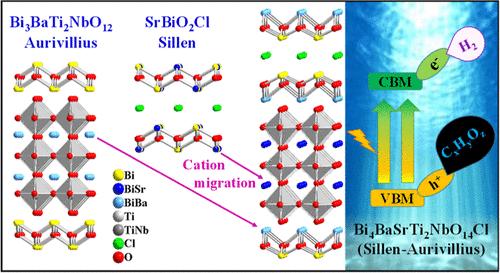
Sillén–Aurivillius (S–A) hybrid layered perovskites constitute an important class of intergrowth compounds that have been recently demonstrated as high-performing semiconductor photocatalysts. The present study reports the synthesis of a series of three-layer S–A perovskites (A3X1 hybrids), Bi4AA′Ti2NbO14Cl (A, A′ = Sr and Ba), by an innovative approach involving interchange of Sr and Ba between the starting Sillén and Aurivillius blocks to examine the cation redistribution in the resulting intergrowth phases. Rietveld structure refinements reveal the preferred occupation of Sr in the perovskite block, while the larger Ba is grounded in the Sillén block. Due to cation migration between the fluorite-like [Bi2O2] layer and the perovskite block during intergrowth formation, the projected composition Bi4Ba[P]Sr[S]Ti2NbO14Cl (where [P] indicates the perovskite block, while [S] indicates the fluorite block) evolves into the phase with a mixed cation distribution, Bi4Ba0.1[P]Sr0.9[P]Ba0.9[S]Sr0.1[S]Ti2NbO14Cl. The cation migration appears to improve the packing by simultaneously reducing the height of the perovskite block and decreasing the divergence in the Bi–O bond lengths of the fluorite block simultaneously. This leads to greater mixing of Ti-3d, Nb-4d, and Bi6p states contributing near the conduction band minima. The cation-migrated S–A hybrid shows enhanced photocatalytic hydrogen evolution (PHE) as compared to the hybrid perovskites with nonmigrated or unmixed cation distribution. The present investigation discusses the innovative synthesis, cation migration, site disorder, and first-principles electronic structure calculations to unveil their role in enhanced PHE.
期刊介绍:
ACS Applied Energy Materials is an interdisciplinary journal publishing original research covering all aspects of materials, engineering, chemistry, physics and biology relevant to energy conversion and storage. The journal is devoted to reports of new and original experimental and theoretical research of an applied nature that integrate knowledge in the areas of materials, engineering, physics, bioscience, and chemistry into important energy applications.




 京公网安备 11010802042870号
京ICP备2023020795号-1
京公网安备 11010802042870号
京ICP备2023020795号-1

 分享
分享
 求助内容:
求助内容: 应助结果提醒方式:
 扫码关注我们
