Kristen Alanis, Savannah A. Silva, Siddharth Singh, Kabin Lin, Tilman E. Schäffer, Ovuokenye Omadoko, John T. Fourkas, Lane A. Baker, Zuzanna S. Siwy
{"title":"单纳米孔中的手性电动现象","authors":"Kristen Alanis, Savannah A. Silva, Siddharth Singh, Kabin Lin, Tilman E. Schäffer, Ovuokenye Omadoko, John T. Fourkas, Lane A. Baker, Zuzanna S. Siwy","doi":"10.1002/elan.202400172","DOIUrl":null,"url":null,"abstract":"<p>The arrangement of solvent molecules and ions at solid–liquid interfaces determines electrochemical properties that are important in separations platforms, sensing technologies, and energy-storage systems. Here we show that single glass and polymer pores in contact with propylene carbonate (PC) solutions of LiClO<sub>4</sub> exhibit an effective surface potential that is modulated by the enantiomeric excess of the solvent. In particular, electrochemical and electrokinetic measurements of ionic transport through glass pipettes and polymer pores reveal that the effective surface potential is significantly lower in solutions prepared using enantiomerically pure PC than in solutions prepared using racemic PC. Both pore systems became positively charged in all racemic solutions examined in the range of LiClO<sub>4</sub> concentrations between 1 mM and 100 mM, whereas solutions in (<i>R</i>)-(+)-PC induced a positive surface potential only at concentrations above ~5 mM. The effective surface potential is quantified through asymmetry in current–voltage curves and zeta-potential measurements. Vibrational sum-frequency-generation experiments on LiClO<sub>4</sub> solutions in racemic and enantiomerically pure PC indicate that the surface lipid-bilayer-like region in the former is more strongly organized than in the latter, dictating the favorable positions for lithium and perchlorate ions in each case. The more ordered molecular packing in the racemic liquid leads to accumulation of lithium ions on the outside of the bilayer, creating a higher effective positive charge. Our results highlight the extreme sensitivity of the interfacial potential on molecular organization of the solvent, and the relatively unexplored role that chirality can play in electrokinetic phenomena.</p>","PeriodicalId":162,"journal":{"name":"Electroanalysis","volume":"37 1","pages":""},"PeriodicalIF":2.6000,"publicationDate":"2024-08-14","publicationTypes":"Journal Article","fieldsOfStudy":null,"isOpenAccess":false,"openAccessPdf":"https://onlinelibrary.wiley.com/doi/epdf/10.1002/elan.202400172","citationCount":"0","resultStr":"{\"title\":\"Chiral Electrokinetic Phenomena in Single Nanopores\",\"authors\":\"Kristen Alanis, Savannah A. Silva, Siddharth Singh, Kabin Lin, Tilman E. Schäffer, Ovuokenye Omadoko, John T. Fourkas, Lane A. Baker, Zuzanna S. Siwy\",\"doi\":\"10.1002/elan.202400172\",\"DOIUrl\":null,\"url\":null,\"abstract\":\"<p>The arrangement of solvent molecules and ions at solid–liquid interfaces determines electrochemical properties that are important in separations platforms, sensing technologies, and energy-storage systems. Here we show that single glass and polymer pores in contact with propylene carbonate (PC) solutions of LiClO<sub>4</sub> exhibit an effective surface potential that is modulated by the enantiomeric excess of the solvent. In particular, electrochemical and electrokinetic measurements of ionic transport through glass pipettes and polymer pores reveal that the effective surface potential is significantly lower in solutions prepared using enantiomerically pure PC than in solutions prepared using racemic PC. Both pore systems became positively charged in all racemic solutions examined in the range of LiClO<sub>4</sub> concentrations between 1 mM and 100 mM, whereas solutions in (<i>R</i>)-(+)-PC induced a positive surface potential only at concentrations above ~5 mM. The effective surface potential is quantified through asymmetry in current–voltage curves and zeta-potential measurements. Vibrational sum-frequency-generation experiments on LiClO<sub>4</sub> solutions in racemic and enantiomerically pure PC indicate that the surface lipid-bilayer-like region in the former is more strongly organized than in the latter, dictating the favorable positions for lithium and perchlorate ions in each case. The more ordered molecular packing in the racemic liquid leads to accumulation of lithium ions on the outside of the bilayer, creating a higher effective positive charge. Our results highlight the extreme sensitivity of the interfacial potential on molecular organization of the solvent, and the relatively unexplored role that chirality can play in electrokinetic phenomena.</p>\",\"PeriodicalId\":162,\"journal\":{\"name\":\"Electroanalysis\",\"volume\":\"37 1\",\"pages\":\"\"},\"PeriodicalIF\":2.6000,\"publicationDate\":\"2024-08-14\",\"publicationTypes\":\"Journal Article\",\"fieldsOfStudy\":null,\"isOpenAccess\":false,\"openAccessPdf\":\"https://onlinelibrary.wiley.com/doi/epdf/10.1002/elan.202400172\",\"citationCount\":\"0\",\"resultStr\":null,\"platform\":\"Semanticscholar\",\"paperid\":null,\"PeriodicalName\":\"Electroanalysis\",\"FirstCategoryId\":\"92\",\"ListUrlMain\":\"https://analyticalsciencejournals.onlinelibrary.wiley.com/doi/10.1002/elan.202400172\",\"RegionNum\":3,\"RegionCategory\":\"化学\",\"ArticlePicture\":[],\"TitleCN\":null,\"AbstractTextCN\":null,\"PMCID\":null,\"EPubDate\":\"\",\"PubModel\":\"\",\"JCR\":\"Q2\",\"JCRName\":\"CHEMISTRY, ANALYTICAL\",\"Score\":null,\"Total\":0}","platform":"Semanticscholar","paperid":null,"PeriodicalName":"Electroanalysis","FirstCategoryId":"92","ListUrlMain":"https://analyticalsciencejournals.onlinelibrary.wiley.com/doi/10.1002/elan.202400172","RegionNum":3,"RegionCategory":"化学","ArticlePicture":[],"TitleCN":null,"AbstractTextCN":null,"PMCID":null,"EPubDate":"","PubModel":"","JCR":"Q2","JCRName":"CHEMISTRY, ANALYTICAL","Score":null,"Total":0}
Chiral Electrokinetic Phenomena in Single Nanopores
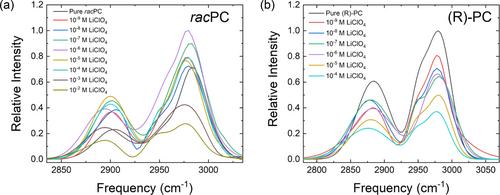
The arrangement of solvent molecules and ions at solid–liquid interfaces determines electrochemical properties that are important in separations platforms, sensing technologies, and energy-storage systems. Here we show that single glass and polymer pores in contact with propylene carbonate (PC) solutions of LiClO4 exhibit an effective surface potential that is modulated by the enantiomeric excess of the solvent. In particular, electrochemical and electrokinetic measurements of ionic transport through glass pipettes and polymer pores reveal that the effective surface potential is significantly lower in solutions prepared using enantiomerically pure PC than in solutions prepared using racemic PC. Both pore systems became positively charged in all racemic solutions examined in the range of LiClO4 concentrations between 1 mM and 100 mM, whereas solutions in (R)-(+)-PC induced a positive surface potential only at concentrations above ~5 mM. The effective surface potential is quantified through asymmetry in current–voltage curves and zeta-potential measurements. Vibrational sum-frequency-generation experiments on LiClO4 solutions in racemic and enantiomerically pure PC indicate that the surface lipid-bilayer-like region in the former is more strongly organized than in the latter, dictating the favorable positions for lithium and perchlorate ions in each case. The more ordered molecular packing in the racemic liquid leads to accumulation of lithium ions on the outside of the bilayer, creating a higher effective positive charge. Our results highlight the extreme sensitivity of the interfacial potential on molecular organization of the solvent, and the relatively unexplored role that chirality can play in electrokinetic phenomena.
期刊介绍:
Electroanalysis is an international, peer-reviewed journal covering all branches of electroanalytical chemistry, including both fundamental and application papers as well as reviews dealing with new electrochemical sensors and biosensors, nanobioelectronics devices, analytical voltammetry, potentiometry, new electrochemical detection schemes based on novel nanomaterials, fuel cells and biofuel cells, and important practical applications.
Serving as a vital communication link between the research labs and the field, Electroanalysis helps you to quickly adapt the latest innovations into practical clinical, environmental, food analysis, industrial and energy-related applications. Electroanalysis provides the most comprehensive coverage of the field and is the number one source for information on electroanalytical chemistry, electrochemical sensors and biosensors and fuel/biofuel cells.







 京公网安备 11010802042870号
京ICP备2023020795号-1
京公网安备 11010802042870号
京ICP备2023020795号-1

 分享
分享
 求助内容:
求助内容: 应助结果提醒方式:
 扫码关注我们
