Ignacio Cuevas, Kenza Elbouazzaoui, Mario Valvo, Jonas Mindemark, Daniel Brandell, Kristina Edström
{"title":"对 Li7La3Zr2O12 进行硼表面处理,为锂金属电池应用提供固体复合电解质","authors":"Ignacio Cuevas, Kenza Elbouazzaoui, Mario Valvo, Jonas Mindemark, Daniel Brandell, Kristina Edström","doi":"10.1002/cssc.202401304","DOIUrl":null,"url":null,"abstract":"<p>Despite being promoted as a superior Li-ion conductor, lithium lanthanum zirconium oxide (LLZO) still suffers from a number of shortcomings when employed as an active ceramic filler in composite polymer–ceramic solid electrolytes for rechargeable all-solid-state lithium metal batteries. One of the main limitations is the detrimental presence of Li<sub>2</sub>CO<sub>3</sub> on the surface of LLZO particles, restricting Li-ion transport at the polymer–ceramic interfaces. In this work, a facile way to improve this interface is presented, by purposely engineering the LLZO particle surfaces for a better compatibility with a PEO:LiTFSI solid polymer electrolyte matrix. It is shown that a surface treatment based on immersing LLZO particles in a boric acid solution can improve the LLZO surface chemistry, resulting in an enhancement in the ionic conductivity and cation transference number of the CPE with 20 wt % of boron-treated LLZO particles compared to the analogous CPE with non-treated LLZO. Ultimately, an improved cycling performance and stability in Li//LiFePO<sub>4</sub> cells was also demonstrated for the modified material.</p>","PeriodicalId":149,"journal":{"name":"ChemSusChem","volume":"18 3","pages":""},"PeriodicalIF":6.6000,"publicationDate":"2024-09-12","publicationTypes":"Journal Article","fieldsOfStudy":null,"isOpenAccess":false,"openAccessPdf":"https://onlinelibrary.wiley.com/doi/epdf/10.1002/cssc.202401304","citationCount":"0","resultStr":"{\"title\":\"Boron Surface Treatment of Li7La3Zr2O12 Enabling Solid Composite Electrolytes for Li-Metal Battery Applications\",\"authors\":\"Ignacio Cuevas, Kenza Elbouazzaoui, Mario Valvo, Jonas Mindemark, Daniel Brandell, Kristina Edström\",\"doi\":\"10.1002/cssc.202401304\",\"DOIUrl\":null,\"url\":null,\"abstract\":\"<p>Despite being promoted as a superior Li-ion conductor, lithium lanthanum zirconium oxide (LLZO) still suffers from a number of shortcomings when employed as an active ceramic filler in composite polymer–ceramic solid electrolytes for rechargeable all-solid-state lithium metal batteries. One of the main limitations is the detrimental presence of Li<sub>2</sub>CO<sub>3</sub> on the surface of LLZO particles, restricting Li-ion transport at the polymer–ceramic interfaces. In this work, a facile way to improve this interface is presented, by purposely engineering the LLZO particle surfaces for a better compatibility with a PEO:LiTFSI solid polymer electrolyte matrix. It is shown that a surface treatment based on immersing LLZO particles in a boric acid solution can improve the LLZO surface chemistry, resulting in an enhancement in the ionic conductivity and cation transference number of the CPE with 20 wt % of boron-treated LLZO particles compared to the analogous CPE with non-treated LLZO. Ultimately, an improved cycling performance and stability in Li//LiFePO<sub>4</sub> cells was also demonstrated for the modified material.</p>\",\"PeriodicalId\":149,\"journal\":{\"name\":\"ChemSusChem\",\"volume\":\"18 3\",\"pages\":\"\"},\"PeriodicalIF\":6.6000,\"publicationDate\":\"2024-09-12\",\"publicationTypes\":\"Journal Article\",\"fieldsOfStudy\":null,\"isOpenAccess\":false,\"openAccessPdf\":\"https://onlinelibrary.wiley.com/doi/epdf/10.1002/cssc.202401304\",\"citationCount\":\"0\",\"resultStr\":null,\"platform\":\"Semanticscholar\",\"paperid\":null,\"PeriodicalName\":\"ChemSusChem\",\"FirstCategoryId\":\"92\",\"ListUrlMain\":\"https://chemistry-europe.onlinelibrary.wiley.com/doi/10.1002/cssc.202401304\",\"RegionNum\":2,\"RegionCategory\":\"化学\",\"ArticlePicture\":[],\"TitleCN\":null,\"AbstractTextCN\":null,\"PMCID\":null,\"EPubDate\":\"\",\"PubModel\":\"\",\"JCR\":\"Q1\",\"JCRName\":\"CHEMISTRY, MULTIDISCIPLINARY\",\"Score\":null,\"Total\":0}","platform":"Semanticscholar","paperid":null,"PeriodicalName":"ChemSusChem","FirstCategoryId":"92","ListUrlMain":"https://chemistry-europe.onlinelibrary.wiley.com/doi/10.1002/cssc.202401304","RegionNum":2,"RegionCategory":"化学","ArticlePicture":[],"TitleCN":null,"AbstractTextCN":null,"PMCID":null,"EPubDate":"","PubModel":"","JCR":"Q1","JCRName":"CHEMISTRY, MULTIDISCIPLINARY","Score":null,"Total":0}
Boron Surface Treatment of Li7La3Zr2O12 Enabling Solid Composite Electrolytes for Li-Metal Battery Applications
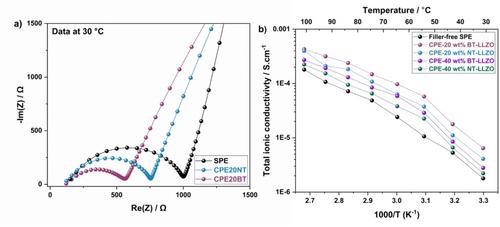
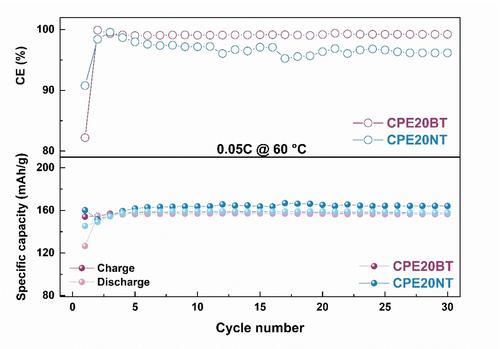
Despite being promoted as a superior Li-ion conductor, lithium lanthanum zirconium oxide (LLZO) still suffers from a number of shortcomings when employed as an active ceramic filler in composite polymer–ceramic solid electrolytes for rechargeable all-solid-state lithium metal batteries. One of the main limitations is the detrimental presence of Li2CO3 on the surface of LLZO particles, restricting Li-ion transport at the polymer–ceramic interfaces. In this work, a facile way to improve this interface is presented, by purposely engineering the LLZO particle surfaces for a better compatibility with a PEO:LiTFSI solid polymer electrolyte matrix. It is shown that a surface treatment based on immersing LLZO particles in a boric acid solution can improve the LLZO surface chemistry, resulting in an enhancement in the ionic conductivity and cation transference number of the CPE with 20 wt % of boron-treated LLZO particles compared to the analogous CPE with non-treated LLZO. Ultimately, an improved cycling performance and stability in Li//LiFePO4 cells was also demonstrated for the modified material.
期刊介绍:
ChemSusChem
Impact Factor (2016): 7.226
Scope:
Interdisciplinary journal
Focuses on research at the interface of chemistry and sustainability
Features the best research on sustainability and energy
Areas Covered:
Chemistry
Materials Science
Chemical Engineering
Biotechnology





 京公网安备 11010802042870号
京ICP备2023020795号-1
京公网安备 11010802042870号
京ICP备2023020795号-1

 分享
分享
 求助内容:
求助内容: 应助结果提醒方式:
 扫码关注我们
