Qiang Zhu, Jean-Luc Chaubard, Didi Geng, Jiechen Shen, Lan Ban, Sheldon T. Cheung, Fangyu Wei, Yating Liu, Haofan Sun, Angie Calderon, Wenbo Dong, Weijie Qin, Tiehai Li, Liuqing Wen, Peng George Wang, Shisheng Sun, Wen Yi, Linda C. Hsieh-Wilson
{"title":"活细胞中核心岩藻糖基化的化学酶标记、检测和剖析","authors":"Qiang Zhu, Jean-Luc Chaubard, Didi Geng, Jiechen Shen, Lan Ban, Sheldon T. Cheung, Fangyu Wei, Yating Liu, Haofan Sun, Angie Calderon, Wenbo Dong, Weijie Qin, Tiehai Li, Liuqing Wen, Peng George Wang, Shisheng Sun, Wen Yi, Linda C. Hsieh-Wilson","doi":"10.1021/jacs.4c09303","DOIUrl":null,"url":null,"abstract":"Core fucosylation, the attachment of an α-1,6-linked-fucose to the N-glycan core pentasaccharide, is an abundant protein modification that plays critical roles in various biological processes such as cell signaling, B cell development, antibody-dependent cellular cytotoxicity, and oncogenesis. However, the tools currently used to detect core fucosylation suffer from poor specificity, exhibiting cross-reactivity against all types of fucosylation. Herein we report the development of a new chemoenzymatic strategy for the rapid and selective detection of core fucosylated glycans. This approach employs a galactosyltransferase enzyme identified from<i>Caenorhabditis elegans</i>that specifically transfers an azido-appended galactose residue onto core fucose via a β-1,4 glycosidic linkage. We demonstrate that the approach exhibits superior specificity toward core fucose on a variety of complex N-glycans. The method enables detection of core fucosylated glycoproteins from complex cell lysates, as well as on live cell surfaces, and it can be integrated into a diagnostic platform to profile protein-specific core fucosylation levels. This chemoenzymatic labeling approach offers a new strategy for the identification of disease biomarkers and will allow researchers to further characterize the fundamental role of this important glycan in normal and disease physiology.","PeriodicalId":49,"journal":{"name":"Journal of the American Chemical Society","volume":"8 1","pages":""},"PeriodicalIF":15.6000,"publicationDate":"2024-09-16","publicationTypes":"Journal Article","fieldsOfStudy":null,"isOpenAccess":false,"openAccessPdf":"","citationCount":"0","resultStr":"{\"title\":\"Chemoenzymatic Labeling, Detection and Profiling of Core Fucosylation in Live Cells\",\"authors\":\"Qiang Zhu, Jean-Luc Chaubard, Didi Geng, Jiechen Shen, Lan Ban, Sheldon T. Cheung, Fangyu Wei, Yating Liu, Haofan Sun, Angie Calderon, Wenbo Dong, Weijie Qin, Tiehai Li, Liuqing Wen, Peng George Wang, Shisheng Sun, Wen Yi, Linda C. Hsieh-Wilson\",\"doi\":\"10.1021/jacs.4c09303\",\"DOIUrl\":null,\"url\":null,\"abstract\":\"Core fucosylation, the attachment of an α-1,6-linked-fucose to the N-glycan core pentasaccharide, is an abundant protein modification that plays critical roles in various biological processes such as cell signaling, B cell development, antibody-dependent cellular cytotoxicity, and oncogenesis. However, the tools currently used to detect core fucosylation suffer from poor specificity, exhibiting cross-reactivity against all types of fucosylation. Herein we report the development of a new chemoenzymatic strategy for the rapid and selective detection of core fucosylated glycans. This approach employs a galactosyltransferase enzyme identified from<i>Caenorhabditis elegans</i>that specifically transfers an azido-appended galactose residue onto core fucose via a β-1,4 glycosidic linkage. We demonstrate that the approach exhibits superior specificity toward core fucose on a variety of complex N-glycans. The method enables detection of core fucosylated glycoproteins from complex cell lysates, as well as on live cell surfaces, and it can be integrated into a diagnostic platform to profile protein-specific core fucosylation levels. This chemoenzymatic labeling approach offers a new strategy for the identification of disease biomarkers and will allow researchers to further characterize the fundamental role of this important glycan in normal and disease physiology.\",\"PeriodicalId\":49,\"journal\":{\"name\":\"Journal of the American Chemical Society\",\"volume\":\"8 1\",\"pages\":\"\"},\"PeriodicalIF\":15.6000,\"publicationDate\":\"2024-09-16\",\"publicationTypes\":\"Journal Article\",\"fieldsOfStudy\":null,\"isOpenAccess\":false,\"openAccessPdf\":\"\",\"citationCount\":\"0\",\"resultStr\":null,\"platform\":\"Semanticscholar\",\"paperid\":null,\"PeriodicalName\":\"Journal of the American Chemical Society\",\"FirstCategoryId\":\"92\",\"ListUrlMain\":\"https://doi.org/10.1021/jacs.4c09303\",\"RegionNum\":1,\"RegionCategory\":\"化学\",\"ArticlePicture\":[],\"TitleCN\":null,\"AbstractTextCN\":null,\"PMCID\":null,\"EPubDate\":\"\",\"PubModel\":\"\",\"JCR\":\"Q1\",\"JCRName\":\"CHEMISTRY, MULTIDISCIPLINARY\",\"Score\":null,\"Total\":0}","platform":"Semanticscholar","paperid":null,"PeriodicalName":"Journal of the American Chemical Society","FirstCategoryId":"92","ListUrlMain":"https://doi.org/10.1021/jacs.4c09303","RegionNum":1,"RegionCategory":"化学","ArticlePicture":[],"TitleCN":null,"AbstractTextCN":null,"PMCID":null,"EPubDate":"","PubModel":"","JCR":"Q1","JCRName":"CHEMISTRY, MULTIDISCIPLINARY","Score":null,"Total":0}
Chemoenzymatic Labeling, Detection and Profiling of Core Fucosylation in Live Cells
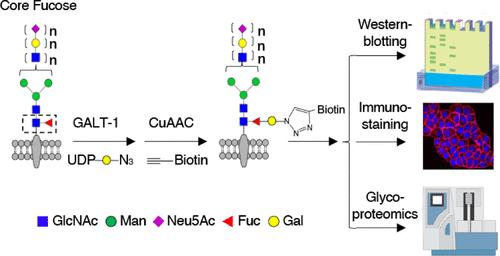
Core fucosylation, the attachment of an α-1,6-linked-fucose to the N-glycan core pentasaccharide, is an abundant protein modification that plays critical roles in various biological processes such as cell signaling, B cell development, antibody-dependent cellular cytotoxicity, and oncogenesis. However, the tools currently used to detect core fucosylation suffer from poor specificity, exhibiting cross-reactivity against all types of fucosylation. Herein we report the development of a new chemoenzymatic strategy for the rapid and selective detection of core fucosylated glycans. This approach employs a galactosyltransferase enzyme identified fromCaenorhabditis elegansthat specifically transfers an azido-appended galactose residue onto core fucose via a β-1,4 glycosidic linkage. We demonstrate that the approach exhibits superior specificity toward core fucose on a variety of complex N-glycans. The method enables detection of core fucosylated glycoproteins from complex cell lysates, as well as on live cell surfaces, and it can be integrated into a diagnostic platform to profile protein-specific core fucosylation levels. This chemoenzymatic labeling approach offers a new strategy for the identification of disease biomarkers and will allow researchers to further characterize the fundamental role of this important glycan in normal and disease physiology.
期刊介绍:
The flagship journal of the American Chemical Society, known as the Journal of the American Chemical Society (JACS), has been a prestigious publication since its establishment in 1879. It holds a preeminent position in the field of chemistry and related interdisciplinary sciences. JACS is committed to disseminating cutting-edge research papers, covering a wide range of topics, and encompasses approximately 19,000 pages of Articles, Communications, and Perspectives annually. With a weekly publication frequency, JACS plays a vital role in advancing the field of chemistry by providing essential research.




 京公网安备 11010802042870号
京ICP备2023020795号-1
京公网安备 11010802042870号
京ICP备2023020795号-1

 分享
分享
 求助内容:
求助内容: 应助结果提醒方式:
 扫码关注我们
