Jiaying Lu, Jing Wang, Jie Wu, Huiwei Zhang, Xiaoxi Ma, Yuhua Zhu, Jie Wang, Yunhao Yang, Zhenxu Xiao, Ming Li, Xiaowen Zhou, Zizhao Ju, Qian Xu, Jingjie Ge, Ding Ding, Tzu-Chen Yen, Chuantao Zuo, Yihui Guan, Qianhua Zhao, the Shanghai Memory Study (SMS)
{"title":"在一家三级记忆诊所试行阿尔茨海默氏症协会工作组修订的阿尔茨海默氏症分期标准","authors":"Jiaying Lu, Jing Wang, Jie Wu, Huiwei Zhang, Xiaoxi Ma, Yuhua Zhu, Jie Wang, Yunhao Yang, Zhenxu Xiao, Ming Li, Xiaowen Zhou, Zizhao Ju, Qian Xu, Jingjie Ge, Ding Ding, Tzu-Chen Yen, Chuantao Zuo, Yihui Guan, Qianhua Zhao, the Shanghai Memory Study (SMS)","doi":"10.1002/alz.14245","DOIUrl":null,"url":null,"abstract":"<div>\n \n \n <section>\n \n <h3> INTRODUCTION</h3>\n \n <p>We aimed to evaluate the feasibility of the 2024 Alzheimer's Association Workgroup's integrated clinical-biological staging scheme in outpatient settings within a tertiary memory clinic.</p>\n </section>\n \n <section>\n \n <h3> METHODS</h3>\n \n <p>The 2018 syndromal cognitive staging system, coupled with a binary biomarker classification, was implemented for 236 outpatients with cognitive concerns. The 2024 numeric clinical staging framework, incorporating biomarker staging, was specifically applied to 154 individuals within the Alzheimer's disease (AD) continuum.</p>\n </section>\n \n <section>\n \n <h3> RESULTS</h3>\n \n <p>The 2024 staging scheme accurately classified 95.5% AD. Among these, 56.5% exhibited concordant clinical and biological stages (canonical), 34.7% demonstrated more advanced clinical stages than biologically expected (susceptible), and 8.8% displayed the inverse pattern (resilient). The susceptible group was characterized by a higher burden of neurodegeneration and inflammation than anticipated from tau, whereas the resilient group showed the opposite.</p>\n </section>\n \n <section>\n \n <h3> DISCUSSION</h3>\n \n <p>The 2024 staging scheme is generally feasible. A discrepancy between clinical and biological stages is relatively frequent among symptomatic patients with AD.</p>\n </section>\n \n <section>\n \n <h3> Highlights</h3>\n \n <div>\n <ul>\n \n <li>The 2024 AA staging scheme is generally feasible in a tertiary memory clinic.</li>\n \n <li>A discrepancy between clinical and biological stages is relatively frequent in AD.</li>\n \n <li>The mismatch may be influenced by a non-specific pathological process involved in AD.</li>\n \n <li>Individual profiles like aging and lifestyles may contribute to such a mismatch.</li>\n \n <li>Matched and mismatched cases converge toward similar clinical outcomes.</li>\n </ul>\n </div>\n </section>\n </div>","PeriodicalId":7471,"journal":{"name":"Alzheimer's & Dementia","volume":"20 11","pages":"7831-7846"},"PeriodicalIF":11.1000,"publicationDate":"2024-09-17","publicationTypes":"Journal Article","fieldsOfStudy":null,"isOpenAccess":false,"openAccessPdf":"https://onlinelibrary.wiley.com/doi/epdf/10.1002/alz.14245","citationCount":"0","resultStr":"{\"title\":\"Pilot implementation of the revised criteria for staging of Alzheimer's disease by the Alzheimer's Association Workgroup in a tertiary memory clinic\",\"authors\":\"Jiaying Lu, Jing Wang, Jie Wu, Huiwei Zhang, Xiaoxi Ma, Yuhua Zhu, Jie Wang, Yunhao Yang, Zhenxu Xiao, Ming Li, Xiaowen Zhou, Zizhao Ju, Qian Xu, Jingjie Ge, Ding Ding, Tzu-Chen Yen, Chuantao Zuo, Yihui Guan, Qianhua Zhao, the Shanghai Memory Study (SMS)\",\"doi\":\"10.1002/alz.14245\",\"DOIUrl\":null,\"url\":null,\"abstract\":\"<div>\\n \\n \\n <section>\\n \\n <h3> INTRODUCTION</h3>\\n \\n <p>We aimed to evaluate the feasibility of the 2024 Alzheimer's Association Workgroup's integrated clinical-biological staging scheme in outpatient settings within a tertiary memory clinic.</p>\\n </section>\\n \\n <section>\\n \\n <h3> METHODS</h3>\\n \\n <p>The 2018 syndromal cognitive staging system, coupled with a binary biomarker classification, was implemented for 236 outpatients with cognitive concerns. The 2024 numeric clinical staging framework, incorporating biomarker staging, was specifically applied to 154 individuals within the Alzheimer's disease (AD) continuum.</p>\\n </section>\\n \\n <section>\\n \\n <h3> RESULTS</h3>\\n \\n <p>The 2024 staging scheme accurately classified 95.5% AD. Among these, 56.5% exhibited concordant clinical and biological stages (canonical), 34.7% demonstrated more advanced clinical stages than biologically expected (susceptible), and 8.8% displayed the inverse pattern (resilient). The susceptible group was characterized by a higher burden of neurodegeneration and inflammation than anticipated from tau, whereas the resilient group showed the opposite.</p>\\n </section>\\n \\n <section>\\n \\n <h3> DISCUSSION</h3>\\n \\n <p>The 2024 staging scheme is generally feasible. A discrepancy between clinical and biological stages is relatively frequent among symptomatic patients with AD.</p>\\n </section>\\n \\n <section>\\n \\n <h3> Highlights</h3>\\n \\n <div>\\n <ul>\\n \\n <li>The 2024 AA staging scheme is generally feasible in a tertiary memory clinic.</li>\\n \\n <li>A discrepancy between clinical and biological stages is relatively frequent in AD.</li>\\n \\n <li>The mismatch may be influenced by a non-specific pathological process involved in AD.</li>\\n \\n <li>Individual profiles like aging and lifestyles may contribute to such a mismatch.</li>\\n \\n <li>Matched and mismatched cases converge toward similar clinical outcomes.</li>\\n </ul>\\n </div>\\n </section>\\n </div>\",\"PeriodicalId\":7471,\"journal\":{\"name\":\"Alzheimer's & Dementia\",\"volume\":\"20 11\",\"pages\":\"7831-7846\"},\"PeriodicalIF\":11.1000,\"publicationDate\":\"2024-09-17\",\"publicationTypes\":\"Journal Article\",\"fieldsOfStudy\":null,\"isOpenAccess\":false,\"openAccessPdf\":\"https://onlinelibrary.wiley.com/doi/epdf/10.1002/alz.14245\",\"citationCount\":\"0\",\"resultStr\":null,\"platform\":\"Semanticscholar\",\"paperid\":null,\"PeriodicalName\":\"Alzheimer's & Dementia\",\"FirstCategoryId\":\"3\",\"ListUrlMain\":\"https://alz-journals.onlinelibrary.wiley.com/doi/10.1002/alz.14245\",\"RegionNum\":1,\"RegionCategory\":\"医学\",\"ArticlePicture\":[],\"TitleCN\":null,\"AbstractTextCN\":null,\"PMCID\":null,\"EPubDate\":\"\",\"PubModel\":\"\",\"JCR\":\"Q1\",\"JCRName\":\"CLINICAL NEUROLOGY\",\"Score\":null,\"Total\":0}","platform":"Semanticscholar","paperid":null,"PeriodicalName":"Alzheimer's & Dementia","FirstCategoryId":"3","ListUrlMain":"https://alz-journals.onlinelibrary.wiley.com/doi/10.1002/alz.14245","RegionNum":1,"RegionCategory":"医学","ArticlePicture":[],"TitleCN":null,"AbstractTextCN":null,"PMCID":null,"EPubDate":"","PubModel":"","JCR":"Q1","JCRName":"CLINICAL NEUROLOGY","Score":null,"Total":0}
Pilot implementation of the revised criteria for staging of Alzheimer's disease by the Alzheimer's Association Workgroup in a tertiary memory clinic
INTRODUCTION
We aimed to evaluate the feasibility of the 2024 Alzheimer's Association Workgroup's integrated clinical-biological staging scheme in outpatient settings within a tertiary memory clinic.
METHODS
The 2018 syndromal cognitive staging system, coupled with a binary biomarker classification, was implemented for 236 outpatients with cognitive concerns. The 2024 numeric clinical staging framework, incorporating biomarker staging, was specifically applied to 154 individuals within the Alzheimer's disease (AD) continuum.
RESULTS
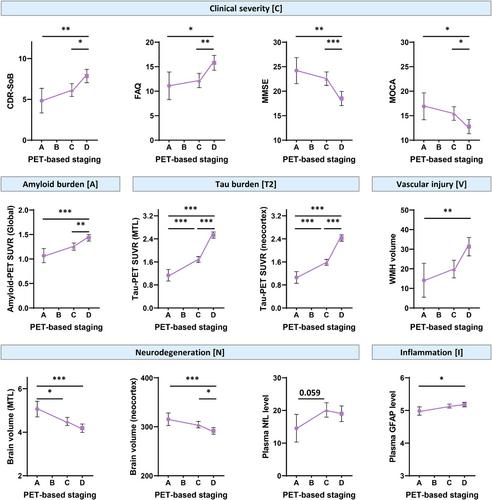
The 2024 staging scheme accurately classified 95.5% AD. Among these, 56.5% exhibited concordant clinical and biological stages (canonical), 34.7% demonstrated more advanced clinical stages than biologically expected (susceptible), and 8.8% displayed the inverse pattern (resilient). The susceptible group was characterized by a higher burden of neurodegeneration and inflammation than anticipated from tau, whereas the resilient group showed the opposite.
DISCUSSION
The 2024 staging scheme is generally feasible. A discrepancy between clinical and biological stages is relatively frequent among symptomatic patients with AD.
Highlights
The 2024 AA staging scheme is generally feasible in a tertiary memory clinic.
A discrepancy between clinical and biological stages is relatively frequent in AD.
The mismatch may be influenced by a non-specific pathological process involved in AD.
Individual profiles like aging and lifestyles may contribute to such a mismatch.
Matched and mismatched cases converge toward similar clinical outcomes.
期刊介绍:
Alzheimer's & Dementia is a peer-reviewed journal that aims to bridge knowledge gaps in dementia research by covering the entire spectrum, from basic science to clinical trials to social and behavioral investigations. It provides a platform for rapid communication of new findings and ideas, optimal translation of research into practical applications, increasing knowledge across diverse disciplines for early detection, diagnosis, and intervention, and identifying promising new research directions. In July 2008, Alzheimer's & Dementia was accepted for indexing by MEDLINE, recognizing its scientific merit and contribution to Alzheimer's research.





 京公网安备 11010802042870号
京ICP备2023020795号-1
京公网安备 11010802042870号
京ICP备2023020795号-1

 分享
分享
 求助内容:
求助内容: 应助结果提醒方式:
 扫码关注我们
