Improving UASS pesticide application: optimizing and validating drift and deposition simulations
BACKGROUND
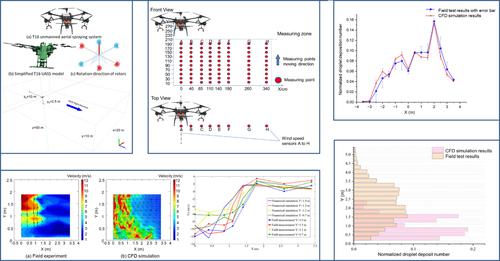
As unmanned aerial spraying systems (UASS) usage grows rapidly worldwide, a critical research study was conducted to optimize the simulation of UASS applications, aiming to enhance pesticide delivery efficiency and reduce environmental impact. The study examined several key aspects for accurate simulation of UASS application with lattice Boltzmann method (LBM). Based on these discussions, the most suitable grid size and simulation parameters were selected to create a robust model for optimizing UASS performance in various pest management scenarios, potentially leading to more targeted and sustainable pest control practices.
RESULTS
The effect of stability parameter, grid size around the rotor and near ground, and parameters at wake flow were carefully analyzed to improve the precision of pesticide drift predictions and deposition patterns. Optimal grid sizes were identified as 0.2 m generally, 0.025 m near rotors, and a 0.1 + 0.2 m scheme for ground proximity, with finer grids improving accuracy but increasing computation time. Wake resolution and threshold significantly influenced simulation results, while wake distance had minimal impact beyond a certain point. The LBM's accuracy was validated by comparing simulated downwash flow and droplet deposition with field test data.
期刊介绍:
Pest Management Science is the international journal of research and development in crop protection and pest control. Since its launch in 1970, the journal has become the premier forum for papers on the discovery, application, and impact on the environment of products and strategies designed for pest management.
Published for SCI by John Wiley & Sons Ltd.




 京公网安备 11010802042870号
京ICP备2023020795号-1
京公网安备 11010802042870号
京ICP备2023020795号-1

 分享
分享
 求助内容:
求助内容: 应助结果提醒方式:
 扫码关注我们
