{"title":"促进氧化亚铁预测:利用基于正交基的隐式子空间识别进行烧结预测","authors":"Shaoqi Wang;Chunjie Yang;Siwei Lou","doi":"10.1109/TII.2024.3431087","DOIUrl":null,"url":null,"abstract":"Sintering, as a preliminary step in the blast furnace, has a profound influence on the ultimate quality of the iron product. Accurate forecasting of the chemical composition during sintering operations has become crucial to facilitate the production of higher quality inputs for downstream processes. However, modeling sintering is complex due to its long timescales, multistage transfers, and intricate redox reactions. To address this, a novel regression neural network based on orthogonal basis decomposition and reconstruction with implicit subspace identification is proposed. First, a recursive Fourier-transform-like enoding block is implemented to extract feature capturing long-term memory via orthogonal basis decomposition. Subsequently, an stochastic-gradient-based identification algorithm is used to approximate the ground truth system and model the output. The feasibility and utility of the approach are demonstrated using simulated and real-world sintering plant data. Considering encoding and identification separately offers deeper insights into sintering processes, resulting in enhanced explicability of model behaviors and a significant improvement of 22.15% loss reduction in forecasting performance.","PeriodicalId":13301,"journal":{"name":"IEEE Transactions on Industrial Informatics","volume":"21 1","pages":"96-106"},"PeriodicalIF":9.9000,"publicationDate":"2024-09-17","publicationTypes":"Journal Article","fieldsOfStudy":null,"isOpenAccess":false,"openAccessPdf":"","citationCount":"0","resultStr":"{\"title\":\"Facilitating Ferrous Oxide Prediction: Enabling Sintering Forecasting With Orthogonal Basis-Based Implicit Subspace Identification\",\"authors\":\"Shaoqi Wang;Chunjie Yang;Siwei Lou\",\"doi\":\"10.1109/TII.2024.3431087\",\"DOIUrl\":null,\"url\":null,\"abstract\":\"Sintering, as a preliminary step in the blast furnace, has a profound influence on the ultimate quality of the iron product. Accurate forecasting of the chemical composition during sintering operations has become crucial to facilitate the production of higher quality inputs for downstream processes. However, modeling sintering is complex due to its long timescales, multistage transfers, and intricate redox reactions. To address this, a novel regression neural network based on orthogonal basis decomposition and reconstruction with implicit subspace identification is proposed. First, a recursive Fourier-transform-like enoding block is implemented to extract feature capturing long-term memory via orthogonal basis decomposition. Subsequently, an stochastic-gradient-based identification algorithm is used to approximate the ground truth system and model the output. The feasibility and utility of the approach are demonstrated using simulated and real-world sintering plant data. Considering encoding and identification separately offers deeper insights into sintering processes, resulting in enhanced explicability of model behaviors and a significant improvement of 22.15% loss reduction in forecasting performance.\",\"PeriodicalId\":13301,\"journal\":{\"name\":\"IEEE Transactions on Industrial Informatics\",\"volume\":\"21 1\",\"pages\":\"96-106\"},\"PeriodicalIF\":9.9000,\"publicationDate\":\"2024-09-17\",\"publicationTypes\":\"Journal Article\",\"fieldsOfStudy\":null,\"isOpenAccess\":false,\"openAccessPdf\":\"\",\"citationCount\":\"0\",\"resultStr\":null,\"platform\":\"Semanticscholar\",\"paperid\":null,\"PeriodicalName\":\"IEEE Transactions on Industrial Informatics\",\"FirstCategoryId\":\"94\",\"ListUrlMain\":\"https://ieeexplore.ieee.org/document/10682106/\",\"RegionNum\":1,\"RegionCategory\":\"计算机科学\",\"ArticlePicture\":[],\"TitleCN\":null,\"AbstractTextCN\":null,\"PMCID\":null,\"EPubDate\":\"\",\"PubModel\":\"\",\"JCR\":\"Q1\",\"JCRName\":\"AUTOMATION & CONTROL SYSTEMS\",\"Score\":null,\"Total\":0}","platform":"Semanticscholar","paperid":null,"PeriodicalName":"IEEE Transactions on Industrial Informatics","FirstCategoryId":"94","ListUrlMain":"https://ieeexplore.ieee.org/document/10682106/","RegionNum":1,"RegionCategory":"计算机科学","ArticlePicture":[],"TitleCN":null,"AbstractTextCN":null,"PMCID":null,"EPubDate":"","PubModel":"","JCR":"Q1","JCRName":"AUTOMATION & CONTROL SYSTEMS","Score":null,"Total":0}
Sintering, as a preliminary step in the blast furnace, has a profound influence on the ultimate quality of the iron product. Accurate forecasting of the chemical composition during sintering operations has become crucial to facilitate the production of higher quality inputs for downstream processes. However, modeling sintering is complex due to its long timescales, multistage transfers, and intricate redox reactions. To address this, a novel regression neural network based on orthogonal basis decomposition and reconstruction with implicit subspace identification is proposed. First, a recursive Fourier-transform-like enoding block is implemented to extract feature capturing long-term memory via orthogonal basis decomposition. Subsequently, an stochastic-gradient-based identification algorithm is used to approximate the ground truth system and model the output. The feasibility and utility of the approach are demonstrated using simulated and real-world sintering plant data. Considering encoding and identification separately offers deeper insights into sintering processes, resulting in enhanced explicability of model behaviors and a significant improvement of 22.15% loss reduction in forecasting performance.
期刊介绍:
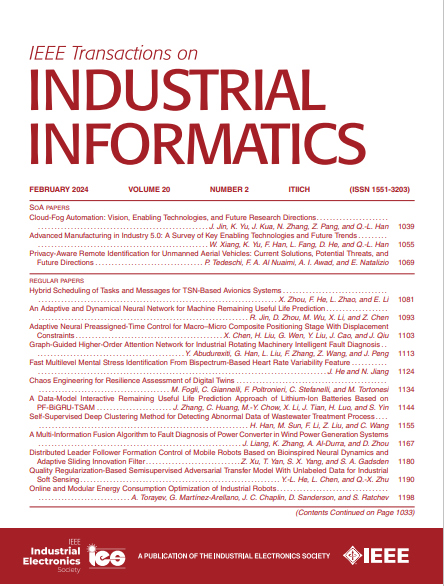
The IEEE Transactions on Industrial Informatics is a multidisciplinary journal dedicated to publishing technical papers that connect theory with practical applications of informatics in industrial settings. It focuses on the utilization of information in intelligent, distributed, and agile industrial automation and control systems. The scope includes topics such as knowledge-based and AI-enhanced automation, intelligent computer control systems, flexible and collaborative manufacturing, industrial informatics in software-defined vehicles and robotics, computer vision, industrial cyber-physical and industrial IoT systems, real-time and networked embedded systems, security in industrial processes, industrial communications, systems interoperability, and human-machine interaction.




 京公网安备 11010802042870号
京ICP备2023020795号-1
京公网安备 11010802042870号
京ICP备2023020795号-1

 分享
分享
 求助内容:
求助内容: 应助结果提醒方式:
 扫码关注我们
