Tomohiro Katsuki, Zaki N. Zahran, Norihisa Hoshino, Yuta Tsubonouchi, Debraj Chandra and Masayuki Yagi
{"title":"一种异向结晶和掺氮的 CuWO4 光阳极,用于高效、稳健的可见光驱动水氧化","authors":"Tomohiro Katsuki, Zaki N. Zahran, Norihisa Hoshino, Yuta Tsubonouchi, Debraj Chandra and Masayuki Yagi","doi":"10.1039/D4TA04120H","DOIUrl":null,"url":null,"abstract":"<p >In this work, a nitrogen-doped CuWO<small><sub>4</sub></small> (N-CuWO<small><sub>4</sub></small>) photoanode for photoelectrochemical (PEC) water oxidation was synthesized by a mixed metal-imidazole casting (MiMIC) method with 1-butylimidazole (BIm). The N-CuWO<small><sub>4</sub></small> electrode achieved PEC water oxidation at a wavelength of 540 nm that is longer than that of the film (neat-CuWO<small><sub>4</sub></small>) prepared without BIm by 40 nm due to the N-doping, which was conscientiously characterized by spectroscopic and theoretical investigations. The N-CuWO<small><sub>4</sub></small> surface was compactly covered with worm-like particles of 100–500 nm diameter, which is responsible for the rigid adherence of the N-CuWO<small><sub>4</sub></small> film onto the substrate. The N-CuWO<small><sub>4</sub></small> film showed anisotropic crystallization of triclinic CuWO<small><sub>4</sub></small> with predominant growth of the (010) and (100) planes, in contrast to the isotropic crystallization observed for the neat-CuWO<small><sub>4</sub></small> film. The N-CuWO<small><sub>4</sub></small> electrode demonstrated superior performance for PEC water oxidation with an incident photon-to-electron conversion efficiency (IPCE) of 5.6% contributed by a charge separation efficiency (<em>η</em><small><sub>sep</sub></small>) of 12.3% and a catalytic efficiency (<em>η</em><small><sub>cat</sub></small>) of 51.9% (at 420 nm and 1.23 V), a faradaic efficiency (FE<small><sub>O<small><sub>2</sub></small></sub></small>) of 97% for O<small><sub>2</sub></small> evolution, and considerable stability for 40 h, which are advantageously comparable to those of the state-of-the-art CuWO<small><sub>4</sub></small>-based photoanodes. The water oxidation rate constant (<em>k</em><small><sub>O<small><sub>2</sub></small></sub></small> = 1.6 × 10<small><sup>2</sup></small> s<small><sup>−1</sup></small>) at the surface for the N-CuWO<small><sub>4</sub></small> electrode was higher than that (6.8 s<small><sup>−1</sup></small>) for the neat-CuWO<small><sub>4</sub></small> electrode by 2 orders of magnitude, which is responsible for the high IPCE and <em>η</em><small><sub>cat</sub></small> of the N-CuWO<small><sub>4</sub></small> electrode. The higher <em>k</em><small><sub>O<small><sub>2</sub></small></sub></small> value for the N-CuWO<small><sub>4</sub></small> electrode is ascribed to the higher active site on the (100) facet for water oxidation at the surface.</p>","PeriodicalId":82,"journal":{"name":"Journal of Materials Chemistry A","volume":" 41","pages":" 28459-28474"},"PeriodicalIF":9.5000,"publicationDate":"2024-09-18","publicationTypes":"Journal Article","fieldsOfStudy":null,"isOpenAccess":false,"openAccessPdf":"","citationCount":"0","resultStr":"{\"title\":\"An anisotropically crystallized and nitrogen-doped CuWO4 photoanode for efficient and robust visible-light-driven water oxidation†\",\"authors\":\"Tomohiro Katsuki, Zaki N. Zahran, Norihisa Hoshino, Yuta Tsubonouchi, Debraj Chandra and Masayuki Yagi\",\"doi\":\"10.1039/D4TA04120H\",\"DOIUrl\":null,\"url\":null,\"abstract\":\"<p >In this work, a nitrogen-doped CuWO<small><sub>4</sub></small> (N-CuWO<small><sub>4</sub></small>) photoanode for photoelectrochemical (PEC) water oxidation was synthesized by a mixed metal-imidazole casting (MiMIC) method with 1-butylimidazole (BIm). The N-CuWO<small><sub>4</sub></small> electrode achieved PEC water oxidation at a wavelength of 540 nm that is longer than that of the film (neat-CuWO<small><sub>4</sub></small>) prepared without BIm by 40 nm due to the N-doping, which was conscientiously characterized by spectroscopic and theoretical investigations. The N-CuWO<small><sub>4</sub></small> surface was compactly covered with worm-like particles of 100–500 nm diameter, which is responsible for the rigid adherence of the N-CuWO<small><sub>4</sub></small> film onto the substrate. The N-CuWO<small><sub>4</sub></small> film showed anisotropic crystallization of triclinic CuWO<small><sub>4</sub></small> with predominant growth of the (010) and (100) planes, in contrast to the isotropic crystallization observed for the neat-CuWO<small><sub>4</sub></small> film. The N-CuWO<small><sub>4</sub></small> electrode demonstrated superior performance for PEC water oxidation with an incident photon-to-electron conversion efficiency (IPCE) of 5.6% contributed by a charge separation efficiency (<em>η</em><small><sub>sep</sub></small>) of 12.3% and a catalytic efficiency (<em>η</em><small><sub>cat</sub></small>) of 51.9% (at 420 nm and 1.23 V), a faradaic efficiency (FE<small><sub>O<small><sub>2</sub></small></sub></small>) of 97% for O<small><sub>2</sub></small> evolution, and considerable stability for 40 h, which are advantageously comparable to those of the state-of-the-art CuWO<small><sub>4</sub></small>-based photoanodes. The water oxidation rate constant (<em>k</em><small><sub>O<small><sub>2</sub></small></sub></small> = 1.6 × 10<small><sup>2</sup></small> s<small><sup>−1</sup></small>) at the surface for the N-CuWO<small><sub>4</sub></small> electrode was higher than that (6.8 s<small><sup>−1</sup></small>) for the neat-CuWO<small><sub>4</sub></small> electrode by 2 orders of magnitude, which is responsible for the high IPCE and <em>η</em><small><sub>cat</sub></small> of the N-CuWO<small><sub>4</sub></small> electrode. The higher <em>k</em><small><sub>O<small><sub>2</sub></small></sub></small> value for the N-CuWO<small><sub>4</sub></small> electrode is ascribed to the higher active site on the (100) facet for water oxidation at the surface.</p>\",\"PeriodicalId\":82,\"journal\":{\"name\":\"Journal of Materials Chemistry A\",\"volume\":\" 41\",\"pages\":\" 28459-28474\"},\"PeriodicalIF\":9.5000,\"publicationDate\":\"2024-09-18\",\"publicationTypes\":\"Journal Article\",\"fieldsOfStudy\":null,\"isOpenAccess\":false,\"openAccessPdf\":\"\",\"citationCount\":\"0\",\"resultStr\":null,\"platform\":\"Semanticscholar\",\"paperid\":null,\"PeriodicalName\":\"Journal of Materials Chemistry A\",\"FirstCategoryId\":\"88\",\"ListUrlMain\":\"https://pubs.rsc.org/en/content/articlelanding/2024/ta/d4ta04120h\",\"RegionNum\":2,\"RegionCategory\":\"材料科学\",\"ArticlePicture\":[],\"TitleCN\":null,\"AbstractTextCN\":null,\"PMCID\":null,\"EPubDate\":\"\",\"PubModel\":\"\",\"JCR\":\"Q1\",\"JCRName\":\"CHEMISTRY, PHYSICAL\",\"Score\":null,\"Total\":0}","platform":"Semanticscholar","paperid":null,"PeriodicalName":"Journal of Materials Chemistry A","FirstCategoryId":"88","ListUrlMain":"https://pubs.rsc.org/en/content/articlelanding/2024/ta/d4ta04120h","RegionNum":2,"RegionCategory":"材料科学","ArticlePicture":[],"TitleCN":null,"AbstractTextCN":null,"PMCID":null,"EPubDate":"","PubModel":"","JCR":"Q1","JCRName":"CHEMISTRY, PHYSICAL","Score":null,"Total":0}
An anisotropically crystallized and nitrogen-doped CuWO4 photoanode for efficient and robust visible-light-driven water oxidation†
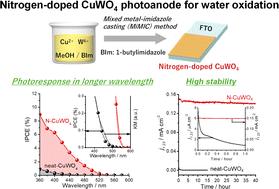
In this work, a nitrogen-doped CuWO4 (N-CuWO4) photoanode for photoelectrochemical (PEC) water oxidation was synthesized by a mixed metal-imidazole casting (MiMIC) method with 1-butylimidazole (BIm). The N-CuWO4 electrode achieved PEC water oxidation at a wavelength of 540 nm that is longer than that of the film (neat-CuWO4) prepared without BIm by 40 nm due to the N-doping, which was conscientiously characterized by spectroscopic and theoretical investigations. The N-CuWO4 surface was compactly covered with worm-like particles of 100–500 nm diameter, which is responsible for the rigid adherence of the N-CuWO4 film onto the substrate. The N-CuWO4 film showed anisotropic crystallization of triclinic CuWO4 with predominant growth of the (010) and (100) planes, in contrast to the isotropic crystallization observed for the neat-CuWO4 film. The N-CuWO4 electrode demonstrated superior performance for PEC water oxidation with an incident photon-to-electron conversion efficiency (IPCE) of 5.6% contributed by a charge separation efficiency (ηsep) of 12.3% and a catalytic efficiency (ηcat) of 51.9% (at 420 nm and 1.23 V), a faradaic efficiency (FEO2) of 97% for O2 evolution, and considerable stability for 40 h, which are advantageously comparable to those of the state-of-the-art CuWO4-based photoanodes. The water oxidation rate constant (kO2 = 1.6 × 10² s−1) at the surface for the N-CuWO4 electrode was higher than that (6.8 s−1) for the neat-CuWO4 electrode by 2 orders of magnitude, which is responsible for the high IPCE and ηcat of the N-CuWO4 electrode. The higher kO2 value for the N-CuWO4 electrode is ascribed to the higher active site on the (100) facet for water oxidation at the surface.
期刊介绍:
The Journal of Materials Chemistry A, B & C covers a wide range of high-quality studies in the field of materials chemistry, with each section focusing on specific applications of the materials studied. Journal of Materials Chemistry A emphasizes applications in energy and sustainability, including topics such as artificial photosynthesis, batteries, and fuel cells. Journal of Materials Chemistry B focuses on applications in biology and medicine, while Journal of Materials Chemistry C covers applications in optical, magnetic, and electronic devices. Example topic areas within the scope of Journal of Materials Chemistry A include catalysis, green/sustainable materials, sensors, and water treatment, among others.



 京公网安备 11010802042870号
京ICP备2023020795号-1
京公网安备 11010802042870号
京ICP备2023020795号-1

 分享
分享
 求助内容:
求助内容: 应助结果提醒方式:
 扫码关注我们
