Martina Mazzaferro , Daniele Crisafulli , Francesca Mancuso , Marco Milone , Fausto Puntoriero , Anna Irto , Salvatore Patanè , Valentina Greco , Alessandro Giuffrida , Ilenia Pisagatti , Anna Notti , Melchiorre F. Parisi , Giuseppe Gattuso
{"title":"用于荧光检测精胺的柱[5]炔基三组份超分子共聚物","authors":"Martina Mazzaferro , Daniele Crisafulli , Francesca Mancuso , Marco Milone , Fausto Puntoriero , Anna Irto , Salvatore Patanè , Valentina Greco , Alessandro Giuffrida , Ilenia Pisagatti , Anna Notti , Melchiorre F. Parisi , Giuseppe Gattuso","doi":"10.1039/d4qo01470g","DOIUrl":null,"url":null,"abstract":"<div><div>The supramolecular polymerization of a bis-pillar[5]arene dicarboxylic acid monomer () in the presence of a mixture of complementary bis-guests 1,12-dodecanediyl-bis-1,1′-1<em>H</em>-imidazole () and bis-<em>N</em>,<em>N’</em>-(6-(1<em>H</em>-imidazole)decyl)-perylene bisimide (), produces an AA/BB-type supramolecular copolymer // that retains the properties of the parent bi-component systems, that is, / solubility and / photoresponsiveness. The supramolecular copolymer showed stimuli-responsiveness, reacting to the presence of the cancer marker, spermine (), by disassemblying and releasing . Once released, the perylene bisimide monomer (quenched in the copolymer by host-to-guest electron transfer), showed a remarkable increase of emission intensity. ESI-MS data are fully consistent with the formation of the // copolymer, and AFM investigations on films cast from // and // + solutions demonstrated that the supramolecular copolymer sensing abilities are retained also in the solid state.</div></div>","PeriodicalId":94379,"journal":{"name":"Organic chemistry frontiers : an international journal of organic chemistry","volume":"11 22","pages":"Pages 6293-6303"},"PeriodicalIF":0.0000,"publicationDate":"2024-09-18","publicationTypes":"Journal Article","fieldsOfStudy":null,"isOpenAccess":false,"openAccessPdf":"","citationCount":"0","resultStr":"{\"title\":\"A pillar[5]arene-based three-component supramolecular copolymer for the fluorescence detection of spermine†\",\"authors\":\"Martina Mazzaferro , Daniele Crisafulli , Francesca Mancuso , Marco Milone , Fausto Puntoriero , Anna Irto , Salvatore Patanè , Valentina Greco , Alessandro Giuffrida , Ilenia Pisagatti , Anna Notti , Melchiorre F. Parisi , Giuseppe Gattuso\",\"doi\":\"10.1039/d4qo01470g\",\"DOIUrl\":null,\"url\":null,\"abstract\":\"<div><div>The supramolecular polymerization of a bis-pillar[5]arene dicarboxylic acid monomer () in the presence of a mixture of complementary bis-guests 1,12-dodecanediyl-bis-1,1′-1<em>H</em>-imidazole () and bis-<em>N</em>,<em>N’</em>-(6-(1<em>H</em>-imidazole)decyl)-perylene bisimide (), produces an AA/BB-type supramolecular copolymer // that retains the properties of the parent bi-component systems, that is, / solubility and / photoresponsiveness. The supramolecular copolymer showed stimuli-responsiveness, reacting to the presence of the cancer marker, spermine (), by disassemblying and releasing . Once released, the perylene bisimide monomer (quenched in the copolymer by host-to-guest electron transfer), showed a remarkable increase of emission intensity. ESI-MS data are fully consistent with the formation of the // copolymer, and AFM investigations on films cast from // and // + solutions demonstrated that the supramolecular copolymer sensing abilities are retained also in the solid state.</div></div>\",\"PeriodicalId\":94379,\"journal\":{\"name\":\"Organic chemistry frontiers : an international journal of organic chemistry\",\"volume\":\"11 22\",\"pages\":\"Pages 6293-6303\"},\"PeriodicalIF\":0.0000,\"publicationDate\":\"2024-09-18\",\"publicationTypes\":\"Journal Article\",\"fieldsOfStudy\":null,\"isOpenAccess\":false,\"openAccessPdf\":\"\",\"citationCount\":\"0\",\"resultStr\":null,\"platform\":\"Semanticscholar\",\"paperid\":null,\"PeriodicalName\":\"Organic chemistry frontiers : an international journal of organic chemistry\",\"FirstCategoryId\":\"1085\",\"ListUrlMain\":\"https://www.sciencedirect.com/org/science/article/pii/S2052412924006697\",\"RegionNum\":0,\"RegionCategory\":null,\"ArticlePicture\":[],\"TitleCN\":null,\"AbstractTextCN\":null,\"PMCID\":null,\"EPubDate\":\"\",\"PubModel\":\"\",\"JCR\":\"\",\"JCRName\":\"\",\"Score\":null,\"Total\":0}","platform":"Semanticscholar","paperid":null,"PeriodicalName":"Organic chemistry frontiers : an international journal of organic chemistry","FirstCategoryId":"1085","ListUrlMain":"https://www.sciencedirect.com/org/science/article/pii/S2052412924006697","RegionNum":0,"RegionCategory":null,"ArticlePicture":[],"TitleCN":null,"AbstractTextCN":null,"PMCID":null,"EPubDate":"","PubModel":"","JCR":"","JCRName":"","Score":null,"Total":0}
A pillar[5]arene-based three-component supramolecular copolymer for the fluorescence detection of spermine†
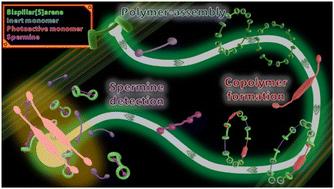
The supramolecular polymerization of a bis-pillar[5]arene dicarboxylic acid monomer () in the presence of a mixture of complementary bis-guests 1,12-dodecanediyl-bis-1,1′-1H-imidazole () and bis-N,N’-(6-(1H-imidazole)decyl)-perylene bisimide (), produces an AA/BB-type supramolecular copolymer // that retains the properties of the parent bi-component systems, that is, / solubility and / photoresponsiveness. The supramolecular copolymer showed stimuli-responsiveness, reacting to the presence of the cancer marker, spermine (), by disassemblying and releasing . Once released, the perylene bisimide monomer (quenched in the copolymer by host-to-guest electron transfer), showed a remarkable increase of emission intensity. ESI-MS data are fully consistent with the formation of the // copolymer, and AFM investigations on films cast from // and // + solutions demonstrated that the supramolecular copolymer sensing abilities are retained also in the solid state.




 京公网安备 11010802042870号
京ICP备2023020795号-1
京公网安备 11010802042870号
京ICP备2023020795号-1

 分享
分享

 求助内容:
求助内容: 应助结果提醒方式:
 扫码关注我们
