{"title":"用于长期光存储和延时 X 射线成像的 Sn2+/Pb2+ 掺杂诱导的具有深阱的高透明硼铝酸盐微晶玻璃","authors":"Panpan Li, Enhai Song, Weichao Wang, Qinyuan Zhang","doi":"10.1002/adom.202401952","DOIUrl":null,"url":null,"abstract":"<p>The development of microcrystalline glass-ceramics with high transparency and deep trap energy levels is crucial for the cost-effective and large-scale production of scintillators and optical data storage applications. In this study, the incorporation of highly electronegative divalent tin (Sn<sup>2+</sup>) plays a key role in modulating the network structure of borate glass. This leads to the successful synthesis of SrAl<sub>2</sub>O<sub>4</sub>:Eu<sup>2+</sup> microcrystalline glass with high transparency, reaching up to 80%, and excellent crystallinity. Additionally, a series of non-optically active ions with different valence states is co-doped with Eu<sup>2+</sup> to fine-tune the trap levels of the SrAl<sub>2</sub>O<sub>4</sub> microcrystals. All samples maintain high crystallinity and exhibit good transparency. In particular, the Pb<sup>2+</sup> ion co-doped samples achieve an increased trap energy level of 1.28 eV, significantly enhancing their capacity to capture X-rays and ultraviolet light. Density functional theory calculations reveal that this enhancement is due to severe lattice distortion caused by Pb<sup>2+</sup> ions occupying interstitial sites in SrAl<sub>2</sub>O<sub>4</sub>. Utilizing the SrAl<sub>2</sub>O<sub>4</sub>:Eu<sup>2+</sup>, Pb<sup>2+</sup> glass-ceramics materials, X-ray imaging with a delay of up to 210 s and optical information storage for >60 d is achieved. This study provides valuable insights into the crystal growth and trap modulation of persistent luminescent materials within a three-dimensional glass network structure.</p>","PeriodicalId":116,"journal":{"name":"Advanced Optical Materials","volume":"13 1","pages":""},"PeriodicalIF":7.2000,"publicationDate":"2024-09-17","publicationTypes":"Journal Article","fieldsOfStudy":null,"isOpenAccess":false,"openAccessPdf":"","citationCount":"0","resultStr":"{\"title\":\"Sn2+/Pb2+ Doping-Induced Highly Transparent Boroaluminate Microcrystalline Glass With Deep Traps for Long-Term Optical Storage and Time-Lapse X-ray Imaging\",\"authors\":\"Panpan Li, Enhai Song, Weichao Wang, Qinyuan Zhang\",\"doi\":\"10.1002/adom.202401952\",\"DOIUrl\":null,\"url\":null,\"abstract\":\"<p>The development of microcrystalline glass-ceramics with high transparency and deep trap energy levels is crucial for the cost-effective and large-scale production of scintillators and optical data storage applications. In this study, the incorporation of highly electronegative divalent tin (Sn<sup>2+</sup>) plays a key role in modulating the network structure of borate glass. This leads to the successful synthesis of SrAl<sub>2</sub>O<sub>4</sub>:Eu<sup>2+</sup> microcrystalline glass with high transparency, reaching up to 80%, and excellent crystallinity. Additionally, a series of non-optically active ions with different valence states is co-doped with Eu<sup>2+</sup> to fine-tune the trap levels of the SrAl<sub>2</sub>O<sub>4</sub> microcrystals. All samples maintain high crystallinity and exhibit good transparency. In particular, the Pb<sup>2+</sup> ion co-doped samples achieve an increased trap energy level of 1.28 eV, significantly enhancing their capacity to capture X-rays and ultraviolet light. Density functional theory calculations reveal that this enhancement is due to severe lattice distortion caused by Pb<sup>2+</sup> ions occupying interstitial sites in SrAl<sub>2</sub>O<sub>4</sub>. Utilizing the SrAl<sub>2</sub>O<sub>4</sub>:Eu<sup>2+</sup>, Pb<sup>2+</sup> glass-ceramics materials, X-ray imaging with a delay of up to 210 s and optical information storage for >60 d is achieved. This study provides valuable insights into the crystal growth and trap modulation of persistent luminescent materials within a three-dimensional glass network structure.</p>\",\"PeriodicalId\":116,\"journal\":{\"name\":\"Advanced Optical Materials\",\"volume\":\"13 1\",\"pages\":\"\"},\"PeriodicalIF\":7.2000,\"publicationDate\":\"2024-09-17\",\"publicationTypes\":\"Journal Article\",\"fieldsOfStudy\":null,\"isOpenAccess\":false,\"openAccessPdf\":\"\",\"citationCount\":\"0\",\"resultStr\":null,\"platform\":\"Semanticscholar\",\"paperid\":null,\"PeriodicalName\":\"Advanced Optical Materials\",\"FirstCategoryId\":\"88\",\"ListUrlMain\":\"https://advanced.onlinelibrary.wiley.com/doi/10.1002/adom.202401952\",\"RegionNum\":2,\"RegionCategory\":\"材料科学\",\"ArticlePicture\":[],\"TitleCN\":null,\"AbstractTextCN\":null,\"PMCID\":null,\"EPubDate\":\"\",\"PubModel\":\"\",\"JCR\":\"Q1\",\"JCRName\":\"MATERIALS SCIENCE, MULTIDISCIPLINARY\",\"Score\":null,\"Total\":0}","platform":"Semanticscholar","paperid":null,"PeriodicalName":"Advanced Optical Materials","FirstCategoryId":"88","ListUrlMain":"https://advanced.onlinelibrary.wiley.com/doi/10.1002/adom.202401952","RegionNum":2,"RegionCategory":"材料科学","ArticlePicture":[],"TitleCN":null,"AbstractTextCN":null,"PMCID":null,"EPubDate":"","PubModel":"","JCR":"Q1","JCRName":"MATERIALS SCIENCE, MULTIDISCIPLINARY","Score":null,"Total":0}
Sn2+/Pb2+ Doping-Induced Highly Transparent Boroaluminate Microcrystalline Glass With Deep Traps for Long-Term Optical Storage and Time-Lapse X-ray Imaging
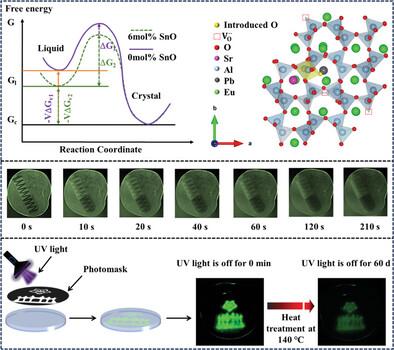
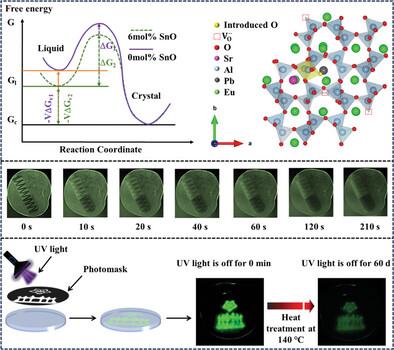
The development of microcrystalline glass-ceramics with high transparency and deep trap energy levels is crucial for the cost-effective and large-scale production of scintillators and optical data storage applications. In this study, the incorporation of highly electronegative divalent tin (Sn2+) plays a key role in modulating the network structure of borate glass. This leads to the successful synthesis of SrAl2O4:Eu2+ microcrystalline glass with high transparency, reaching up to 80%, and excellent crystallinity. Additionally, a series of non-optically active ions with different valence states is co-doped with Eu2+ to fine-tune the trap levels of the SrAl2O4 microcrystals. All samples maintain high crystallinity and exhibit good transparency. In particular, the Pb2+ ion co-doped samples achieve an increased trap energy level of 1.28 eV, significantly enhancing their capacity to capture X-rays and ultraviolet light. Density functional theory calculations reveal that this enhancement is due to severe lattice distortion caused by Pb2+ ions occupying interstitial sites in SrAl2O4. Utilizing the SrAl2O4:Eu2+, Pb2+ glass-ceramics materials, X-ray imaging with a delay of up to 210 s and optical information storage for >60 d is achieved. This study provides valuable insights into the crystal growth and trap modulation of persistent luminescent materials within a three-dimensional glass network structure.
期刊介绍:
Advanced Optical Materials, part of the esteemed Advanced portfolio, is a unique materials science journal concentrating on all facets of light-matter interactions. For over a decade, it has been the preferred optical materials journal for significant discoveries in photonics, plasmonics, metamaterials, and more. The Advanced portfolio from Wiley is a collection of globally respected, high-impact journals that disseminate the best science from established and emerging researchers, aiding them in fulfilling their mission and amplifying the reach of their scientific discoveries.







 京公网安备 11010802042870号
京ICP备2023020795号-1
京公网安备 11010802042870号
京ICP备2023020795号-1

 分享
分享
 求助内容:
求助内容: 应助结果提醒方式:
 扫码关注我们
