Wei Du, Mingxuan Zhou, Guancheng Wang, Mingze Lu, Xiao Wang, Zhirui Guo, Ming Ma and Yu Zhang
{"title":"基于 HPRR 的二原子催化剂电化学生物传感器用于检测与癌症有关的细胞外囊泡","authors":"Wei Du, Mingxuan Zhou, Guancheng Wang, Mingze Lu, Xiao Wang, Zhirui Guo, Ming Ma and Yu Zhang","doi":"10.1039/D4AY01573H","DOIUrl":null,"url":null,"abstract":"<p >Cancer-associated extracellular vesicles (EVs) are crucial biomarkers for cancer diagnosis as they contain abundant tumor cell information. To efficiently and accurately detect cancer-associated EVs, an electrochemical hydrogen peroxide reduction reaction (HPRR)-based biosensor was developed, utilizing enzyme-linked immunosorbent and diatomic catalyst strategies for catalytic HPRR current amplification for specific identification and highly sensitive detection. The anti-CXCR4 antibody was immobilized on a Au-plated electrode to selectively capture EVs from the sample. Subsequently, Fe/Cu diatomic catalysts, modified with an anti-CD63 antibody, were bound to the CD63 on the EVs. Quantitative detection of EVs was achieved by measuring the electrical signals from the HPRR catalyzed by the labeled Fe/Cu diatomic catalysts. Under optimized conditions, the electrochemical signals exhibited a linear relationship with EV concentration in the range of 500 to 1 × 10<small><sup>7</sup></small> particles mL<small><sup>−1</sup></small>, with a detection limit of 117 particles mL<small><sup>−1</sup></small>, maintaining accuracy even in FBS. With its affordability, high sensitivity, and ease of use, this sensor holds significant potential for medication guidance and postoperative evaluation.</p>","PeriodicalId":64,"journal":{"name":"Analytical Methods","volume":" 43","pages":" 7381-7389"},"PeriodicalIF":2.6000,"publicationDate":"2024-09-19","publicationTypes":"Journal Article","fieldsOfStudy":null,"isOpenAccess":false,"openAccessPdf":"","citationCount":"0","resultStr":"{\"title\":\"A HPRR-based diatomic catalyst electrochemical biosensor for detecting cancer-related extracellular vesicles†\",\"authors\":\"Wei Du, Mingxuan Zhou, Guancheng Wang, Mingze Lu, Xiao Wang, Zhirui Guo, Ming Ma and Yu Zhang\",\"doi\":\"10.1039/D4AY01573H\",\"DOIUrl\":null,\"url\":null,\"abstract\":\"<p >Cancer-associated extracellular vesicles (EVs) are crucial biomarkers for cancer diagnosis as they contain abundant tumor cell information. To efficiently and accurately detect cancer-associated EVs, an electrochemical hydrogen peroxide reduction reaction (HPRR)-based biosensor was developed, utilizing enzyme-linked immunosorbent and diatomic catalyst strategies for catalytic HPRR current amplification for specific identification and highly sensitive detection. The anti-CXCR4 antibody was immobilized on a Au-plated electrode to selectively capture EVs from the sample. Subsequently, Fe/Cu diatomic catalysts, modified with an anti-CD63 antibody, were bound to the CD63 on the EVs. Quantitative detection of EVs was achieved by measuring the electrical signals from the HPRR catalyzed by the labeled Fe/Cu diatomic catalysts. Under optimized conditions, the electrochemical signals exhibited a linear relationship with EV concentration in the range of 500 to 1 × 10<small><sup>7</sup></small> particles mL<small><sup>−1</sup></small>, with a detection limit of 117 particles mL<small><sup>−1</sup></small>, maintaining accuracy even in FBS. With its affordability, high sensitivity, and ease of use, this sensor holds significant potential for medication guidance and postoperative evaluation.</p>\",\"PeriodicalId\":64,\"journal\":{\"name\":\"Analytical Methods\",\"volume\":\" 43\",\"pages\":\" 7381-7389\"},\"PeriodicalIF\":2.6000,\"publicationDate\":\"2024-09-19\",\"publicationTypes\":\"Journal Article\",\"fieldsOfStudy\":null,\"isOpenAccess\":false,\"openAccessPdf\":\"\",\"citationCount\":\"0\",\"resultStr\":null,\"platform\":\"Semanticscholar\",\"paperid\":null,\"PeriodicalName\":\"Analytical Methods\",\"FirstCategoryId\":\"92\",\"ListUrlMain\":\"https://pubs.rsc.org/en/content/articlelanding/2024/ay/d4ay01573h\",\"RegionNum\":3,\"RegionCategory\":\"化学\",\"ArticlePicture\":[],\"TitleCN\":null,\"AbstractTextCN\":null,\"PMCID\":null,\"EPubDate\":\"\",\"PubModel\":\"\",\"JCR\":\"Q2\",\"JCRName\":\"CHEMISTRY, ANALYTICAL\",\"Score\":null,\"Total\":0}","platform":"Semanticscholar","paperid":null,"PeriodicalName":"Analytical Methods","FirstCategoryId":"92","ListUrlMain":"https://pubs.rsc.org/en/content/articlelanding/2024/ay/d4ay01573h","RegionNum":3,"RegionCategory":"化学","ArticlePicture":[],"TitleCN":null,"AbstractTextCN":null,"PMCID":null,"EPubDate":"","PubModel":"","JCR":"Q2","JCRName":"CHEMISTRY, ANALYTICAL","Score":null,"Total":0}
A HPRR-based diatomic catalyst electrochemical biosensor for detecting cancer-related extracellular vesicles†
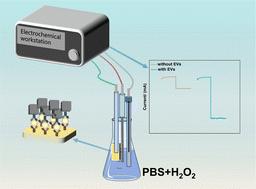
Cancer-associated extracellular vesicles (EVs) are crucial biomarkers for cancer diagnosis as they contain abundant tumor cell information. To efficiently and accurately detect cancer-associated EVs, an electrochemical hydrogen peroxide reduction reaction (HPRR)-based biosensor was developed, utilizing enzyme-linked immunosorbent and diatomic catalyst strategies for catalytic HPRR current amplification for specific identification and highly sensitive detection. The anti-CXCR4 antibody was immobilized on a Au-plated electrode to selectively capture EVs from the sample. Subsequently, Fe/Cu diatomic catalysts, modified with an anti-CD63 antibody, were bound to the CD63 on the EVs. Quantitative detection of EVs was achieved by measuring the electrical signals from the HPRR catalyzed by the labeled Fe/Cu diatomic catalysts. Under optimized conditions, the electrochemical signals exhibited a linear relationship with EV concentration in the range of 500 to 1 × 10⁷ particles mL−1, with a detection limit of 117 particles mL−1, maintaining accuracy even in FBS. With its affordability, high sensitivity, and ease of use, this sensor holds significant potential for medication guidance and postoperative evaluation.




 京公网安备 11010802042870号
京ICP备2023020795号-1
京公网安备 11010802042870号
京ICP备2023020795号-1

 分享
分享
 求助内容:
求助内容: 应助结果提醒方式:
 扫码关注我们
