Parnian Hossein-Pour, Maya Rajasingham, Giulia M. Muraca
{"title":"产钳与真空助产的宫颈裂伤风险:系统回顾和荟萃分析","authors":"Parnian Hossein-Pour, Maya Rajasingham, Giulia M. Muraca","doi":"10.1111/aogs.14969","DOIUrl":null,"url":null,"abstract":"<div>\n \n \n <section>\n \n <h3> Introduction</h3>\n \n <p>Cervical laceration is an obstetric injury associated with severe postpartum hemorrhage and subsequent spontaneous preterm birth. While operative vaginal delivery is a known risk factor for cervical laceration, it is unclear whether forceps and vacuum deliveries incur the same risk. The aim of this systematic review was to compare the risk of cervical laceration between operative instruments (forceps vs vacuum).</p>\n </section>\n \n <section>\n \n <h3> Material and Methods</h3>\n \n <p>Medline, Embase, Global Health, CENTRAL, Emcare, and Web of Science were searched from inception until August 2024 with terms related to operative vaginal delivery and cervical laceration. Studies comparing the risk of cervical laceration in individuals undergoing forceps or vacuum delivery were included. Two authors conducted screening, data extraction, and quality assessment of all studies. Random-effects models were used to pool risk ratios across studies and certainty of evidence was assessed using Cochrane methods and the GRADE approach. PROSPERO Registration Number CRD42023421890.</p>\n </section>\n \n <section>\n \n <h3> Results</h3>\n \n <p>Thirteen studies were eligible for inclusion, 3 randomized controlled trials (RCTs) and 10 observational studies. The overall rate of cervical laceration was 0.35% (990/284218 births) where 1.04% of forceps deliveries (456/43817) were complicated by cervical laceration compared to 0.22% of vacuum deliveries (534/240401). The risk of cervical laceration was 2–5 fold greater in forceps deliveries than in vacuum deliveries: pooled unadjusted risk ratio [RR] 4.83, 95% confidence interval [CI] 1.56–14.98 among RCTs and pooled unadjusted RR 1.89, 95% CI 1.59–2.24 among observational studies. The overall quality of evidence was low to moderate mainly due to the lack of attention to confounding in the included literature. The GRADE assessment indicated that the certainty of evidence was very low for observational studies and moderate for RCTs.</p>\n </section>\n \n <section>\n \n <h3> Conclusions</h3>\n \n <p>Low certainty of evidence indicates that forceps deliveries may be associated with an increased risk of cervical laceration compared to vacuum deliveries.</p>\n </section>\n </div>","PeriodicalId":6990,"journal":{"name":"Acta Obstetricia et Gynecologica Scandinavica","volume":"104 1","pages":"29-38"},"PeriodicalIF":3.5000,"publicationDate":"2024-09-15","publicationTypes":"Journal Article","fieldsOfStudy":null,"isOpenAccess":false,"openAccessPdf":"https://onlinelibrary.wiley.com/doi/epdf/10.1111/aogs.14969","citationCount":"0","resultStr":"{\"title\":\"Risk of cervical laceration in forceps vs vacuum delivery: A systematic review and meta-analysis\",\"authors\":\"Parnian Hossein-Pour, Maya Rajasingham, Giulia M. Muraca\",\"doi\":\"10.1111/aogs.14969\",\"DOIUrl\":null,\"url\":null,\"abstract\":\"<div>\\n \\n \\n <section>\\n \\n <h3> Introduction</h3>\\n \\n <p>Cervical laceration is an obstetric injury associated with severe postpartum hemorrhage and subsequent spontaneous preterm birth. While operative vaginal delivery is a known risk factor for cervical laceration, it is unclear whether forceps and vacuum deliveries incur the same risk. The aim of this systematic review was to compare the risk of cervical laceration between operative instruments (forceps vs vacuum).</p>\\n </section>\\n \\n <section>\\n \\n <h3> Material and Methods</h3>\\n \\n <p>Medline, Embase, Global Health, CENTRAL, Emcare, and Web of Science were searched from inception until August 2024 with terms related to operative vaginal delivery and cervical laceration. Studies comparing the risk of cervical laceration in individuals undergoing forceps or vacuum delivery were included. Two authors conducted screening, data extraction, and quality assessment of all studies. Random-effects models were used to pool risk ratios across studies and certainty of evidence was assessed using Cochrane methods and the GRADE approach. PROSPERO Registration Number CRD42023421890.</p>\\n </section>\\n \\n <section>\\n \\n <h3> Results</h3>\\n \\n <p>Thirteen studies were eligible for inclusion, 3 randomized controlled trials (RCTs) and 10 observational studies. The overall rate of cervical laceration was 0.35% (990/284218 births) where 1.04% of forceps deliveries (456/43817) were complicated by cervical laceration compared to 0.22% of vacuum deliveries (534/240401). The risk of cervical laceration was 2–5 fold greater in forceps deliveries than in vacuum deliveries: pooled unadjusted risk ratio [RR] 4.83, 95% confidence interval [CI] 1.56–14.98 among RCTs and pooled unadjusted RR 1.89, 95% CI 1.59–2.24 among observational studies. The overall quality of evidence was low to moderate mainly due to the lack of attention to confounding in the included literature. The GRADE assessment indicated that the certainty of evidence was very low for observational studies and moderate for RCTs.</p>\\n </section>\\n \\n <section>\\n \\n <h3> Conclusions</h3>\\n \\n <p>Low certainty of evidence indicates that forceps deliveries may be associated with an increased risk of cervical laceration compared to vacuum deliveries.</p>\\n </section>\\n </div>\",\"PeriodicalId\":6990,\"journal\":{\"name\":\"Acta Obstetricia et Gynecologica Scandinavica\",\"volume\":\"104 1\",\"pages\":\"29-38\"},\"PeriodicalIF\":3.5000,\"publicationDate\":\"2024-09-15\",\"publicationTypes\":\"Journal Article\",\"fieldsOfStudy\":null,\"isOpenAccess\":false,\"openAccessPdf\":\"https://onlinelibrary.wiley.com/doi/epdf/10.1111/aogs.14969\",\"citationCount\":\"0\",\"resultStr\":null,\"platform\":\"Semanticscholar\",\"paperid\":null,\"PeriodicalName\":\"Acta Obstetricia et Gynecologica Scandinavica\",\"FirstCategoryId\":\"3\",\"ListUrlMain\":\"https://obgyn.onlinelibrary.wiley.com/doi/10.1111/aogs.14969\",\"RegionNum\":2,\"RegionCategory\":\"医学\",\"ArticlePicture\":[],\"TitleCN\":null,\"AbstractTextCN\":null,\"PMCID\":null,\"EPubDate\":\"\",\"PubModel\":\"\",\"JCR\":\"Q1\",\"JCRName\":\"OBSTETRICS & GYNECOLOGY\",\"Score\":null,\"Total\":0}","platform":"Semanticscholar","paperid":null,"PeriodicalName":"Acta Obstetricia et Gynecologica Scandinavica","FirstCategoryId":"3","ListUrlMain":"https://obgyn.onlinelibrary.wiley.com/doi/10.1111/aogs.14969","RegionNum":2,"RegionCategory":"医学","ArticlePicture":[],"TitleCN":null,"AbstractTextCN":null,"PMCID":null,"EPubDate":"","PubModel":"","JCR":"Q1","JCRName":"OBSTETRICS & GYNECOLOGY","Score":null,"Total":0}
Risk of cervical laceration in forceps vs vacuum delivery: A systematic review and meta-analysis
Introduction
Cervical laceration is an obstetric injury associated with severe postpartum hemorrhage and subsequent spontaneous preterm birth. While operative vaginal delivery is a known risk factor for cervical laceration, it is unclear whether forceps and vacuum deliveries incur the same risk. The aim of this systematic review was to compare the risk of cervical laceration between operative instruments (forceps vs vacuum).
Material and Methods
Medline, Embase, Global Health, CENTRAL, Emcare, and Web of Science were searched from inception until August 2024 with terms related to operative vaginal delivery and cervical laceration. Studies comparing the risk of cervical laceration in individuals undergoing forceps or vacuum delivery were included. Two authors conducted screening, data extraction, and quality assessment of all studies. Random-effects models were used to pool risk ratios across studies and certainty of evidence was assessed using Cochrane methods and the GRADE approach. PROSPERO Registration Number CRD42023421890.
Results
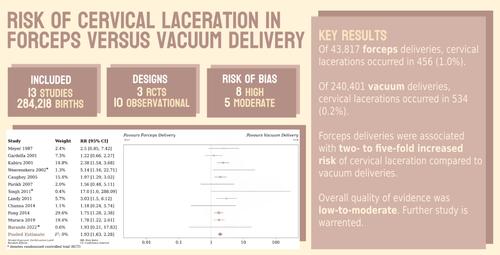
Thirteen studies were eligible for inclusion, 3 randomized controlled trials (RCTs) and 10 observational studies. The overall rate of cervical laceration was 0.35% (990/284218 births) where 1.04% of forceps deliveries (456/43817) were complicated by cervical laceration compared to 0.22% of vacuum deliveries (534/240401). The risk of cervical laceration was 2–5 fold greater in forceps deliveries than in vacuum deliveries: pooled unadjusted risk ratio [RR] 4.83, 95% confidence interval [CI] 1.56–14.98 among RCTs and pooled unadjusted RR 1.89, 95% CI 1.59–2.24 among observational studies. The overall quality of evidence was low to moderate mainly due to the lack of attention to confounding in the included literature. The GRADE assessment indicated that the certainty of evidence was very low for observational studies and moderate for RCTs.
Conclusions
Low certainty of evidence indicates that forceps deliveries may be associated with an increased risk of cervical laceration compared to vacuum deliveries.
期刊介绍:
Published monthly, Acta Obstetricia et Gynecologica Scandinavica is an international journal dedicated to providing the very latest information on the results of both clinical, basic and translational research work related to all aspects of women’s health from around the globe. The journal regularly publishes commentaries, reviews, and original articles on a wide variety of topics including: gynecology, pregnancy, birth, female urology, gynecologic oncology, fertility and reproductive biology.








 京公网安备 11010802042870号
京ICP备2023020795号-1
京公网安备 11010802042870号
京ICP备2023020795号-1

 分享
分享
 求助内容:
求助内容: 应助结果提醒方式:
 扫码关注我们
