Megan M. Lilley, Marta Salek, Ashley Holland, Hiroto Inaba, Sara M. Federico
{"title":"治疗一名同时患有神经母细胞瘤和急性淋巴细胞白血病的儿童患者","authors":"Megan M. Lilley, Marta Salek, Ashley Holland, Hiroto Inaba, Sara M. Federico","doi":"10.1002/pbc.31313","DOIUrl":null,"url":null,"abstract":"<p>To the Editor:</p><p>Leukemia is the most common type of childhood cancer, with a 5-year survival rate of 86.2%.<span><sup>1</sup></span> Neuroblastoma (NB) is the most common pediatric extracranial solid tumor, with a survival rate ranging from 62% to 98% dependent on risk classification.<span><sup>2</sup></span> Second malignancies of leukemia can occur following NB treatment; however, concurrent diagnoses of acute lymphoblastic leukemia (ALL) and NB have not been previously described. Coexistence of NB and Langerhans cell histiocytosis or acute myeloid leukemia have been reported, but the closest “simultaneous” NB and ALL were diagnosed 9 months apart.<span><sup>3-5</sup></span> Here, we describe a unique case of a patient treated for concurrent ALL and NB.</p><p>A 2-year-old male presented with limp, lymphadenopathy, and abdominal pain. Computed tomography (CT) identified a calcified mass arising from the adrenal gland. Lymphoblasts were identified on peripheral blood smear. Bone marrow studies demonstrated 90% lymphoblasts, and patient therefore diagnosed with low-risk B lymphoblastic leukemia (B-ALL). White blood cell count was 8.09 × 10<sup>9</sup>/L, no central nervous system (CNS) involvement, and next-generation sequencing revealed high-hyperdiploid (55–57 chromosomes; alterations of <i>NRAS</i>, <i>PTPN11</i>, and <i>PAX5</i>). The adrenal mass was resected; pathology showed unfavorable histology, MYCN nonamplified NB. A postoperative meta-iodobenzylguanidine (MIBG) scan identified two avid lymph nodes in the tumor bed. NB was staged as L1 disease and classified low risk. Figure 1 describes the following treatment plan.</p><p>Therapy for B-ALL was initiated as per St. Jude Total XVI protocol,<span><sup>6</sup></span> with remission induction therapy (prednisone, vincristine, daunorubicin, peg-asparaginase, cyclophosphamide, mercaptopurine, cytarabine, and triple intrathecal chemotherapy [methotrexate, hydrocortisone, and cytarabine or “MHA”]). Day 15 bone marrow minimal residual disease (MRD) identified 0.375% lymphoblasts, and end-of-induction MRD was negative.</p><p>As the patient completed ALL remission induction therapy, comprehensive NB testing identified segmental copy number aberrations (SCAs) including 11q loss of heterozygosity (LOH), 17q gain, and 1p36 subclonal deletion. No germline cancer predisposition gene alterations were identified. Surveillance CT revealed local disease progression in the tumor bed. Subsequently, intermediate-risk NB treatment was initiated as per A3961 (carboplatin, etoposide, doxorubicin, cyclophosphamide).<span><sup>7</sup></span> Concurrent oral dexamethasone and intrathecal chemotherapy were given for leukemia control while the patient received NB chemotherapy. Granulocyte colony-stimulating factor (G-CSF) was not administered due to risk of secondary hematological malignancy. Chemotherapy was dose adjusted for myelosuppression.</p><p>An NB disease evaluation demonstrated stable disease (SD), per revised International Neuroblastoma Response Criteria (INRC),<span><sup>8</sup></span> with minimal anatomic improvement following the second chemotherapy cycle and persistent MIBG avidity. Thus, the patient underwent resection of left pararenal lymph nodes, eight total cycles of intermediate-risk NB chemotherapy, and proton radiation to tumor bed due to high risk of local recurrence in the setting of multiple SCAs.<span><sup>9</sup></span> During radiation therapy, vincristine and dexamethasone were administered as interim leukemia therapy.</p><p>After completing NB therapy, consolidation and continuation therapy for ALL was planned, as per St. Jude Total XVI protocol.<span><sup>6</sup></span> However, the patient experienced treatment toxicity (myelosuppression) during consolidation. Therefore, two cycles of blinatumomab were administered without significant complications. Blinatumomab was followed by continuation therapy as per low-risk Total XVI protocol (dexamethasone, vincristine, mercaptopurine, methotrexate, and peg-asparaginase).<span><sup>6</sup></span> The patient completed ALL treatment 2.5 years following diagnosis.</p><p>The patient is 34 months post completion of NB therapy and 12 months post completion of ALL therapy without evidence of disease.</p><p>The treatment of a patient with two concurrent malignancies requires a unique therapeutic approach, combining therapies and modalities targeting both malignancies while mitigating toxicities. NB treatment can range from observation or resection only (low risk) to multimodal therapy requiring chemotherapy, surgery, radiation, myeloablative therapy with autologous stem cell transplant, immunotherapy, and isotretinoin (high risk). ALL therapy is also dictated by risk classification and may include some or all the following: chemotherapy, intrathecal chemotherapy, immunotherapy, chimeric antigen receptor (CAR) T-cell therapy, and allogeneic stem cell transplant. Two specific strategies can be learned from this case.</p><p>First, it is imperative to treat the disease with highest risk of rapid progression leading to worsened risk classification or death. In the referenced patient, at diagnosis the adrenal mass was localized with near complete surgical resection and lacked the most aggressive biologic feature (MYCN amplification). Therefore, risk of NB leading to acute clinical decompensation was lower than risks related to rapid ALL progression, and initial chemotherapy regimen targeted leukemia treatment. However, when surveillance imaging for NB demonstrated local NB progression (and three SCAs identified), the treatment paradigm shifted to address the actively progressing NB. In this case, intermediate-risk chemotherapy was given to treat NB and maintenance therapy administered to maintain ALL remission.</p><p>Second, therapy combinations used to treat both malignancies must be considered while mitigating overlapping toxicities. In this case, dexamethasone (to maintain leukemia remission) was successfully added to intermediate-risk NB chemotherapy, and vincristine plus dexamethasone (as leukemia maintenance) was tolerated during focal radiation for NB treatment. However, treatment required omission of certain aspects of therapy and replacement with alternative treatments. G-CSF typically used for myelosuppression following NB chemotherapy was omitted due to theoretical increased risk of secondary leukemia, leading to prolonged neutropenia requiring NB chemotherapy dosage reductions. Once the patient reached consolidation and continuation therapy for ALL, there was significant prolonged myelosuppression. Thus, immunotherapy (blinatumomab) was administered as a less myelosuppressive alternative consolidation given its known treatment effect in B-ALL.<span><sup>10</sup></span></p><p>In summary, we describe the first successful treatment of a patient with concurrent ALL and NB. The treatment strategies required a unique therapeutic approach. However, combining therapies and modalities targeting both malignancies while mitigating toxicities was achieved. Similar approaches can be used for future rare patients requiring treatment for concurrent cancer diagnoses.</p><p>The authors declare they have no conflicts of interest.</p>","PeriodicalId":19822,"journal":{"name":"Pediatric Blood & Cancer","volume":"71 12","pages":""},"PeriodicalIF":2.4000,"publicationDate":"2024-09-17","publicationTypes":"Journal Article","fieldsOfStudy":null,"isOpenAccess":false,"openAccessPdf":"https://onlinelibrary.wiley.com/doi/epdf/10.1002/pbc.31313","citationCount":"0","resultStr":"{\"title\":\"Treatment of a pediatric patient with concurrent neuroblastoma and acute lymphoblastic leukemia\",\"authors\":\"Megan M. Lilley, Marta Salek, Ashley Holland, Hiroto Inaba, Sara M. Federico\",\"doi\":\"10.1002/pbc.31313\",\"DOIUrl\":null,\"url\":null,\"abstract\":\"<p>To the Editor:</p><p>Leukemia is the most common type of childhood cancer, with a 5-year survival rate of 86.2%.<span><sup>1</sup></span> Neuroblastoma (NB) is the most common pediatric extracranial solid tumor, with a survival rate ranging from 62% to 98% dependent on risk classification.<span><sup>2</sup></span> Second malignancies of leukemia can occur following NB treatment; however, concurrent diagnoses of acute lymphoblastic leukemia (ALL) and NB have not been previously described. Coexistence of NB and Langerhans cell histiocytosis or acute myeloid leukemia have been reported, but the closest “simultaneous” NB and ALL were diagnosed 9 months apart.<span><sup>3-5</sup></span> Here, we describe a unique case of a patient treated for concurrent ALL and NB.</p><p>A 2-year-old male presented with limp, lymphadenopathy, and abdominal pain. Computed tomography (CT) identified a calcified mass arising from the adrenal gland. Lymphoblasts were identified on peripheral blood smear. Bone marrow studies demonstrated 90% lymphoblasts, and patient therefore diagnosed with low-risk B lymphoblastic leukemia (B-ALL). White blood cell count was 8.09 × 10<sup>9</sup>/L, no central nervous system (CNS) involvement, and next-generation sequencing revealed high-hyperdiploid (55–57 chromosomes; alterations of <i>NRAS</i>, <i>PTPN11</i>, and <i>PAX5</i>). The adrenal mass was resected; pathology showed unfavorable histology, MYCN nonamplified NB. A postoperative meta-iodobenzylguanidine (MIBG) scan identified two avid lymph nodes in the tumor bed. NB was staged as L1 disease and classified low risk. Figure 1 describes the following treatment plan.</p><p>Therapy for B-ALL was initiated as per St. Jude Total XVI protocol,<span><sup>6</sup></span> with remission induction therapy (prednisone, vincristine, daunorubicin, peg-asparaginase, cyclophosphamide, mercaptopurine, cytarabine, and triple intrathecal chemotherapy [methotrexate, hydrocortisone, and cytarabine or “MHA”]). Day 15 bone marrow minimal residual disease (MRD) identified 0.375% lymphoblasts, and end-of-induction MRD was negative.</p><p>As the patient completed ALL remission induction therapy, comprehensive NB testing identified segmental copy number aberrations (SCAs) including 11q loss of heterozygosity (LOH), 17q gain, and 1p36 subclonal deletion. No germline cancer predisposition gene alterations were identified. Surveillance CT revealed local disease progression in the tumor bed. Subsequently, intermediate-risk NB treatment was initiated as per A3961 (carboplatin, etoposide, doxorubicin, cyclophosphamide).<span><sup>7</sup></span> Concurrent oral dexamethasone and intrathecal chemotherapy were given for leukemia control while the patient received NB chemotherapy. Granulocyte colony-stimulating factor (G-CSF) was not administered due to risk of secondary hematological malignancy. Chemotherapy was dose adjusted for myelosuppression.</p><p>An NB disease evaluation demonstrated stable disease (SD), per revised International Neuroblastoma Response Criteria (INRC),<span><sup>8</sup></span> with minimal anatomic improvement following the second chemotherapy cycle and persistent MIBG avidity. Thus, the patient underwent resection of left pararenal lymph nodes, eight total cycles of intermediate-risk NB chemotherapy, and proton radiation to tumor bed due to high risk of local recurrence in the setting of multiple SCAs.<span><sup>9</sup></span> During radiation therapy, vincristine and dexamethasone were administered as interim leukemia therapy.</p><p>After completing NB therapy, consolidation and continuation therapy for ALL was planned, as per St. Jude Total XVI protocol.<span><sup>6</sup></span> However, the patient experienced treatment toxicity (myelosuppression) during consolidation. Therefore, two cycles of blinatumomab were administered without significant complications. Blinatumomab was followed by continuation therapy as per low-risk Total XVI protocol (dexamethasone, vincristine, mercaptopurine, methotrexate, and peg-asparaginase).<span><sup>6</sup></span> The patient completed ALL treatment 2.5 years following diagnosis.</p><p>The patient is 34 months post completion of NB therapy and 12 months post completion of ALL therapy without evidence of disease.</p><p>The treatment of a patient with two concurrent malignancies requires a unique therapeutic approach, combining therapies and modalities targeting both malignancies while mitigating toxicities. NB treatment can range from observation or resection only (low risk) to multimodal therapy requiring chemotherapy, surgery, radiation, myeloablative therapy with autologous stem cell transplant, immunotherapy, and isotretinoin (high risk). ALL therapy is also dictated by risk classification and may include some or all the following: chemotherapy, intrathecal chemotherapy, immunotherapy, chimeric antigen receptor (CAR) T-cell therapy, and allogeneic stem cell transplant. Two specific strategies can be learned from this case.</p><p>First, it is imperative to treat the disease with highest risk of rapid progression leading to worsened risk classification or death. In the referenced patient, at diagnosis the adrenal mass was localized with near complete surgical resection and lacked the most aggressive biologic feature (MYCN amplification). Therefore, risk of NB leading to acute clinical decompensation was lower than risks related to rapid ALL progression, and initial chemotherapy regimen targeted leukemia treatment. However, when surveillance imaging for NB demonstrated local NB progression (and three SCAs identified), the treatment paradigm shifted to address the actively progressing NB. In this case, intermediate-risk chemotherapy was given to treat NB and maintenance therapy administered to maintain ALL remission.</p><p>Second, therapy combinations used to treat both malignancies must be considered while mitigating overlapping toxicities. In this case, dexamethasone (to maintain leukemia remission) was successfully added to intermediate-risk NB chemotherapy, and vincristine plus dexamethasone (as leukemia maintenance) was tolerated during focal radiation for NB treatment. However, treatment required omission of certain aspects of therapy and replacement with alternative treatments. G-CSF typically used for myelosuppression following NB chemotherapy was omitted due to theoretical increased risk of secondary leukemia, leading to prolonged neutropenia requiring NB chemotherapy dosage reductions. Once the patient reached consolidation and continuation therapy for ALL, there was significant prolonged myelosuppression. Thus, immunotherapy (blinatumomab) was administered as a less myelosuppressive alternative consolidation given its known treatment effect in B-ALL.<span><sup>10</sup></span></p><p>In summary, we describe the first successful treatment of a patient with concurrent ALL and NB. The treatment strategies required a unique therapeutic approach. However, combining therapies and modalities targeting both malignancies while mitigating toxicities was achieved. Similar approaches can be used for future rare patients requiring treatment for concurrent cancer diagnoses.</p><p>The authors declare they have no conflicts of interest.</p>\",\"PeriodicalId\":19822,\"journal\":{\"name\":\"Pediatric Blood & Cancer\",\"volume\":\"71 12\",\"pages\":\"\"},\"PeriodicalIF\":2.4000,\"publicationDate\":\"2024-09-17\",\"publicationTypes\":\"Journal Article\",\"fieldsOfStudy\":null,\"isOpenAccess\":false,\"openAccessPdf\":\"https://onlinelibrary.wiley.com/doi/epdf/10.1002/pbc.31313\",\"citationCount\":\"0\",\"resultStr\":null,\"platform\":\"Semanticscholar\",\"paperid\":null,\"PeriodicalName\":\"Pediatric Blood & Cancer\",\"FirstCategoryId\":\"3\",\"ListUrlMain\":\"https://onlinelibrary.wiley.com/doi/10.1002/pbc.31313\",\"RegionNum\":3,\"RegionCategory\":\"医学\",\"ArticlePicture\":[],\"TitleCN\":null,\"AbstractTextCN\":null,\"PMCID\":null,\"EPubDate\":\"\",\"PubModel\":\"\",\"JCR\":\"Q2\",\"JCRName\":\"HEMATOLOGY\",\"Score\":null,\"Total\":0}","platform":"Semanticscholar","paperid":null,"PeriodicalName":"Pediatric Blood & Cancer","FirstCategoryId":"3","ListUrlMain":"https://onlinelibrary.wiley.com/doi/10.1002/pbc.31313","RegionNum":3,"RegionCategory":"医学","ArticlePicture":[],"TitleCN":null,"AbstractTextCN":null,"PMCID":null,"EPubDate":"","PubModel":"","JCR":"Q2","JCRName":"HEMATOLOGY","Score":null,"Total":0}
引用次数: 0
摘要
致编辑:白血病是最常见的儿童癌症类型,5 年生存率为 86.2%。1 神经母细胞瘤(NB)是最常见的儿童颅外实体瘤,根据风险分级,生存率在 62% 到 98% 之间。NB 和朗格汉斯细胞组织细胞增生症或急性髓性白血病并存的病例已有报道,但最接近 "同时 "确诊 NB 和 ALL 的病例相隔 9 个月。计算机断层扫描(CT)发现肾上腺有一个钙化肿块。外周血涂片中发现了淋巴母细胞。骨髓检查显示90%为淋巴母细胞,因此患者被诊断为低风险B淋巴细胞白血病(B-ALL)。白细胞计数为 8.09 × 10⁹/L,未累及中枢神经系统(CNS),下一代测序显示为高超二倍体(55-57 条染色体;NRAS、PTPN11 和 PAX5 发生改变)。肾上腺肿块被切除;病理显示组织学情况不佳,为 MYCN 非扩增 NB。术后的甲碘苄基胍(MIBG)扫描发现肿瘤床有两个淋巴结。NB 被分期为 L1 病变,属于低风险。B-ALL 的治疗按照圣犹达 XVI 方案6 启动,采用缓解诱导疗法(泼尼松、长春新碱、达诺鲁比星、聚天冬酰胺酶、环磷酰胺、巯嘌呤、阿糖胞苷和三联鞘内化疗[甲氨蝶呤、氢化可的松和阿糖胞苷或 "MHA"])。第15天骨髓微小残留病(MRD)发现了0.375%的淋巴细胞,诱导末期MRD为阴性。随着患者完成ALL缓解诱导治疗,全面的NB检测发现了节段拷贝数畸变(SCA),包括11q杂合性缺失(LOH)、17q增益和1p36亚克隆缺失。未发现种系癌症易感基因改变。监视 CT 显示肿瘤床局部疾病进展。随后,按照 A3961(卡铂、依托泊苷、多柔比星、环磷酰胺)7 开始了中危 NB 治疗。在患者接受 NB 化疗期间,同时口服地塞米松和鞘内化疗以控制白血病。由于存在继发性血液恶性肿瘤的风险,因此没有使用粒细胞集落刺激因子(G-CSF)。根据修订后的《国际神经母细胞瘤反应标准》(INRC)8 ,NB 疾病评估显示病情稳定(SD),第二个化疗周期后解剖学改善极小,MIBG 阳性持续存在。因此,患者接受了左侧肾旁淋巴结切除术,共进行了八个周期的中危NB化疗,并对肿瘤床进行了质子放疗,因为在多发性SCA的情况下,局部复发的风险很高。在放疗期间,患者接受了长春新碱和地塞米松作为白血病的临时治疗。完成 NB 治疗后,根据圣裘德 Total XVI 方案,患者计划接受 ALL 的巩固和继续治疗。6 然而,患者在巩固治疗期间出现了治疗毒性(骨髓抑制),因此,在没有出现明显并发症的情况下,患者接受了两个周期的 blinatumomab 治疗。6 患者在确诊后 2.5 年完成了 ALL 治疗。患者在完成 NB 治疗 34 个月后和完成 ALL 治疗 12 个月后均未出现疾病证据。治疗同时患有两种恶性肿瘤的患者需要采用独特的治疗方法,在减轻毒性的同时结合针对两种恶性肿瘤的疗法和方式。NB 治疗的范围包括观察或仅切除(低风险),以及需要化疗、手术、放疗、自体干细胞移植的髓脱落疗法、免疫疗法和异维A酸的多模式治疗(高风险)。ALL 疗法也由风险分类决定,可能包括以下部分或全部疗法:化疗、鞘内化疗、免疫疗法、嵌合抗原受体(CAR)T 细胞疗法和异体干细胞移植。从这个病例中,我们可以学到两个具体的策略。首先,必须治疗最有可能导致风险分级恶化或死亡的快速进展的疾病。 在该例患者中,肾上腺肿块在确诊时已接近完全手术切除,并缺乏最具侵袭性的生物特征(MYCN扩增)。因此,NB导致急性临床失代偿的风险低于ALL快速进展的相关风险,且初始化疗方案以白血病治疗为目标。然而,当 NB 的监测成像显示局部 NB 进展(并发现了三个 SCA)时,治疗模式发生了转变,以应对进展活跃的 NB。在这种情况下,中危化疗用于治疗 NB,维持治疗用于维持 ALL 的缓解。其次,必须考虑治疗两种恶性肿瘤的疗法组合,同时减轻重叠毒性。在该病例中,地塞米松(维持白血病缓解)被成功地加入到中危NB化疗中,而长春新碱加地塞米松(作为白血病维持治疗)在治疗NB的病灶放射治疗中也是可以耐受的。然而,治疗过程中需要省略某些治疗环节,代之以其他治疗方法。由于理论上会增加继发性白血病的风险,因此放弃了通常在 NB 化疗后用于骨髓抑制的 G-CSF,导致中性粒细胞减少时间延长,需要减少 NB 化疗的剂量。一旦患者接受了 ALL 的巩固和继续治疗,骨髓抑制就会明显延长。因此,考虑到免疫疗法(blinatumomab)对 B-ALL 的已知治疗效果,我们采用了骨髓抑制较少的替代巩固疗法。治疗策略需要一种独特的治疗方法。然而,我们成功地将针对两种恶性肿瘤的疗法和模式结合起来,同时减轻了毒性。类似的方法也可用于未来需要治疗并发癌症的罕见患者。
Treatment of a pediatric patient with concurrent neuroblastoma and acute lymphoblastic leukemia
To the Editor:
Leukemia is the most common type of childhood cancer, with a 5-year survival rate of 86.2%.1 Neuroblastoma (NB) is the most common pediatric extracranial solid tumor, with a survival rate ranging from 62% to 98% dependent on risk classification.2 Second malignancies of leukemia can occur following NB treatment; however, concurrent diagnoses of acute lymphoblastic leukemia (ALL) and NB have not been previously described. Coexistence of NB and Langerhans cell histiocytosis or acute myeloid leukemia have been reported, but the closest “simultaneous” NB and ALL were diagnosed 9 months apart.3-5 Here, we describe a unique case of a patient treated for concurrent ALL and NB.
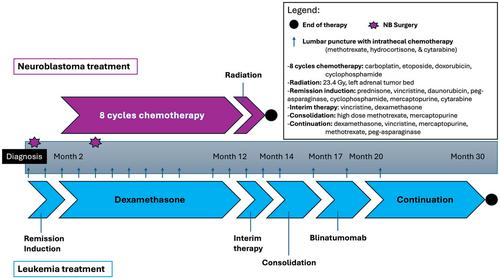
A 2-year-old male presented with limp, lymphadenopathy, and abdominal pain. Computed tomography (CT) identified a calcified mass arising from the adrenal gland. Lymphoblasts were identified on peripheral blood smear. Bone marrow studies demonstrated 90% lymphoblasts, and patient therefore diagnosed with low-risk B lymphoblastic leukemia (B-ALL). White blood cell count was 8.09 × 10⁹/L, no central nervous system (CNS) involvement, and next-generation sequencing revealed high-hyperdiploid (55–57 chromosomes; alterations of NRAS, PTPN11, and PAX5). The adrenal mass was resected; pathology showed unfavorable histology, MYCN nonamplified NB. A postoperative meta-iodobenzylguanidine (MIBG) scan identified two avid lymph nodes in the tumor bed. NB was staged as L1 disease and classified low risk. Figure 1 describes the following treatment plan.
Therapy for B-ALL was initiated as per St. Jude Total XVI protocol,6 with remission induction therapy (prednisone, vincristine, daunorubicin, peg-asparaginase, cyclophosphamide, mercaptopurine, cytarabine, and triple intrathecal chemotherapy [methotrexate, hydrocortisone, and cytarabine or “MHA”]). Day 15 bone marrow minimal residual disease (MRD) identified 0.375% lymphoblasts, and end-of-induction MRD was negative.
As the patient completed ALL remission induction therapy, comprehensive NB testing identified segmental copy number aberrations (SCAs) including 11q loss of heterozygosity (LOH), 17q gain, and 1p36 subclonal deletion. No germline cancer predisposition gene alterations were identified. Surveillance CT revealed local disease progression in the tumor bed. Subsequently, intermediate-risk NB treatment was initiated as per A3961 (carboplatin, etoposide, doxorubicin, cyclophosphamide).7 Concurrent oral dexamethasone and intrathecal chemotherapy were given for leukemia control while the patient received NB chemotherapy. Granulocyte colony-stimulating factor (G-CSF) was not administered due to risk of secondary hematological malignancy. Chemotherapy was dose adjusted for myelosuppression.
An NB disease evaluation demonstrated stable disease (SD), per revised International Neuroblastoma Response Criteria (INRC),8 with minimal anatomic improvement following the second chemotherapy cycle and persistent MIBG avidity. Thus, the patient underwent resection of left pararenal lymph nodes, eight total cycles of intermediate-risk NB chemotherapy, and proton radiation to tumor bed due to high risk of local recurrence in the setting of multiple SCAs.9 During radiation therapy, vincristine and dexamethasone were administered as interim leukemia therapy.
After completing NB therapy, consolidation and continuation therapy for ALL was planned, as per St. Jude Total XVI protocol.6 However, the patient experienced treatment toxicity (myelosuppression) during consolidation. Therefore, two cycles of blinatumomab were administered without significant complications. Blinatumomab was followed by continuation therapy as per low-risk Total XVI protocol (dexamethasone, vincristine, mercaptopurine, methotrexate, and peg-asparaginase).6 The patient completed ALL treatment 2.5 years following diagnosis.
The patient is 34 months post completion of NB therapy and 12 months post completion of ALL therapy without evidence of disease.
The treatment of a patient with two concurrent malignancies requires a unique therapeutic approach, combining therapies and modalities targeting both malignancies while mitigating toxicities. NB treatment can range from observation or resection only (low risk) to multimodal therapy requiring chemotherapy, surgery, radiation, myeloablative therapy with autologous stem cell transplant, immunotherapy, and isotretinoin (high risk). ALL therapy is also dictated by risk classification and may include some or all the following: chemotherapy, intrathecal chemotherapy, immunotherapy, chimeric antigen receptor (CAR) T-cell therapy, and allogeneic stem cell transplant. Two specific strategies can be learned from this case.
First, it is imperative to treat the disease with highest risk of rapid progression leading to worsened risk classification or death. In the referenced patient, at diagnosis the adrenal mass was localized with near complete surgical resection and lacked the most aggressive biologic feature (MYCN amplification). Therefore, risk of NB leading to acute clinical decompensation was lower than risks related to rapid ALL progression, and initial chemotherapy regimen targeted leukemia treatment. However, when surveillance imaging for NB demonstrated local NB progression (and three SCAs identified), the treatment paradigm shifted to address the actively progressing NB. In this case, intermediate-risk chemotherapy was given to treat NB and maintenance therapy administered to maintain ALL remission.
Second, therapy combinations used to treat both malignancies must be considered while mitigating overlapping toxicities. In this case, dexamethasone (to maintain leukemia remission) was successfully added to intermediate-risk NB chemotherapy, and vincristine plus dexamethasone (as leukemia maintenance) was tolerated during focal radiation for NB treatment. However, treatment required omission of certain aspects of therapy and replacement with alternative treatments. G-CSF typically used for myelosuppression following NB chemotherapy was omitted due to theoretical increased risk of secondary leukemia, leading to prolonged neutropenia requiring NB chemotherapy dosage reductions. Once the patient reached consolidation and continuation therapy for ALL, there was significant prolonged myelosuppression. Thus, immunotherapy (blinatumomab) was administered as a less myelosuppressive alternative consolidation given its known treatment effect in B-ALL.10
In summary, we describe the first successful treatment of a patient with concurrent ALL and NB. The treatment strategies required a unique therapeutic approach. However, combining therapies and modalities targeting both malignancies while mitigating toxicities was achieved. Similar approaches can be used for future rare patients requiring treatment for concurrent cancer diagnoses.
The authors declare they have no conflicts of interest.
期刊介绍:
Pediatric Blood & Cancer publishes the highest quality manuscripts describing basic and clinical investigations of blood disorders and malignant diseases of childhood including diagnosis, treatment, epidemiology, etiology, biology, and molecular and clinical genetics of these diseases as they affect children, adolescents, and young adults. Pediatric Blood & Cancer will also include studies on such treatment options as hematopoietic stem cell transplantation, immunology, and gene therapy.




 京公网安备 11010802042870号
京ICP备2023020795号-1
京公网安备 11010802042870号
京ICP备2023020795号-1

 分享
分享
 求助内容:
求助内容: 应助结果提醒方式:
 扫码关注我们
