David P. Vaughan MRCPI, Riona Fumi MSc, Marte Theilmann Jensen MSc, Megan Hodgson MSc, Tatiana Georgiades MSc, Lesley Wu MSc, Danielle Lux MRCP, Ruth Obrocki MRCP, Jennifer Lamoureux PhD, Olaf Ansorge FRCPath, PhD, Kieren S.J. Allinson FRCPath, PhD, Thomas T. Warner FRCP, PhD, Zane Jaunmuktane FRCPath, Anjum Misbahuddin FRCP, PhD, P. Nigel Leigh FMedSci, PhD, Boyd C.P. Ghosh FRCP, PhD, Kailash P. Bhatia FRCP, Alistair Church FRCP, Christopher Kobylecki FRCP, PhD, Michele T.M. Hu FRCP, PhD, James B. Rowe FRCP, PhD, Cornelis Blauwendraat PhD, Huw R. Morris FRCP, PhD, Edwin Jabbari MRCP, PhD
{"title":"对进行性核上性麻痹和皮质基底综合征脑脊液α-突触核蛋白种子扩增测定的评估","authors":"David P. Vaughan MRCPI, Riona Fumi MSc, Marte Theilmann Jensen MSc, Megan Hodgson MSc, Tatiana Georgiades MSc, Lesley Wu MSc, Danielle Lux MRCP, Ruth Obrocki MRCP, Jennifer Lamoureux PhD, Olaf Ansorge FRCPath, PhD, Kieren S.J. Allinson FRCPath, PhD, Thomas T. Warner FRCP, PhD, Zane Jaunmuktane FRCPath, Anjum Misbahuddin FRCP, PhD, P. Nigel Leigh FMedSci, PhD, Boyd C.P. Ghosh FRCP, PhD, Kailash P. Bhatia FRCP, Alistair Church FRCP, Christopher Kobylecki FRCP, PhD, Michele T.M. Hu FRCP, PhD, James B. Rowe FRCP, PhD, Cornelis Blauwendraat PhD, Huw R. Morris FRCP, PhD, Edwin Jabbari MRCP, PhD","doi":"10.1002/mds.30019","DOIUrl":null,"url":null,"abstract":"<div>\n \n \n <section>\n \n <h3> Background</h3>\n \n <p>Seed amplification assay (SAA) testing has been developed as a biomarker for the diagnosis of α-synuclein-related neurodegenerative disorders.</p>\n </section>\n \n <section>\n \n <h3> Objective</h3>\n \n <p>The objective of this study was to assess the rate of α-synuclein SAA positivity in progressive supranuclear palsy (PSP) and corticobasal syndrome (CBS) and to analyze clinical and pathological features of SAA-positive and -negative cases.</p>\n </section>\n \n <section>\n \n <h3> Methods</h3>\n \n <p>A total of 96 cerebrospinal fluid samples from clinically diagnosed PSP (n = 59) and CBS (n = 37) cases were analyzed using α-synuclein SAA.</p>\n </section>\n \n <section>\n \n <h3> Results</h3>\n \n <p>Six of 59 (10.2%) PSP cases were α-synuclein SAA positive, including one case who was MSA-type positive. An exploratory analysis showed that PSP cases who were Parkinson's disease–type positive were older and had a shorter disease duration compared with SAA-negative cases. In contrast, 11 of 37 (29.7%) CBS cases were α-synuclein SAA positive, including two cases who were MSA-type positive.</p>\n </section>\n \n <section>\n \n <h3> Conclusions</h3>\n \n <p>Our results suggest that α-synuclein seeds can be detected in PSP and CBS using a cerebrospinal fluid α-synuclein SAA, and in PSP this may impact on clinical course.</p>\n </section>\n </div>","PeriodicalId":213,"journal":{"name":"Movement Disorders","volume":"39 12","pages":"2285-2291"},"PeriodicalIF":7.7000,"publicationDate":"2024-09-20","publicationTypes":"Journal Article","fieldsOfStudy":null,"isOpenAccess":false,"openAccessPdf":"https://onlinelibrary.wiley.com/doi/epdf/10.1002/mds.30019","citationCount":"0","resultStr":"{\"title\":\"Evaluation of Cerebrospinal Fluid α-Synuclein Seed Amplification Assay in Progressive Supranuclear Palsy and Corticobasal Syndrome\",\"authors\":\"David P. Vaughan MRCPI, Riona Fumi MSc, Marte Theilmann Jensen MSc, Megan Hodgson MSc, Tatiana Georgiades MSc, Lesley Wu MSc, Danielle Lux MRCP, Ruth Obrocki MRCP, Jennifer Lamoureux PhD, Olaf Ansorge FRCPath, PhD, Kieren S.J. Allinson FRCPath, PhD, Thomas T. Warner FRCP, PhD, Zane Jaunmuktane FRCPath, Anjum Misbahuddin FRCP, PhD, P. Nigel Leigh FMedSci, PhD, Boyd C.P. Ghosh FRCP, PhD, Kailash P. Bhatia FRCP, Alistair Church FRCP, Christopher Kobylecki FRCP, PhD, Michele T.M. Hu FRCP, PhD, James B. Rowe FRCP, PhD, Cornelis Blauwendraat PhD, Huw R. Morris FRCP, PhD, Edwin Jabbari MRCP, PhD\",\"doi\":\"10.1002/mds.30019\",\"DOIUrl\":null,\"url\":null,\"abstract\":\"<div>\\n \\n \\n <section>\\n \\n <h3> Background</h3>\\n \\n <p>Seed amplification assay (SAA) testing has been developed as a biomarker for the diagnosis of α-synuclein-related neurodegenerative disorders.</p>\\n </section>\\n \\n <section>\\n \\n <h3> Objective</h3>\\n \\n <p>The objective of this study was to assess the rate of α-synuclein SAA positivity in progressive supranuclear palsy (PSP) and corticobasal syndrome (CBS) and to analyze clinical and pathological features of SAA-positive and -negative cases.</p>\\n </section>\\n \\n <section>\\n \\n <h3> Methods</h3>\\n \\n <p>A total of 96 cerebrospinal fluid samples from clinically diagnosed PSP (n = 59) and CBS (n = 37) cases were analyzed using α-synuclein SAA.</p>\\n </section>\\n \\n <section>\\n \\n <h3> Results</h3>\\n \\n <p>Six of 59 (10.2%) PSP cases were α-synuclein SAA positive, including one case who was MSA-type positive. An exploratory analysis showed that PSP cases who were Parkinson's disease–type positive were older and had a shorter disease duration compared with SAA-negative cases. In contrast, 11 of 37 (29.7%) CBS cases were α-synuclein SAA positive, including two cases who were MSA-type positive.</p>\\n </section>\\n \\n <section>\\n \\n <h3> Conclusions</h3>\\n \\n <p>Our results suggest that α-synuclein seeds can be detected in PSP and CBS using a cerebrospinal fluid α-synuclein SAA, and in PSP this may impact on clinical course.</p>\\n </section>\\n </div>\",\"PeriodicalId\":213,\"journal\":{\"name\":\"Movement Disorders\",\"volume\":\"39 12\",\"pages\":\"2285-2291\"},\"PeriodicalIF\":7.7000,\"publicationDate\":\"2024-09-20\",\"publicationTypes\":\"Journal Article\",\"fieldsOfStudy\":null,\"isOpenAccess\":false,\"openAccessPdf\":\"https://onlinelibrary.wiley.com/doi/epdf/10.1002/mds.30019\",\"citationCount\":\"0\",\"resultStr\":null,\"platform\":\"Semanticscholar\",\"paperid\":null,\"PeriodicalName\":\"Movement Disorders\",\"FirstCategoryId\":\"3\",\"ListUrlMain\":\"https://movementdisorders.onlinelibrary.wiley.com/doi/10.1002/mds.30019\",\"RegionNum\":1,\"RegionCategory\":\"医学\",\"ArticlePicture\":[],\"TitleCN\":null,\"AbstractTextCN\":null,\"PMCID\":null,\"EPubDate\":\"\",\"PubModel\":\"\",\"JCR\":\"Q1\",\"JCRName\":\"CLINICAL NEUROLOGY\",\"Score\":null,\"Total\":0}","platform":"Semanticscholar","paperid":null,"PeriodicalName":"Movement Disorders","FirstCategoryId":"3","ListUrlMain":"https://movementdisorders.onlinelibrary.wiley.com/doi/10.1002/mds.30019","RegionNum":1,"RegionCategory":"医学","ArticlePicture":[],"TitleCN":null,"AbstractTextCN":null,"PMCID":null,"EPubDate":"","PubModel":"","JCR":"Q1","JCRName":"CLINICAL NEUROLOGY","Score":null,"Total":0}
Evaluation of Cerebrospinal Fluid α-Synuclein Seed Amplification Assay in Progressive Supranuclear Palsy and Corticobasal Syndrome
Background
Seed amplification assay (SAA) testing has been developed as a biomarker for the diagnosis of α-synuclein-related neurodegenerative disorders.
Objective
The objective of this study was to assess the rate of α-synuclein SAA positivity in progressive supranuclear palsy (PSP) and corticobasal syndrome (CBS) and to analyze clinical and pathological features of SAA-positive and -negative cases.
Methods
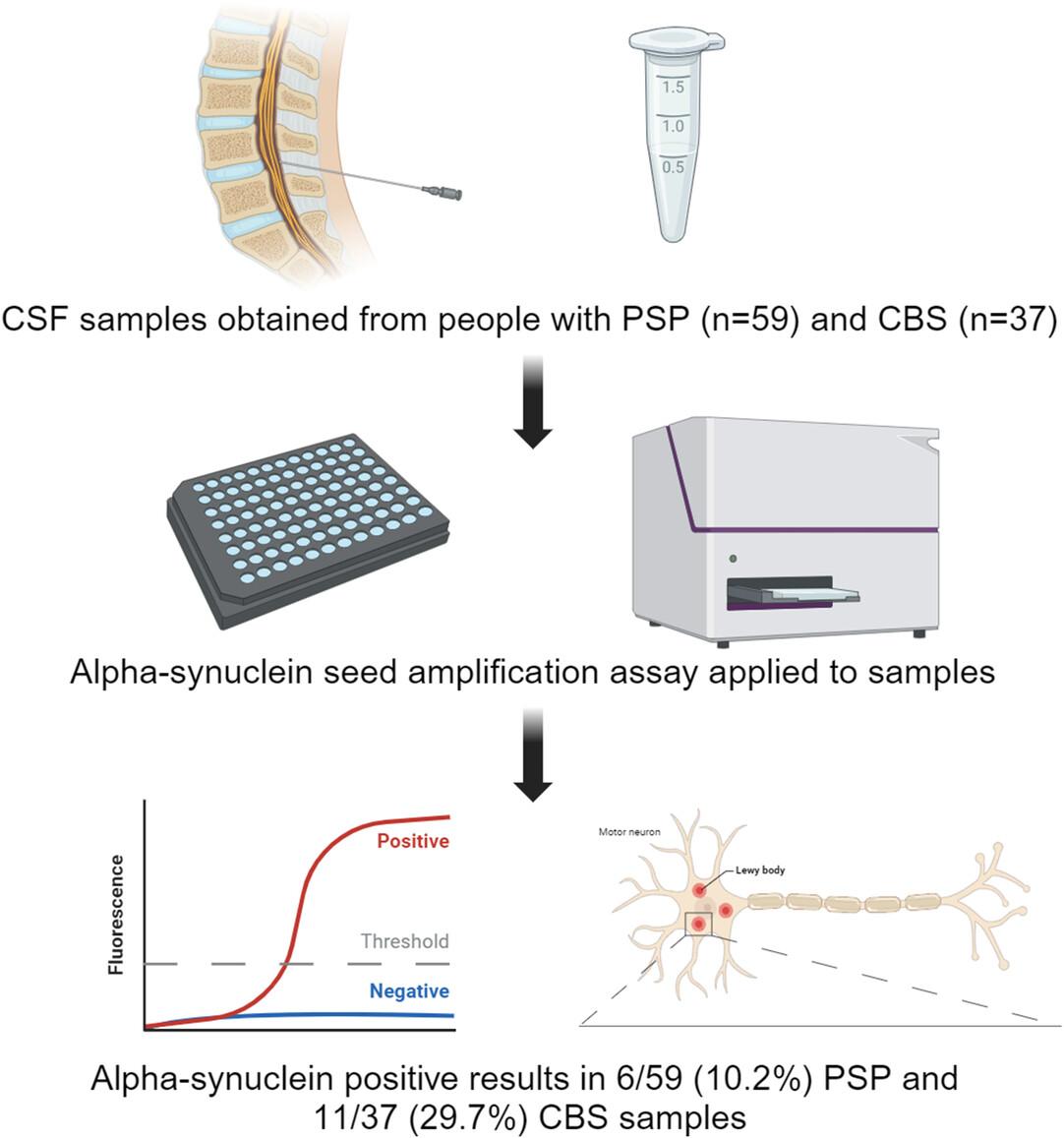
A total of 96 cerebrospinal fluid samples from clinically diagnosed PSP (n = 59) and CBS (n = 37) cases were analyzed using α-synuclein SAA.
Results
Six of 59 (10.2%) PSP cases were α-synuclein SAA positive, including one case who was MSA-type positive. An exploratory analysis showed that PSP cases who were Parkinson's disease–type positive were older and had a shorter disease duration compared with SAA-negative cases. In contrast, 11 of 37 (29.7%) CBS cases were α-synuclein SAA positive, including two cases who were MSA-type positive.
Conclusions
Our results suggest that α-synuclein seeds can be detected in PSP and CBS using a cerebrospinal fluid α-synuclein SAA, and in PSP this may impact on clinical course.
期刊介绍:
Movement Disorders publishes a variety of content types including Reviews, Viewpoints, Full Length Articles, Historical Reports, Brief Reports, and Letters. The journal considers original manuscripts on topics related to the diagnosis, therapeutics, pharmacology, biochemistry, physiology, etiology, genetics, and epidemiology of movement disorders. Appropriate topics include Parkinsonism, Chorea, Tremors, Dystonia, Myoclonus, Tics, Tardive Dyskinesia, Spasticity, and Ataxia.





 京公网安备 11010802042870号
京ICP备2023020795号-1
京公网安备 11010802042870号
京ICP备2023020795号-1

 分享
分享
 求助内容:
求助内容: 应助结果提醒方式:
 扫码关注我们
