Kirti Dhingra, Neha Saini, Amit Kumar and Kamalakannan Kailasam
{"title":"利用合作光催化技术同时生产太阳能燃料和增值化学品:以无金属卟啉为基础的聚合物网络为媒介","authors":"Kirti Dhingra, Neha Saini, Amit Kumar and Kamalakannan Kailasam","doi":"10.1039/D4TA04445B","DOIUrl":null,"url":null,"abstract":"<p >Limitations in the conventional energy-intensive anthraquinone oxidation process for H<small><sub>2</sub></small>O<small><sub>2</sub></small> production have led researchers to develop an environmentally sustainable, energy-efficient, and cost-effective approach. The photocatalytic H<small><sub>2</sub></small>O<small><sub>2</sub></small> generation from molecular oxygen has emerged as a leading edge in sustainable technology development, yet efficiency remains a key challenge. Various sacrificial agents are added to the reaction medium to improve efficiency, but their underutilization is the primary concern. To address this issue, we design a reaction system that considers the selective oxidation of the sacrificial agent along with the reduction of oxygen. Notably, we constructed a metal-free organic polymer Porp-Tz exhibiting broad visible light absorption and suitable band positions that consider the efficient reduction of O<small><sub>2</sub></small> for the co-production of H<small><sub>2</sub></small>O<small><sub>2</sub></small> with a remarkable generation rate of 25.13 mmol g<small><sup>−1</sup></small> h<small><sup>−1</sup></small> along with the synthesis of industrially important chemical <em>N</em>-benzylidenebenzylamine (AQY = 7.9% at 420 nm). In addition, the concurrent production of regioselective 3,4-dihydroisoquinolines (DHIQs) from tetrahydroisoquinolines (THIQs) alongside the H<small><sub>2</sub></small>O<small><sub>2</sub></small> generation rate of 13.34 mmol g<small><sup>−1</sup></small> h<small><sup>−1</sup></small> was explored. Moreover, the photocatalytic reaction mechanism highlights the synergistic role of the reactive oxygen species (O<small><sub>2</sub></small>˙<small><sup>−</sup></small> and <small><sup>1</sup></small>O<small><sub>2</sub></small>), h<small><sup>+</sup></small>, and proton donors, providing a comprehensive understanding of the photocatalytic process. This study emphasizes new insights into deploying the next-generation multifunctional polymeric framework for the photocatalytic co-production of solar fuel and the selective synthesis of fine value-added chemicals, broadening the scope of porous organic polymers for potential industrial interest.</p>","PeriodicalId":82,"journal":{"name":"Journal of Materials Chemistry A","volume":" 43","pages":" 29657-29668"},"PeriodicalIF":9.5000,"publicationDate":"2024-09-21","publicationTypes":"Journal Article","fieldsOfStudy":null,"isOpenAccess":false,"openAccessPdf":"","citationCount":"0","resultStr":"{\"title\":\"Leveraging cooperative photocatalysis for the concurrent production of solar fuels and value-added chemicals: mediated by a metal-free porphyrin-based polymeric framework†\",\"authors\":\"Kirti Dhingra, Neha Saini, Amit Kumar and Kamalakannan Kailasam\",\"doi\":\"10.1039/D4TA04445B\",\"DOIUrl\":null,\"url\":null,\"abstract\":\"<p >Limitations in the conventional energy-intensive anthraquinone oxidation process for H<small><sub>2</sub></small>O<small><sub>2</sub></small> production have led researchers to develop an environmentally sustainable, energy-efficient, and cost-effective approach. The photocatalytic H<small><sub>2</sub></small>O<small><sub>2</sub></small> generation from molecular oxygen has emerged as a leading edge in sustainable technology development, yet efficiency remains a key challenge. Various sacrificial agents are added to the reaction medium to improve efficiency, but their underutilization is the primary concern. To address this issue, we design a reaction system that considers the selective oxidation of the sacrificial agent along with the reduction of oxygen. Notably, we constructed a metal-free organic polymer Porp-Tz exhibiting broad visible light absorption and suitable band positions that consider the efficient reduction of O<small><sub>2</sub></small> for the co-production of H<small><sub>2</sub></small>O<small><sub>2</sub></small> with a remarkable generation rate of 25.13 mmol g<small><sup>−1</sup></small> h<small><sup>−1</sup></small> along with the synthesis of industrially important chemical <em>N</em>-benzylidenebenzylamine (AQY = 7.9% at 420 nm). In addition, the concurrent production of regioselective 3,4-dihydroisoquinolines (DHIQs) from tetrahydroisoquinolines (THIQs) alongside the H<small><sub>2</sub></small>O<small><sub>2</sub></small> generation rate of 13.34 mmol g<small><sup>−1</sup></small> h<small><sup>−1</sup></small> was explored. Moreover, the photocatalytic reaction mechanism highlights the synergistic role of the reactive oxygen species (O<small><sub>2</sub></small>˙<small><sup>−</sup></small> and <small><sup>1</sup></small>O<small><sub>2</sub></small>), h<small><sup>+</sup></small>, and proton donors, providing a comprehensive understanding of the photocatalytic process. This study emphasizes new insights into deploying the next-generation multifunctional polymeric framework for the photocatalytic co-production of solar fuel and the selective synthesis of fine value-added chemicals, broadening the scope of porous organic polymers for potential industrial interest.</p>\",\"PeriodicalId\":82,\"journal\":{\"name\":\"Journal of Materials Chemistry A\",\"volume\":\" 43\",\"pages\":\" 29657-29668\"},\"PeriodicalIF\":9.5000,\"publicationDate\":\"2024-09-21\",\"publicationTypes\":\"Journal Article\",\"fieldsOfStudy\":null,\"isOpenAccess\":false,\"openAccessPdf\":\"\",\"citationCount\":\"0\",\"resultStr\":null,\"platform\":\"Semanticscholar\",\"paperid\":null,\"PeriodicalName\":\"Journal of Materials Chemistry A\",\"FirstCategoryId\":\"88\",\"ListUrlMain\":\"https://pubs.rsc.org/en/content/articlelanding/2024/ta/d4ta04445b\",\"RegionNum\":2,\"RegionCategory\":\"材料科学\",\"ArticlePicture\":[],\"TitleCN\":null,\"AbstractTextCN\":null,\"PMCID\":null,\"EPubDate\":\"\",\"PubModel\":\"\",\"JCR\":\"Q1\",\"JCRName\":\"CHEMISTRY, PHYSICAL\",\"Score\":null,\"Total\":0}","platform":"Semanticscholar","paperid":null,"PeriodicalName":"Journal of Materials Chemistry A","FirstCategoryId":"88","ListUrlMain":"https://pubs.rsc.org/en/content/articlelanding/2024/ta/d4ta04445b","RegionNum":2,"RegionCategory":"材料科学","ArticlePicture":[],"TitleCN":null,"AbstractTextCN":null,"PMCID":null,"EPubDate":"","PubModel":"","JCR":"Q1","JCRName":"CHEMISTRY, PHYSICAL","Score":null,"Total":0}
Leveraging cooperative photocatalysis for the concurrent production of solar fuels and value-added chemicals: mediated by a metal-free porphyrin-based polymeric framework†
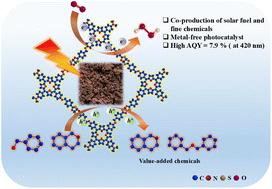
Limitations in the conventional energy-intensive anthraquinone oxidation process for H2O2 production have led researchers to develop an environmentally sustainable, energy-efficient, and cost-effective approach. The photocatalytic H2O2 generation from molecular oxygen has emerged as a leading edge in sustainable technology development, yet efficiency remains a key challenge. Various sacrificial agents are added to the reaction medium to improve efficiency, but their underutilization is the primary concern. To address this issue, we design a reaction system that considers the selective oxidation of the sacrificial agent along with the reduction of oxygen. Notably, we constructed a metal-free organic polymer Porp-Tz exhibiting broad visible light absorption and suitable band positions that consider the efficient reduction of O2 for the co-production of H2O2 with a remarkable generation rate of 25.13 mmol g−1 h−1 along with the synthesis of industrially important chemical N-benzylidenebenzylamine (AQY = 7.9% at 420 nm). In addition, the concurrent production of regioselective 3,4-dihydroisoquinolines (DHIQs) from tetrahydroisoquinolines (THIQs) alongside the H2O2 generation rate of 13.34 mmol g−1 h−1 was explored. Moreover, the photocatalytic reaction mechanism highlights the synergistic role of the reactive oxygen species (O2˙− and 1O2), h+, and proton donors, providing a comprehensive understanding of the photocatalytic process. This study emphasizes new insights into deploying the next-generation multifunctional polymeric framework for the photocatalytic co-production of solar fuel and the selective synthesis of fine value-added chemicals, broadening the scope of porous organic polymers for potential industrial interest.
期刊介绍:
The Journal of Materials Chemistry A, B & C covers a wide range of high-quality studies in the field of materials chemistry, with each section focusing on specific applications of the materials studied. Journal of Materials Chemistry A emphasizes applications in energy and sustainability, including topics such as artificial photosynthesis, batteries, and fuel cells. Journal of Materials Chemistry B focuses on applications in biology and medicine, while Journal of Materials Chemistry C covers applications in optical, magnetic, and electronic devices. Example topic areas within the scope of Journal of Materials Chemistry A include catalysis, green/sustainable materials, sensors, and water treatment, among others.




 京公网安备 11010802042870号
京ICP备2023020795号-1
京公网安备 11010802042870号
京ICP备2023020795号-1

 分享
分享
 求助内容:
求助内容: 应助结果提醒方式:
 扫码关注我们
