{"title":"利用稳态线宽分析测量原子磁力计密封单元的内部温度","authors":"Hong Zhang , Sheng Zou , Wei Quan , Xiyuan Chen","doi":"10.1016/j.sna.2024.115900","DOIUrl":null,"url":null,"abstract":"<div><p>We report a non-destructive and <em>in-situ</em> measurement technique to infer the internal temperature inside a sealed cell of an atomic magnetometer, based on steady-state linewidth analysis. This approach exploits the relationship between the alkali vapor density and the steady-state linewidth of the magnetometer in the presence of an applied DC magnetic field, particularly when the spin polarization of the alkali metal is significantly low (<span><math><mrow><mi>P</mi><mo>≪</mo><mn>1</mn></mrow></math></span>). The atomic density inside the cell is a univariate nonlinear function of the cell temperature, enabling us to establish a model linking the magnetometer’s steady-state linewidth to the internal temperature of the cell. To validate the accuracy and feasibility of this method, we conducted a series of experiments over a wide temperature range, from 140 °C to 190 °C. Using the magnetometer’s steady-state linewidth as a key parameter, we successfully measured the actual temperature inside the cell. The test results were corrected to ensure precision and reliability, and comprehensive evaluations of measurement uncertainty were performed to quantify the confidence level in the temperature measurements. This novel determination method marks a significant advancement in atomic magnetometer temperature measurement, offering real-time and on-site monitoring capabilities within sealed cells.</p></div>","PeriodicalId":21689,"journal":{"name":"Sensors and Actuators A-physical","volume":"379 ","pages":"Article 115900"},"PeriodicalIF":5.1000,"publicationDate":"2024-12-01","publicationTypes":"Journal Article","fieldsOfStudy":null,"isOpenAccess":false,"openAccessPdf":"","citationCount":"0","resultStr":"{\"title\":\"Measuring internal temperature inside a sealed cell of an atomic magnetometer using steady-state linewidth analysis\",\"authors\":\"Hong Zhang , Sheng Zou , Wei Quan , Xiyuan Chen\",\"doi\":\"10.1016/j.sna.2024.115900\",\"DOIUrl\":null,\"url\":null,\"abstract\":\"<div><p>We report a non-destructive and <em>in-situ</em> measurement technique to infer the internal temperature inside a sealed cell of an atomic magnetometer, based on steady-state linewidth analysis. This approach exploits the relationship between the alkali vapor density and the steady-state linewidth of the magnetometer in the presence of an applied DC magnetic field, particularly when the spin polarization of the alkali metal is significantly low (<span><math><mrow><mi>P</mi><mo>≪</mo><mn>1</mn></mrow></math></span>). The atomic density inside the cell is a univariate nonlinear function of the cell temperature, enabling us to establish a model linking the magnetometer’s steady-state linewidth to the internal temperature of the cell. To validate the accuracy and feasibility of this method, we conducted a series of experiments over a wide temperature range, from 140 °C to 190 °C. Using the magnetometer’s steady-state linewidth as a key parameter, we successfully measured the actual temperature inside the cell. The test results were corrected to ensure precision and reliability, and comprehensive evaluations of measurement uncertainty were performed to quantify the confidence level in the temperature measurements. This novel determination method marks a significant advancement in atomic magnetometer temperature measurement, offering real-time and on-site monitoring capabilities within sealed cells.</p></div>\",\"PeriodicalId\":21689,\"journal\":{\"name\":\"Sensors and Actuators A-physical\",\"volume\":\"379 \",\"pages\":\"Article 115900\"},\"PeriodicalIF\":5.1000,\"publicationDate\":\"2024-12-01\",\"publicationTypes\":\"Journal Article\",\"fieldsOfStudy\":null,\"isOpenAccess\":false,\"openAccessPdf\":\"\",\"citationCount\":\"0\",\"resultStr\":null,\"platform\":\"Semanticscholar\",\"paperid\":null,\"PeriodicalName\":\"Sensors and Actuators A-physical\",\"FirstCategoryId\":\"5\",\"ListUrlMain\":\"https://www.sciencedirect.com/science/article/pii/S092442472400894X\",\"RegionNum\":3,\"RegionCategory\":\"工程技术\",\"ArticlePicture\":[],\"TitleCN\":null,\"AbstractTextCN\":null,\"PMCID\":null,\"EPubDate\":\"2024/9/12 0:00:00\",\"PubModel\":\"Epub\",\"JCR\":\"Q2\",\"JCRName\":\"ENGINEERING, ELECTRICAL & ELECTRONIC\",\"Score\":null,\"Total\":0}","platform":"Semanticscholar","paperid":null,"PeriodicalName":"Sensors and Actuators A-physical","FirstCategoryId":"5","ListUrlMain":"https://www.sciencedirect.com/science/article/pii/S092442472400894X","RegionNum":3,"RegionCategory":"工程技术","ArticlePicture":[],"TitleCN":null,"AbstractTextCN":null,"PMCID":null,"EPubDate":"2024/9/12 0:00:00","PubModel":"Epub","JCR":"Q2","JCRName":"ENGINEERING, ELECTRICAL & ELECTRONIC","Score":null,"Total":0}
引用次数: 0
摘要
我们报告了一种基于稳态线宽分析的非破坏性原位测量技术,用于推断原子磁强计密封单元的内部温度。这种方法利用了碱蒸气密度与外加直流磁场下磁力计稳态线宽之间的关系,尤其是当碱金属的自旋极化显著较低时(P≪1)。电池内部的原子密度是电池温度的单变量非线性函数,这使我们能够建立一个模型,将磁力计的稳态线宽与电池内部温度联系起来。为了验证这种方法的准确性和可行性,我们在 140 °C 至 190 °C 的宽温度范围内进行了一系列实验。利用磁强计的稳态线宽作为关键参数,我们成功测量了电池内部的实际温度。我们对测试结果进行了校正,以确保精度和可靠性,并对测量不确定性进行了全面评估,以量化温度测量的置信度。这种新颖的测定方法标志着原子磁强计温度测量的重大进步,为密封电池提供了实时和现场监测能力。
Measuring internal temperature inside a sealed cell of an atomic magnetometer using steady-state linewidth analysis
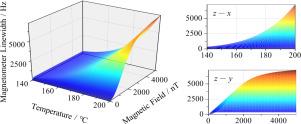
We report a non-destructive and in-situ measurement technique to infer the internal temperature inside a sealed cell of an atomic magnetometer, based on steady-state linewidth analysis. This approach exploits the relationship between the alkali vapor density and the steady-state linewidth of the magnetometer in the presence of an applied DC magnetic field, particularly when the spin polarization of the alkali metal is significantly low (). The atomic density inside the cell is a univariate nonlinear function of the cell temperature, enabling us to establish a model linking the magnetometer’s steady-state linewidth to the internal temperature of the cell. To validate the accuracy and feasibility of this method, we conducted a series of experiments over a wide temperature range, from 140 °C to 190 °C. Using the magnetometer’s steady-state linewidth as a key parameter, we successfully measured the actual temperature inside the cell. The test results were corrected to ensure precision and reliability, and comprehensive evaluations of measurement uncertainty were performed to quantify the confidence level in the temperature measurements. This novel determination method marks a significant advancement in atomic magnetometer temperature measurement, offering real-time and on-site monitoring capabilities within sealed cells.
期刊介绍:
Sensors and Actuators A: Physical brings together multidisciplinary interests in one journal entirely devoted to disseminating information on all aspects of research and development of solid-state devices for transducing physical signals. Sensors and Actuators A: Physical regularly publishes original papers, letters to the Editors and from time to time invited review articles within the following device areas:
• Fundamentals and Physics, such as: classification of effects, physical effects, measurement theory, modelling of sensors, measurement standards, measurement errors, units and constants, time and frequency measurement. Modeling papers should bring new modeling techniques to the field and be supported by experimental results.
• Materials and their Processing, such as: piezoelectric materials, polymers, metal oxides, III-V and II-VI semiconductors, thick and thin films, optical glass fibres, amorphous, polycrystalline and monocrystalline silicon.
• Optoelectronic sensors, such as: photovoltaic diodes, photoconductors, photodiodes, phototransistors, positron-sensitive photodetectors, optoisolators, photodiode arrays, charge-coupled devices, light-emitting diodes, injection lasers and liquid-crystal displays.
• Mechanical sensors, such as: metallic, thin-film and semiconductor strain gauges, diffused silicon pressure sensors, silicon accelerometers, solid-state displacement transducers, piezo junction devices, piezoelectric field-effect transducers (PiFETs), tunnel-diode strain sensors, surface acoustic wave devices, silicon micromechanical switches, solid-state flow meters and electronic flow controllers.
Etc...




 京公网安备 11010802042870号
京ICP备2023020795号-1
京公网安备 11010802042870号
京ICP备2023020795号-1

 分享
分享
 求助内容:
求助内容: 应助结果提醒方式:
 扫码关注我们
