Inheritance of chlorantraniliprole resistance and fitness costs in a field population of Cnaphalocrocis medinalis (Lepidoptera: Pyralidae) in China
BACKGROUND
Cnaphalocrocis medinalis is one of the major rice insect pests in Asia. Chlorantraniliprole is one of the most important insecticides for the control of C. medinalis. In this study, a field-resistant population and a susceptible strain of C. medinalis were used to evaluate the inheritance of chlorantraniliprole resistance and fitness costs in the field.
RESULTS
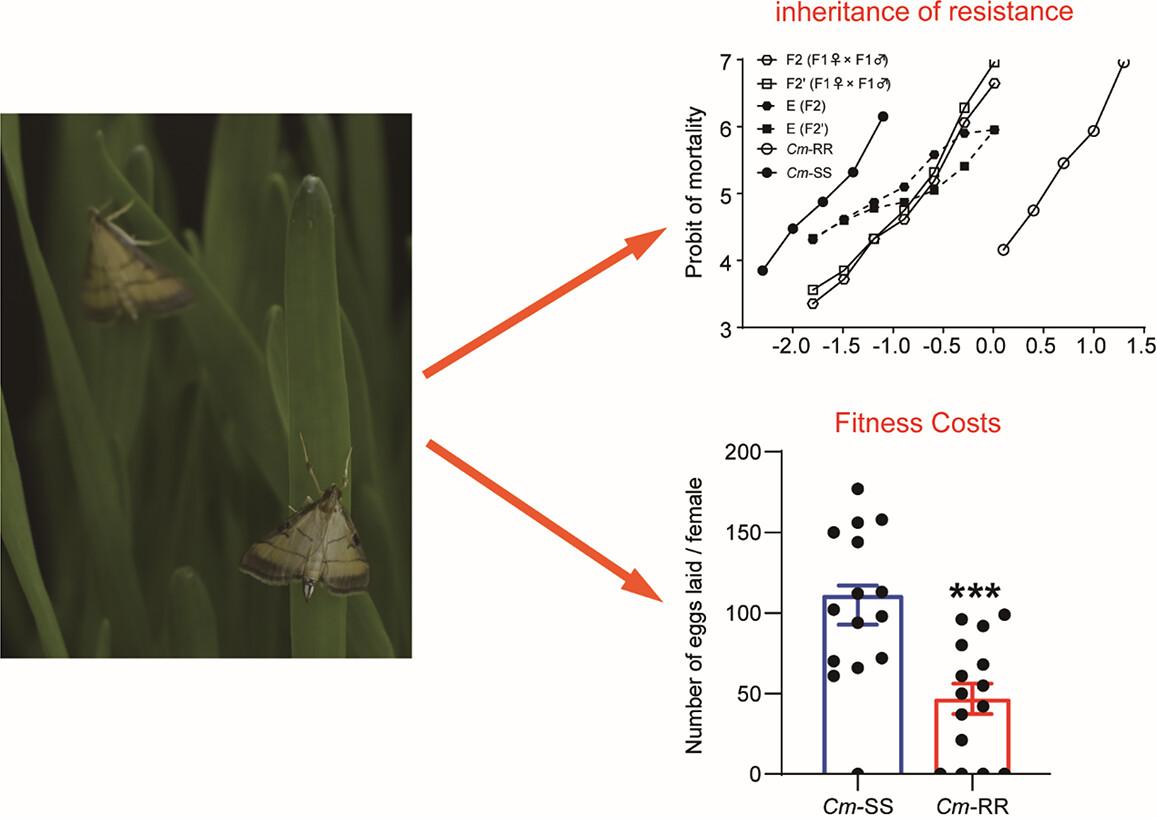
The field-resistant population (Cm-RR) showed 128.4-fold resistance to chlorantraniliprole compared with the susceptible strain (Cm-SS). The dose–response of reciprocal cross progeny (F1 and F1′) showed no significant difference, which indicated the inheritance of resistance to chlorantraniliprole in C. medinalis was autosomal. The degrees of dominance (D) of resistance for F1 and F1′ were −0.19 and −0.05, respectively, indicating that the chlorantraniliprole resistance of C. medinalis was incompletely recessive inheritance. At the same time, significant differences between observed and expected mortalities of self-cross (F2 and F2′) and backcross (BC and BC′) progenies suggested chlorantraniliprole resistance is controlled by multiple genes. Furthermore, the Cm-RR population had a relative fitness of 0.32 with a substantially decreased pupation rate, emergence rate, fecundity, and substantially increased developmental time of larval and pupa stages.
期刊介绍:
Pest Management Science is the international journal of research and development in crop protection and pest control. Since its launch in 1970, the journal has become the premier forum for papers on the discovery, application, and impact on the environment of products and strategies designed for pest management.
Published for SCI by John Wiley & Sons Ltd.






 京公网安备 11010802042870号
京ICP备2023020795号-1
京公网安备 11010802042870号
京ICP备2023020795号-1

 分享
分享
 求助内容:
求助内容: 应助结果提醒方式:
 扫码关注我们
