Samuel D. Spetalnick;Ashwin Sanjay Lele;Brian Crafton;Muya Chang;Sigang Ryu;Jong-Hyeok Yoon;Zhijian Hao;Azadeh Ansari;Win-San Khwa;Yu-Der Chih;Meng-Fan Chang;Arijit Raychowdhury
{"title":"配备 5 MB 0.256-pJ/bit 嵌入式 RRAM 的边缘加速器和用于鬃毛机器人监控的定位解算器","authors":"Samuel D. Spetalnick;Ashwin Sanjay Lele;Brian Crafton;Muya Chang;Sigang Ryu;Jong-Hyeok Yoon;Zhijian Hao;Azadeh Ansari;Win-San Khwa;Yu-Der Chih;Meng-Fan Chang;Arijit Raychowdhury","doi":"10.1109/JSSC.2024.3457676","DOIUrl":null,"url":null,"abstract":"Accelerators for miniaturized robots addressing tasks such as autonomous surveillance need to balance their compute capabilities against the requirements for low energy use and a compact form factor imposed by the small size of the platforms. Many applications require machine learning (ML) inference for perception tasks as well as estimation of the robot’s own trajectory for localization. The paradigm of using large on-die memories to store deep neural network (DNN) weights on-chip has the potential to yield improved efficiency by reducing off-chip memory accesses. By implementing these large weight stores on-die using an embedded nonvolatile memory (eNVM) technology, density can be improved while leakage can be reduced using power-down modes. Furthermore, the localization workflow requires the evaluation of state equations with concurrent addition operations. This presents a potential bottleneck, motivating a dedicated localization block. We introduce an accelerator combining a resistive random access memory (RRAM)-based inference subsection and a localization accelerator block using an SRAM-like cross-coupled structure. The inference subsection combines INT8 matrix datapaths with 5 MB of RRAM (<inline-formula> <tex-math>$2.07~{\\mathrm {Mb/mm}^{2}}$ </tex-math></inline-formula> considering the <inline-formula> <tex-math>$20.25\\text {-}\\mathrm {mm}^{2}$ </tex-math></inline-formula> die) at 0.256 pJ/bit and 12.8 GB/s, and supports an SRAM-retentive power-down mode consuming <inline-formula> <tex-math>$110~\\mathrm {\\mu W}$ </tex-math></inline-formula>. At full utilization, at <inline-formula> <tex-math>$V_{\\text {MIN}}$ </tex-math></inline-formula>, throughput is 102.4 GOPS and efficiency is 0.84 TOPS/W. The localization block allows voltage-pulse-driven data updates to support concurrent in-place addition to address the related bottleneck.","PeriodicalId":13129,"journal":{"name":"IEEE Journal of Solid-state Circuits","volume":"60 1","pages":"35-48"},"PeriodicalIF":5.6000,"publicationDate":"2024-09-19","publicationTypes":"Journal Article","fieldsOfStudy":null,"isOpenAccess":false,"openAccessPdf":"","citationCount":"0","resultStr":"{\"title\":\"An Edge Accelerator With 5 MB of 0.256-pJ/bit Embedded RRAM and a Localization Solver for Bristle Robot Surveillance\",\"authors\":\"Samuel D. Spetalnick;Ashwin Sanjay Lele;Brian Crafton;Muya Chang;Sigang Ryu;Jong-Hyeok Yoon;Zhijian Hao;Azadeh Ansari;Win-San Khwa;Yu-Der Chih;Meng-Fan Chang;Arijit Raychowdhury\",\"doi\":\"10.1109/JSSC.2024.3457676\",\"DOIUrl\":null,\"url\":null,\"abstract\":\"Accelerators for miniaturized robots addressing tasks such as autonomous surveillance need to balance their compute capabilities against the requirements for low energy use and a compact form factor imposed by the small size of the platforms. Many applications require machine learning (ML) inference for perception tasks as well as estimation of the robot’s own trajectory for localization. The paradigm of using large on-die memories to store deep neural network (DNN) weights on-chip has the potential to yield improved efficiency by reducing off-chip memory accesses. By implementing these large weight stores on-die using an embedded nonvolatile memory (eNVM) technology, density can be improved while leakage can be reduced using power-down modes. Furthermore, the localization workflow requires the evaluation of state equations with concurrent addition operations. This presents a potential bottleneck, motivating a dedicated localization block. We introduce an accelerator combining a resistive random access memory (RRAM)-based inference subsection and a localization accelerator block using an SRAM-like cross-coupled structure. The inference subsection combines INT8 matrix datapaths with 5 MB of RRAM (<inline-formula> <tex-math>$2.07~{\\\\mathrm {Mb/mm}^{2}}$ </tex-math></inline-formula> considering the <inline-formula> <tex-math>$20.25\\\\text {-}\\\\mathrm {mm}^{2}$ </tex-math></inline-formula> die) at 0.256 pJ/bit and 12.8 GB/s, and supports an SRAM-retentive power-down mode consuming <inline-formula> <tex-math>$110~\\\\mathrm {\\\\mu W}$ </tex-math></inline-formula>. At full utilization, at <inline-formula> <tex-math>$V_{\\\\text {MIN}}$ </tex-math></inline-formula>, throughput is 102.4 GOPS and efficiency is 0.84 TOPS/W. The localization block allows voltage-pulse-driven data updates to support concurrent in-place addition to address the related bottleneck.\",\"PeriodicalId\":13129,\"journal\":{\"name\":\"IEEE Journal of Solid-state Circuits\",\"volume\":\"60 1\",\"pages\":\"35-48\"},\"PeriodicalIF\":5.6000,\"publicationDate\":\"2024-09-19\",\"publicationTypes\":\"Journal Article\",\"fieldsOfStudy\":null,\"isOpenAccess\":false,\"openAccessPdf\":\"\",\"citationCount\":\"0\",\"resultStr\":null,\"platform\":\"Semanticscholar\",\"paperid\":null,\"PeriodicalName\":\"IEEE Journal of Solid-state Circuits\",\"FirstCategoryId\":\"5\",\"ListUrlMain\":\"https://ieeexplore.ieee.org/document/10684255/\",\"RegionNum\":1,\"RegionCategory\":\"工程技术\",\"ArticlePicture\":[],\"TitleCN\":null,\"AbstractTextCN\":null,\"PMCID\":null,\"EPubDate\":\"\",\"PubModel\":\"\",\"JCR\":\"Q1\",\"JCRName\":\"ENGINEERING, ELECTRICAL & ELECTRONIC\",\"Score\":null,\"Total\":0}","platform":"Semanticscholar","paperid":null,"PeriodicalName":"IEEE Journal of Solid-state Circuits","FirstCategoryId":"5","ListUrlMain":"https://ieeexplore.ieee.org/document/10684255/","RegionNum":1,"RegionCategory":"工程技术","ArticlePicture":[],"TitleCN":null,"AbstractTextCN":null,"PMCID":null,"EPubDate":"","PubModel":"","JCR":"Q1","JCRName":"ENGINEERING, ELECTRICAL & ELECTRONIC","Score":null,"Total":0}
An Edge Accelerator With 5 MB of 0.256-pJ/bit Embedded RRAM and a Localization Solver for Bristle Robot Surveillance
Accelerators for miniaturized robots addressing tasks such as autonomous surveillance need to balance their compute capabilities against the requirements for low energy use and a compact form factor imposed by the small size of the platforms. Many applications require machine learning (ML) inference for perception tasks as well as estimation of the robot’s own trajectory for localization. The paradigm of using large on-die memories to store deep neural network (DNN) weights on-chip has the potential to yield improved efficiency by reducing off-chip memory accesses. By implementing these large weight stores on-die using an embedded nonvolatile memory (eNVM) technology, density can be improved while leakage can be reduced using power-down modes. Furthermore, the localization workflow requires the evaluation of state equations with concurrent addition operations. This presents a potential bottleneck, motivating a dedicated localization block. We introduce an accelerator combining a resistive random access memory (RRAM)-based inference subsection and a localization accelerator block using an SRAM-like cross-coupled structure. The inference subsection combines INT8 matrix datapaths with 5 MB of RRAM ($2.07~{\mathrm {Mb/mm}^{2}}$ considering the $20.25\text {-}\mathrm {mm}^{2}$ die) at 0.256 pJ/bit and 12.8 GB/s, and supports an SRAM-retentive power-down mode consuming $110~\mathrm {\mu W}$ . At full utilization, at $V_{\text {MIN}}$ , throughput is 102.4 GOPS and efficiency is 0.84 TOPS/W. The localization block allows voltage-pulse-driven data updates to support concurrent in-place addition to address the related bottleneck.
期刊介绍:
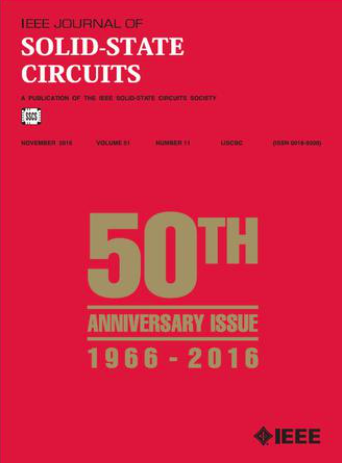
The IEEE Journal of Solid-State Circuits publishes papers each month in the broad area of solid-state circuits with particular emphasis on transistor-level design of integrated circuits. It also provides coverage of topics such as circuits modeling, technology, systems design, layout, and testing that relate directly to IC design. Integrated circuits and VLSI are of principal interest; material related to discrete circuit design is seldom published. Experimental verification is strongly encouraged.




 京公网安备 11010802042870号
京ICP备2023020795号-1
京公网安备 11010802042870号
京ICP备2023020795号-1

 分享
分享
 求助内容:
求助内容: 应助结果提醒方式:
 扫码关注我们
