Yuting Wang, Nan Zhang, Weilong Shang, Huagang Peng, Zhen Hu, Yi Yang, Li Tan, Li Zhang, Fengtian He, Xiancai Rao
{"title":"地塞米松通过下调 DOT1L 抑制 B 淋巴瘤细胞的生长","authors":"Yuting Wang, Nan Zhang, Weilong Shang, Huagang Peng, Zhen Hu, Yi Yang, Li Tan, Li Zhang, Fengtian He, Xiancai Rao","doi":"10.1002/cnr2.2150","DOIUrl":null,"url":null,"abstract":"<div>\n \n \n <section>\n \n <h3> Background</h3>\n \n <p>Dexamethasone (Dex), a synthetic glucocorticoid that acts by binding to the glucocorticoid receptor (GR), has been widely applied to treat leukemia and lymphoma; however, the precise mechanism underlying Dex action is still not well elucidated. DOT1L, a histone H3-lysine79 (H3K79) methyltransferase, has been linked to multiple cancer types, particularly mixed lineage leukemia (MLL) gene rearranged leukemia, but its contribution to lymphoma is yet to be delineated. Analysis from the TCGA database displayed that DOT1L was highly expressed in lymphoma and leukemia.</p>\n </section>\n \n <section>\n \n <h3> Results</h3>\n \n <p>We initially demonstrated that DOT1L served as a new target gene controlled by GR, and the downregulation of DOT1L was critical for the killing of B-lymphoma cells by Dex. Further study revealed that Dex had no impact on the transcriptional activity of the DOT1L promoter, rather it reduced the mRNA level of DOT1L at the posttranscriptional level. In addition, knockdown of DOT1L remarkably inhibited the B-lymphoma cell growth.</p>\n </section>\n \n <section>\n \n <h3> Conclusions</h3>\n \n <p>Overall, our findings indicated that DOT1L may serve as a potential drug target and a promising biomarker of Dex sensitivity when it comes to treating B lymphoma.</p>\n </section>\n </div>","PeriodicalId":9440,"journal":{"name":"Cancer reports","volume":"7 9","pages":""},"PeriodicalIF":1.9000,"publicationDate":"2024-09-22","publicationTypes":"Journal Article","fieldsOfStudy":null,"isOpenAccess":false,"openAccessPdf":"https://onlinelibrary.wiley.com/doi/epdf/10.1002/cnr2.2150","citationCount":"0","resultStr":"{\"title\":\"Dexamethasone Inhibits the Growth of B-Lymphoma Cells by Downregulating DOT1L\",\"authors\":\"Yuting Wang, Nan Zhang, Weilong Shang, Huagang Peng, Zhen Hu, Yi Yang, Li Tan, Li Zhang, Fengtian He, Xiancai Rao\",\"doi\":\"10.1002/cnr2.2150\",\"DOIUrl\":null,\"url\":null,\"abstract\":\"<div>\\n \\n \\n <section>\\n \\n <h3> Background</h3>\\n \\n <p>Dexamethasone (Dex), a synthetic glucocorticoid that acts by binding to the glucocorticoid receptor (GR), has been widely applied to treat leukemia and lymphoma; however, the precise mechanism underlying Dex action is still not well elucidated. DOT1L, a histone H3-lysine79 (H3K79) methyltransferase, has been linked to multiple cancer types, particularly mixed lineage leukemia (MLL) gene rearranged leukemia, but its contribution to lymphoma is yet to be delineated. Analysis from the TCGA database displayed that DOT1L was highly expressed in lymphoma and leukemia.</p>\\n </section>\\n \\n <section>\\n \\n <h3> Results</h3>\\n \\n <p>We initially demonstrated that DOT1L served as a new target gene controlled by GR, and the downregulation of DOT1L was critical for the killing of B-lymphoma cells by Dex. Further study revealed that Dex had no impact on the transcriptional activity of the DOT1L promoter, rather it reduced the mRNA level of DOT1L at the posttranscriptional level. In addition, knockdown of DOT1L remarkably inhibited the B-lymphoma cell growth.</p>\\n </section>\\n \\n <section>\\n \\n <h3> Conclusions</h3>\\n \\n <p>Overall, our findings indicated that DOT1L may serve as a potential drug target and a promising biomarker of Dex sensitivity when it comes to treating B lymphoma.</p>\\n </section>\\n </div>\",\"PeriodicalId\":9440,\"journal\":{\"name\":\"Cancer reports\",\"volume\":\"7 9\",\"pages\":\"\"},\"PeriodicalIF\":1.9000,\"publicationDate\":\"2024-09-22\",\"publicationTypes\":\"Journal Article\",\"fieldsOfStudy\":null,\"isOpenAccess\":false,\"openAccessPdf\":\"https://onlinelibrary.wiley.com/doi/epdf/10.1002/cnr2.2150\",\"citationCount\":\"0\",\"resultStr\":null,\"platform\":\"Semanticscholar\",\"paperid\":null,\"PeriodicalName\":\"Cancer reports\",\"FirstCategoryId\":\"1085\",\"ListUrlMain\":\"https://onlinelibrary.wiley.com/doi/10.1002/cnr2.2150\",\"RegionNum\":0,\"RegionCategory\":null,\"ArticlePicture\":[],\"TitleCN\":null,\"AbstractTextCN\":null,\"PMCID\":null,\"EPubDate\":\"\",\"PubModel\":\"\",\"JCR\":\"Q4\",\"JCRName\":\"ONCOLOGY\",\"Score\":null,\"Total\":0}","platform":"Semanticscholar","paperid":null,"PeriodicalName":"Cancer reports","FirstCategoryId":"1085","ListUrlMain":"https://onlinelibrary.wiley.com/doi/10.1002/cnr2.2150","RegionNum":0,"RegionCategory":null,"ArticlePicture":[],"TitleCN":null,"AbstractTextCN":null,"PMCID":null,"EPubDate":"","PubModel":"","JCR":"Q4","JCRName":"ONCOLOGY","Score":null,"Total":0}
引用次数: 0
摘要
背景地塞米松(Dex)是一种通过与糖皮质激素受体(GR)结合而发挥作用的合成糖皮质激素,已被广泛应用于治疗白血病和淋巴瘤;然而,地塞米松作用的确切机制仍未得到很好的阐明。DOT1L是一种组蛋白H3-赖氨酸79(H3K79)甲基转移酶,它与多种癌症类型有关,尤其是与混合系白血病(MLL)基因重排的白血病有关,但它对淋巴瘤的作用尚未明确。对 TCGA 数据库的分析表明,DOT1L 在淋巴瘤和白血病中高度表达。 结果 我们初步证明 DOT1L 是受 GR 控制的新靶基因,DOT1L 的下调对 Dex 杀死 B 淋巴瘤细胞至关重要。进一步研究发现,Dex对DOT1L启动子的转录活性没有影响,而是在转录后水平降低了DOT1L的mRNA水平。此外,敲除 DOT1L 能显著抑制 B 淋巴瘤细胞的生长。 结论 总的来说,我们的研究结果表明,DOT1L可作为治疗B淋巴瘤的潜在药物靶点和Dex敏感性的生物标志物。
Dexamethasone Inhibits the Growth of B-Lymphoma Cells by Downregulating DOT1L
Background
Dexamethasone (Dex), a synthetic glucocorticoid that acts by binding to the glucocorticoid receptor (GR), has been widely applied to treat leukemia and lymphoma; however, the precise mechanism underlying Dex action is still not well elucidated. DOT1L, a histone H3-lysine79 (H3K79) methyltransferase, has been linked to multiple cancer types, particularly mixed lineage leukemia (MLL) gene rearranged leukemia, but its contribution to lymphoma is yet to be delineated. Analysis from the TCGA database displayed that DOT1L was highly expressed in lymphoma and leukemia.
Results
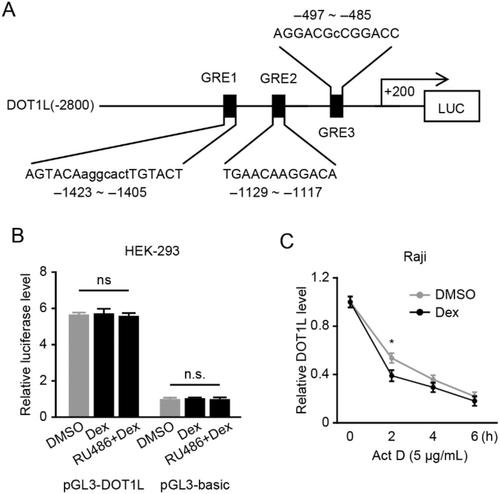
We initially demonstrated that DOT1L served as a new target gene controlled by GR, and the downregulation of DOT1L was critical for the killing of B-lymphoma cells by Dex. Further study revealed that Dex had no impact on the transcriptional activity of the DOT1L promoter, rather it reduced the mRNA level of DOT1L at the posttranscriptional level. In addition, knockdown of DOT1L remarkably inhibited the B-lymphoma cell growth.
Conclusions
Overall, our findings indicated that DOT1L may serve as a potential drug target and a promising biomarker of Dex sensitivity when it comes to treating B lymphoma.





 京公网安备 11010802042870号
京ICP备2023020795号-1
京公网安备 11010802042870号
京ICP备2023020795号-1

 分享
分享
 求助内容:
求助内容: 应助结果提醒方式:
 扫码关注我们
