Teng Ma, Jun Chen, Ziyi Chen, Run Wang, Jinning Hu, Weishu Guo, Rongqiu Lv, Xiaoting Wang, Rongrong Xu, Qianxi Yin, Jiancheng Lai, Botao Ji, Hengyang Xiang, Zhenhua Li and Haibo Zeng
{"title":"用连续波激光制造小间距/尺寸的过磷酸盐像素,实现高分辨率色彩转换微型 LED 显示器","authors":"Teng Ma, Jun Chen, Ziyi Chen, Run Wang, Jinning Hu, Weishu Guo, Rongqiu Lv, Xiaoting Wang, Rongrong Xu, Qianxi Yin, Jiancheng Lai, Botao Ji, Hengyang Xiang, Zhenhua Li and Haibo Zeng","doi":"10.1039/D4NR02424A","DOIUrl":null,"url":null,"abstract":"<p >As a new generation of display technology, micro-light-emitting diodes (micro-LEDs) have been widely recognized owing to their excellent performance in brightness, contrast ratio, resolution, <em>etc</em>. This work proposes a continuous wave (CW) laser writing strategy to achieve perovskite quantum dots (PQDs) array with small pixel size and pitch, overcoming the processing difficulties and limitations of mass transfer. Since PQDs have highly dynamic surface ligand states and low ionic bond energy, suitable laser power can quench PQDs and form an array area. The use of low-power CW lasers in the laser direct writing process, on the one hand, greatly maintains the luminescence performance and edge flatness of each PQD array, and the pixel pitch (1.5 μm–9 μm)/size can be adjusted arbitrarily, which meets the high-resolution micro-display requirements. On the other hand, we found that after the low-power laser quenches the PQDs, its residual oxide can absorb photons, thus reducing the backlight leakage in color conversion micro-LEDs. Finally, red/green/blue three-color conversion micro-LED and laser projection displays were realized; these results provide a feasible strategy for next-generation micro-LED displays.</p>","PeriodicalId":92,"journal":{"name":"Nanoscale","volume":" 40","pages":" 19042-19047"},"PeriodicalIF":5.1000,"publicationDate":"2024-09-23","publicationTypes":"Journal Article","fieldsOfStudy":null,"isOpenAccess":false,"openAccessPdf":"","citationCount":"0","resultStr":"{\"title\":\"Continuous wave laser fabrication of small pitch/size perovskite pixels realizes high-resolution color conversion micro-LED displays†\",\"authors\":\"Teng Ma, Jun Chen, Ziyi Chen, Run Wang, Jinning Hu, Weishu Guo, Rongqiu Lv, Xiaoting Wang, Rongrong Xu, Qianxi Yin, Jiancheng Lai, Botao Ji, Hengyang Xiang, Zhenhua Li and Haibo Zeng\",\"doi\":\"10.1039/D4NR02424A\",\"DOIUrl\":null,\"url\":null,\"abstract\":\"<p >As a new generation of display technology, micro-light-emitting diodes (micro-LEDs) have been widely recognized owing to their excellent performance in brightness, contrast ratio, resolution, <em>etc</em>. This work proposes a continuous wave (CW) laser writing strategy to achieve perovskite quantum dots (PQDs) array with small pixel size and pitch, overcoming the processing difficulties and limitations of mass transfer. Since PQDs have highly dynamic surface ligand states and low ionic bond energy, suitable laser power can quench PQDs and form an array area. The use of low-power CW lasers in the laser direct writing process, on the one hand, greatly maintains the luminescence performance and edge flatness of each PQD array, and the pixel pitch (1.5 μm–9 μm)/size can be adjusted arbitrarily, which meets the high-resolution micro-display requirements. On the other hand, we found that after the low-power laser quenches the PQDs, its residual oxide can absorb photons, thus reducing the backlight leakage in color conversion micro-LEDs. Finally, red/green/blue three-color conversion micro-LED and laser projection displays were realized; these results provide a feasible strategy for next-generation micro-LED displays.</p>\",\"PeriodicalId\":92,\"journal\":{\"name\":\"Nanoscale\",\"volume\":\" 40\",\"pages\":\" 19042-19047\"},\"PeriodicalIF\":5.1000,\"publicationDate\":\"2024-09-23\",\"publicationTypes\":\"Journal Article\",\"fieldsOfStudy\":null,\"isOpenAccess\":false,\"openAccessPdf\":\"\",\"citationCount\":\"0\",\"resultStr\":null,\"platform\":\"Semanticscholar\",\"paperid\":null,\"PeriodicalName\":\"Nanoscale\",\"FirstCategoryId\":\"88\",\"ListUrlMain\":\"https://pubs.rsc.org/en/content/articlelanding/2024/nr/d4nr02424a\",\"RegionNum\":3,\"RegionCategory\":\"材料科学\",\"ArticlePicture\":[],\"TitleCN\":null,\"AbstractTextCN\":null,\"PMCID\":null,\"EPubDate\":\"\",\"PubModel\":\"\",\"JCR\":\"Q1\",\"JCRName\":\"CHEMISTRY, MULTIDISCIPLINARY\",\"Score\":null,\"Total\":0}","platform":"Semanticscholar","paperid":null,"PeriodicalName":"Nanoscale","FirstCategoryId":"88","ListUrlMain":"https://pubs.rsc.org/en/content/articlelanding/2024/nr/d4nr02424a","RegionNum":3,"RegionCategory":"材料科学","ArticlePicture":[],"TitleCN":null,"AbstractTextCN":null,"PMCID":null,"EPubDate":"","PubModel":"","JCR":"Q1","JCRName":"CHEMISTRY, MULTIDISCIPLINARY","Score":null,"Total":0}
引用次数: 0
摘要
作为新一代显示技术,微型发光二极管(micro-LED)因其在亮度、对比度、分辨率等方面的优异性能而得到广泛认可。本研究提出了一种连续波(CW)激光写入策略,以实现像素尺寸和间距较小的过氧化物量子点(PQDs)阵列,克服了加工难度和传质的限制。由于 PQDs 具有高动态表面配体态和低离子键能,合适的激光功率可以淬灭 PQDs 并形成阵列区域。在激光直写过程中使用低功率连续波激光器,一方面极大地保持了每个 PQD 阵列的发光性能和边缘平整度,像素间距(1.5 μm-9 μm)/尺寸可任意调节,满足了高分辨率微显示的要求。另一方面,我们发现低功率激光淬灭 PQDs 后,其残余氧化物可以吸收光子,从而减少了色彩转换微型 LED 的背光泄漏。最后,我们实现了红/绿/蓝三色转换微型 LED 和激光投影显示器;这些成果为下一代微型 LED 显示器提供了可行的策略。
Continuous wave laser fabrication of small pitch/size perovskite pixels realizes high-resolution color conversion micro-LED displays†
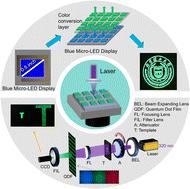
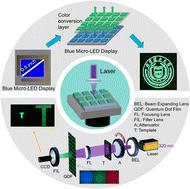
As a new generation of display technology, micro-light-emitting diodes (micro-LEDs) have been widely recognized owing to their excellent performance in brightness, contrast ratio, resolution, etc. This work proposes a continuous wave (CW) laser writing strategy to achieve perovskite quantum dots (PQDs) array with small pixel size and pitch, overcoming the processing difficulties and limitations of mass transfer. Since PQDs have highly dynamic surface ligand states and low ionic bond energy, suitable laser power can quench PQDs and form an array area. The use of low-power CW lasers in the laser direct writing process, on the one hand, greatly maintains the luminescence performance and edge flatness of each PQD array, and the pixel pitch (1.5 μm–9 μm)/size can be adjusted arbitrarily, which meets the high-resolution micro-display requirements. On the other hand, we found that after the low-power laser quenches the PQDs, its residual oxide can absorb photons, thus reducing the backlight leakage in color conversion micro-LEDs. Finally, red/green/blue three-color conversion micro-LED and laser projection displays were realized; these results provide a feasible strategy for next-generation micro-LED displays.
期刊介绍:
Nanoscale is a high-impact international journal, publishing high-quality research across nanoscience and nanotechnology. Nanoscale publishes a full mix of research articles on experimental and theoretical work, including reviews, communications, and full papers.Highly interdisciplinary, this journal appeals to scientists, researchers and professionals interested in nanoscience and nanotechnology, quantum materials and quantum technology, including the areas of physics, chemistry, biology, medicine, materials, energy/environment, information technology, detection science, healthcare and drug discovery, and electronics.




 京公网安备 11010802042870号
京ICP备2023020795号-1
京公网安备 11010802042870号
京ICP备2023020795号-1

 分享
分享
 求助内容:
求助内容: 应助结果提醒方式:
 扫码关注我们
