Isabelle C Bote, Zoe A Krevlin, Maria Christina F Crespo, Sudchananya Udomphan, Carolyn T Levin, Christie C Lam, Amy M Glanzer, Holly L Hutchinson, Alisha M Blades, Danielle L McConnell, Crystal Lin, John P Frank, William R Strutton, Jordan C Merklin, Beau A Sinardo, Khady J Gueye, Karly V Leiman, Ashley Thayaparan, Joel K A Adade, Nestor L Martinez, Wesley W Kramer, Max M Majireck
{"title":"作为 2-氨基吡啶衍生物合成试剂的台式稳定 2-卤代吡啶鎓烯酮半二胺。","authors":"Isabelle C Bote, Zoe A Krevlin, Maria Christina F Crespo, Sudchananya Udomphan, Carolyn T Levin, Christie C Lam, Amy M Glanzer, Holly L Hutchinson, Alisha M Blades, Danielle L McConnell, Crystal Lin, John P Frank, William R Strutton, Jordan C Merklin, Beau A Sinardo, Khady J Gueye, Karly V Leiman, Ashley Thayaparan, Joel K A Adade, Nestor L Martinez, Wesley W Kramer, Max M Majireck","doi":"10.1021/acs.orglett.4c02915","DOIUrl":null,"url":null,"abstract":"<p><p>2-Chloro-1-(1-ethoxyvinyl)pyridinium triflate and several other bench-stable <i>N</i>-(1-alkoxyvinyl) 2-halopyridinium triflates have been developed as reagents for the synthesis of valuable 2-aminopyridine scaffolds via unusually mild S<sub>N</sub>Ar substitutions with amine nucleophiles. Advantages of this approach include an operationally simple mix-and-stir procedure at room temperature or mild heat and ambient atmosphere and without the need for transition metal catalysts, coupling reagents, or high-boiling solvents. The stable <i>N</i>-(1-ethoxyvinyl) moiety serves as a dual S<sub>N</sub>Ar-activating group and pyridine <i>N</i>-protecting group that can be cleaved under thermal, acidic, or oxidative conditions. Preliminary results of other nucleophilic substitutions using oxygen-, sulfur-, and carbon-based nucleophiles are also demonstrated.</p>","PeriodicalId":54,"journal":{"name":"Organic Letters","volume":" ","pages":"9805-9810"},"PeriodicalIF":5.0000,"publicationDate":"2024-11-22","publicationTypes":"Journal Article","fieldsOfStudy":null,"isOpenAccess":false,"openAccessPdf":"https://www.ncbi.nlm.nih.gov/pmc/articles/PMC11590095/pdf/","citationCount":"0","resultStr":"{\"title\":\"Bench-Stable 2-Halopyridinium Ketene Hemiaminals as Reagents for the Synthesis of 2-Aminopyridine Derivatives.\",\"authors\":\"Isabelle C Bote, Zoe A Krevlin, Maria Christina F Crespo, Sudchananya Udomphan, Carolyn T Levin, Christie C Lam, Amy M Glanzer, Holly L Hutchinson, Alisha M Blades, Danielle L McConnell, Crystal Lin, John P Frank, William R Strutton, Jordan C Merklin, Beau A Sinardo, Khady J Gueye, Karly V Leiman, Ashley Thayaparan, Joel K A Adade, Nestor L Martinez, Wesley W Kramer, Max M Majireck\",\"doi\":\"10.1021/acs.orglett.4c02915\",\"DOIUrl\":null,\"url\":null,\"abstract\":\"<p><p>2-Chloro-1-(1-ethoxyvinyl)pyridinium triflate and several other bench-stable <i>N</i>-(1-alkoxyvinyl) 2-halopyridinium triflates have been developed as reagents for the synthesis of valuable 2-aminopyridine scaffolds via unusually mild S<sub>N</sub>Ar substitutions with amine nucleophiles. Advantages of this approach include an operationally simple mix-and-stir procedure at room temperature or mild heat and ambient atmosphere and without the need for transition metal catalysts, coupling reagents, or high-boiling solvents. The stable <i>N</i>-(1-ethoxyvinyl) moiety serves as a dual S<sub>N</sub>Ar-activating group and pyridine <i>N</i>-protecting group that can be cleaved under thermal, acidic, or oxidative conditions. Preliminary results of other nucleophilic substitutions using oxygen-, sulfur-, and carbon-based nucleophiles are also demonstrated.</p>\",\"PeriodicalId\":54,\"journal\":{\"name\":\"Organic Letters\",\"volume\":\" \",\"pages\":\"9805-9810\"},\"PeriodicalIF\":5.0000,\"publicationDate\":\"2024-11-22\",\"publicationTypes\":\"Journal Article\",\"fieldsOfStudy\":null,\"isOpenAccess\":false,\"openAccessPdf\":\"https://www.ncbi.nlm.nih.gov/pmc/articles/PMC11590095/pdf/\",\"citationCount\":\"0\",\"resultStr\":null,\"platform\":\"Semanticscholar\",\"paperid\":null,\"PeriodicalName\":\"Organic Letters\",\"FirstCategoryId\":\"92\",\"ListUrlMain\":\"https://doi.org/10.1021/acs.orglett.4c02915\",\"RegionNum\":1,\"RegionCategory\":\"化学\",\"ArticlePicture\":[],\"TitleCN\":null,\"AbstractTextCN\":null,\"PMCID\":null,\"EPubDate\":\"2024/9/20 0:00:00\",\"PubModel\":\"Epub\",\"JCR\":\"Q1\",\"JCRName\":\"CHEMISTRY, ORGANIC\",\"Score\":null,\"Total\":0}","platform":"Semanticscholar","paperid":null,"PeriodicalName":"Organic Letters","FirstCategoryId":"92","ListUrlMain":"https://doi.org/10.1021/acs.orglett.4c02915","RegionNum":1,"RegionCategory":"化学","ArticlePicture":[],"TitleCN":null,"AbstractTextCN":null,"PMCID":null,"EPubDate":"2024/9/20 0:00:00","PubModel":"Epub","JCR":"Q1","JCRName":"CHEMISTRY, ORGANIC","Score":null,"Total":0}
引用次数: 0
摘要
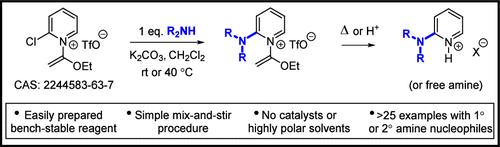
作为试剂,2-氯-1-(1-乙氧基乙烯基)吡啶鎓三氟化物和其他几种稳定的 N-(1-烷氧基乙烯基)2-卤代吡啶鎓三氟化物已被开发出来,用于通过异常温和的 SNAr 与胺类亲核剂的取代反应合成有价值的 2-氨基吡啶支架。这种方法的优点包括操作简单,可在室温或微热环境下进行混合搅拌,无需过渡金属催化剂、偶联试剂或高沸点溶剂。稳定的 N-(1-乙氧基乙烯基)分子具有 SNAr 活性基团和吡啶 N 保护基团的双重作用,可以在热、酸或氧化条件下裂解。此外,还展示了使用氧、硫和碳基亲核物进行其他亲核取代的初步结果。
Bench-Stable 2-Halopyridinium Ketene Hemiaminals as Reagents for the Synthesis of 2-Aminopyridine Derivatives.
2-Chloro-1-(1-ethoxyvinyl)pyridinium triflate and several other bench-stable N-(1-alkoxyvinyl) 2-halopyridinium triflates have been developed as reagents for the synthesis of valuable 2-aminopyridine scaffolds via unusually mild SNAr substitutions with amine nucleophiles. Advantages of this approach include an operationally simple mix-and-stir procedure at room temperature or mild heat and ambient atmosphere and without the need for transition metal catalysts, coupling reagents, or high-boiling solvents. The stable N-(1-ethoxyvinyl) moiety serves as a dual SNAr-activating group and pyridine N-protecting group that can be cleaved under thermal, acidic, or oxidative conditions. Preliminary results of other nucleophilic substitutions using oxygen-, sulfur-, and carbon-based nucleophiles are also demonstrated.
期刊介绍:
Organic Letters invites original reports of fundamental research in all branches of the theory and practice of organic, physical organic, organometallic,medicinal, and bioorganic chemistry. Organic Letters provides rapid disclosure of the key elements of significant studies that are of interest to a large portion of the organic community. In selecting manuscripts for publication, the Editors place emphasis on the originality, quality and wide interest of the work. Authors should provide enough background information to place the new disclosure in context and to justify the rapid publication format. Back-to-back Letters will be considered. Full details should be reserved for an Article, which should appear in due course.




 京公网安备 11010802042870号
京ICP备2023020795号-1
京公网安备 11010802042870号
京ICP备2023020795号-1

 分享
分享
 求助内容:
求助内容: 应助结果提醒方式:
 扫码关注我们
