Polina Paramonova , Rodion Lebedev , Alexander Sokolov , Dmitry Dar'in , Evgeny Kanov , Ramilya Murtazina , Raul Gainetdinov , Stanislav Kalinin , Olga Bakulina
{"title":"基于叠氮化物的原位制备融合杂环亚胺及其多组分反应。","authors":"Polina Paramonova , Rodion Lebedev , Alexander Sokolov , Dmitry Dar'in , Evgeny Kanov , Ramilya Murtazina , Raul Gainetdinov , Stanislav Kalinin , Olga Bakulina","doi":"10.1039/d4ob01321b","DOIUrl":null,"url":null,"abstract":"<div><div>Structurally diverse pyrroles, indoles and imidazoles bearing an <em>N</em>-ω-azidoalkyl moiety and an aldehyde or ketone function were prepared and successfully introduced into <em>in situ</em> imine generation <em>via</em> the intramolecular Staudinger/aza-Wittig tandem reaction. Reduction of the generated imines led to medicinally relevant nitrogen-containing fused heterocycles such as tetrahydropyrrolo[1,2-<em>a</em>]pyrazines and diazepines. Rare 8-membered hexahydropyrrolo[1,2-<em>a</em>][1,4]diazocine and 9-membered dihydro-4,8-(metheno)pyrrolo[1,2-<em>a</em>][1,4]diazacycloundecine were also synthesized. In addition, several one-pot transformations involving cyclic anhydrides or isocyanides (Castagnoli–Cushman, Ugi and azido-Ugi reactions) were added to the Staudinger/aza-Wittig sequence to afford novel fused polyheterocyclic delta-lactams, cyclic bisamides and tetrazoles in a multicomponent fashion. The synthesized compounds were profiled against human Trace Amine-Associated Receptor 1 (hTAAR1), and the best performing compound showed low nanomolar agonistic activity with an EC<sub>50</sub> of 0.025 μM.</div></div>","PeriodicalId":96,"journal":{"name":"Organic & Biomolecular Chemistry","volume":"22 41","pages":"Pages 8328-8336"},"PeriodicalIF":2.8000,"publicationDate":"2024-09-16","publicationTypes":"Journal Article","fieldsOfStudy":null,"isOpenAccess":false,"openAccessPdf":"","citationCount":"0","resultStr":"{\"title\":\"Azide-based in situ preparation of fused heterocyclic imines and their multicomponent reactions†\",\"authors\":\"Polina Paramonova , Rodion Lebedev , Alexander Sokolov , Dmitry Dar'in , Evgeny Kanov , Ramilya Murtazina , Raul Gainetdinov , Stanislav Kalinin , Olga Bakulina\",\"doi\":\"10.1039/d4ob01321b\",\"DOIUrl\":null,\"url\":null,\"abstract\":\"<div><div>Structurally diverse pyrroles, indoles and imidazoles bearing an <em>N</em>-ω-azidoalkyl moiety and an aldehyde or ketone function were prepared and successfully introduced into <em>in situ</em> imine generation <em>via</em> the intramolecular Staudinger/aza-Wittig tandem reaction. Reduction of the generated imines led to medicinally relevant nitrogen-containing fused heterocycles such as tetrahydropyrrolo[1,2-<em>a</em>]pyrazines and diazepines. Rare 8-membered hexahydropyrrolo[1,2-<em>a</em>][1,4]diazocine and 9-membered dihydro-4,8-(metheno)pyrrolo[1,2-<em>a</em>][1,4]diazacycloundecine were also synthesized. In addition, several one-pot transformations involving cyclic anhydrides or isocyanides (Castagnoli–Cushman, Ugi and azido-Ugi reactions) were added to the Staudinger/aza-Wittig sequence to afford novel fused polyheterocyclic delta-lactams, cyclic bisamides and tetrazoles in a multicomponent fashion. The synthesized compounds were profiled against human Trace Amine-Associated Receptor 1 (hTAAR1), and the best performing compound showed low nanomolar agonistic activity with an EC<sub>50</sub> of 0.025 μM.</div></div>\",\"PeriodicalId\":96,\"journal\":{\"name\":\"Organic & Biomolecular Chemistry\",\"volume\":\"22 41\",\"pages\":\"Pages 8328-8336\"},\"PeriodicalIF\":2.8000,\"publicationDate\":\"2024-09-16\",\"publicationTypes\":\"Journal Article\",\"fieldsOfStudy\":null,\"isOpenAccess\":false,\"openAccessPdf\":\"\",\"citationCount\":\"0\",\"resultStr\":null,\"platform\":\"Semanticscholar\",\"paperid\":null,\"PeriodicalName\":\"Organic & Biomolecular Chemistry\",\"FirstCategoryId\":\"92\",\"ListUrlMain\":\"https://www.sciencedirect.com/org/science/article/pii/S1477052024008401\",\"RegionNum\":3,\"RegionCategory\":\"化学\",\"ArticlePicture\":[],\"TitleCN\":null,\"AbstractTextCN\":null,\"PMCID\":null,\"EPubDate\":\"2024/9/19 0:00:00\",\"PubModel\":\"Epub\",\"JCR\":\"Q1\",\"JCRName\":\"CHEMISTRY, ORGANIC\",\"Score\":null,\"Total\":0}","platform":"Semanticscholar","paperid":null,"PeriodicalName":"Organic & Biomolecular Chemistry","FirstCategoryId":"92","ListUrlMain":"https://www.sciencedirect.com/org/science/article/pii/S1477052024008401","RegionNum":3,"RegionCategory":"化学","ArticlePicture":[],"TitleCN":null,"AbstractTextCN":null,"PMCID":null,"EPubDate":"2024/9/19 0:00:00","PubModel":"Epub","JCR":"Q1","JCRName":"CHEMISTRY, ORGANIC","Score":null,"Total":0}
Azide-based in situ preparation of fused heterocyclic imines and their multicomponent reactions†
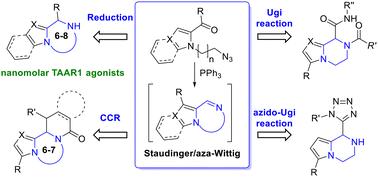
Structurally diverse pyrroles, indoles and imidazoles bearing an N-ω-azidoalkyl moiety and an aldehyde or ketone function were prepared and successfully introduced into in situ imine generation via the intramolecular Staudinger/aza-Wittig tandem reaction. Reduction of the generated imines led to medicinally relevant nitrogen-containing fused heterocycles such as tetrahydropyrrolo[1,2-a]pyrazines and diazepines. Rare 8-membered hexahydropyrrolo[1,2-a][1,4]diazocine and 9-membered dihydro-4,8-(metheno)pyrrolo[1,2-a][1,4]diazacycloundecine were also synthesized. In addition, several one-pot transformations involving cyclic anhydrides or isocyanides (Castagnoli–Cushman, Ugi and azido-Ugi reactions) were added to the Staudinger/aza-Wittig sequence to afford novel fused polyheterocyclic delta-lactams, cyclic bisamides and tetrazoles in a multicomponent fashion. The synthesized compounds were profiled against human Trace Amine-Associated Receptor 1 (hTAAR1), and the best performing compound showed low nanomolar agonistic activity with an EC50 of 0.025 μM.
期刊介绍:
Organic & Biomolecular Chemistry is an international journal using integrated research in chemistry-organic chemistry. Founded in 2003 by the Royal Society of Chemistry, the journal is published in Semimonthly issues and has been indexed by SCIE, a leading international database. The journal focuses on the key research and cutting-edge progress in the field of chemistry-organic chemistry, publishes and reports the research results in this field in a timely manner, and is committed to becoming a window and platform for rapid academic exchanges among peers in this field. The journal's impact factor in 2023 is 2.9, and its CiteScore is 5.5.




 京公网安备 11010802042870号
京ICP备2023020795号-1
京公网安备 11010802042870号
京ICP备2023020795号-1

 分享
分享
 求助内容:
求助内容: 应助结果提醒方式:
 扫码关注我们
