Verena Behringer, Ruth Sonnweber, Gottfried Hohmann, Jeroen M. G. Stevens, Jonas Verspeek, Tracy L. Kivell
{"title":"哺乳动物骨骼生长的无创测量方法:通过倭黑猩猩的长骨生长速度验证尿液 CTX-I 作为骨吸收标记的有效性。","authors":"Verena Behringer, Ruth Sonnweber, Gottfried Hohmann, Jeroen M. G. Stevens, Jonas Verspeek, Tracy L. Kivell","doi":"10.1002/ece3.70326","DOIUrl":null,"url":null,"abstract":"<p>Assessing bone growth trajectories in mammals is crucial for understanding life history dynamics, but the quantification of bone growth in natural settings can be challenging. Bone resorption markers that can be measured in urine, such as C-telopeptide of type I collagen (CTX-I), offer a non-invasive solution to assess bone growth. Although measurement of urinary CTX-I levels has been applied extensively in human studies, its use in other species is so far limited to a few clinical studies. To validate urinary CTX-I as a bone resorption marker under less controlled conditions, we investigated within-individual day-to-day variation, diurnal patterns, and sex and age-specific variation in zoo-housed bonobos (<i>Pan paniscus</i>). We then also correlated urinary CTX-I levels with forearm growth velocity measures. We found a day-to-day variability in urinary CTX-I levels of around 25%, comparable to human variation. Diurnally, CTX-I levels decreased, aligning with observations in humans and other species. Both sexes showed an age-related decline in urinary CTX-I levels, with a steady decrease after the age of 10 years. Additionally, we found a positive correlation between forearm growth velocity and urinary CTX-I levels across age in female, but not in male, bonobos. Our results demonstrate that urinary CTX-I levels are a meaningful measure of bone growth and highlight its potential to examine bone growth trajectories also in wild populations to investigate life history dynamics.</p>","PeriodicalId":11467,"journal":{"name":"Ecology and Evolution","volume":"14 9","pages":""},"PeriodicalIF":2.6000,"publicationDate":"2024-09-23","publicationTypes":"Journal Article","fieldsOfStudy":null,"isOpenAccess":false,"openAccessPdf":"https://www.ncbi.nlm.nih.gov/pmc/articles/PMC11417956/pdf/","citationCount":"0","resultStr":"{\"title\":\"A non-invasive measure of bone growth in mammals: Validating urinary CTX-I as a bone resorption marker through long-bone growth velocity in bonobos\",\"authors\":\"Verena Behringer, Ruth Sonnweber, Gottfried Hohmann, Jeroen M. G. Stevens, Jonas Verspeek, Tracy L. Kivell\",\"doi\":\"10.1002/ece3.70326\",\"DOIUrl\":null,\"url\":null,\"abstract\":\"<p>Assessing bone growth trajectories in mammals is crucial for understanding life history dynamics, but the quantification of bone growth in natural settings can be challenging. Bone resorption markers that can be measured in urine, such as C-telopeptide of type I collagen (CTX-I), offer a non-invasive solution to assess bone growth. Although measurement of urinary CTX-I levels has been applied extensively in human studies, its use in other species is so far limited to a few clinical studies. To validate urinary CTX-I as a bone resorption marker under less controlled conditions, we investigated within-individual day-to-day variation, diurnal patterns, and sex and age-specific variation in zoo-housed bonobos (<i>Pan paniscus</i>). We then also correlated urinary CTX-I levels with forearm growth velocity measures. We found a day-to-day variability in urinary CTX-I levels of around 25%, comparable to human variation. Diurnally, CTX-I levels decreased, aligning with observations in humans and other species. Both sexes showed an age-related decline in urinary CTX-I levels, with a steady decrease after the age of 10 years. Additionally, we found a positive correlation between forearm growth velocity and urinary CTX-I levels across age in female, but not in male, bonobos. Our results demonstrate that urinary CTX-I levels are a meaningful measure of bone growth and highlight its potential to examine bone growth trajectories also in wild populations to investigate life history dynamics.</p>\",\"PeriodicalId\":11467,\"journal\":{\"name\":\"Ecology and Evolution\",\"volume\":\"14 9\",\"pages\":\"\"},\"PeriodicalIF\":2.6000,\"publicationDate\":\"2024-09-23\",\"publicationTypes\":\"Journal Article\",\"fieldsOfStudy\":null,\"isOpenAccess\":false,\"openAccessPdf\":\"https://www.ncbi.nlm.nih.gov/pmc/articles/PMC11417956/pdf/\",\"citationCount\":\"0\",\"resultStr\":null,\"platform\":\"Semanticscholar\",\"paperid\":null,\"PeriodicalName\":\"Ecology and Evolution\",\"FirstCategoryId\":\"99\",\"ListUrlMain\":\"https://onlinelibrary.wiley.com/doi/10.1002/ece3.70326\",\"RegionNum\":2,\"RegionCategory\":\"生物学\",\"ArticlePicture\":[],\"TitleCN\":null,\"AbstractTextCN\":null,\"PMCID\":null,\"EPubDate\":\"\",\"PubModel\":\"\",\"JCR\":\"Q2\",\"JCRName\":\"ECOLOGY\",\"Score\":null,\"Total\":0}","platform":"Semanticscholar","paperid":null,"PeriodicalName":"Ecology and Evolution","FirstCategoryId":"99","ListUrlMain":"https://onlinelibrary.wiley.com/doi/10.1002/ece3.70326","RegionNum":2,"RegionCategory":"生物学","ArticlePicture":[],"TitleCN":null,"AbstractTextCN":null,"PMCID":null,"EPubDate":"","PubModel":"","JCR":"Q2","JCRName":"ECOLOGY","Score":null,"Total":0}
A non-invasive measure of bone growth in mammals: Validating urinary CTX-I as a bone resorption marker through long-bone growth velocity in bonobos
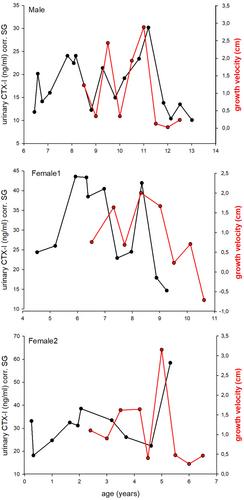
Assessing bone growth trajectories in mammals is crucial for understanding life history dynamics, but the quantification of bone growth in natural settings can be challenging. Bone resorption markers that can be measured in urine, such as C-telopeptide of type I collagen (CTX-I), offer a non-invasive solution to assess bone growth. Although measurement of urinary CTX-I levels has been applied extensively in human studies, its use in other species is so far limited to a few clinical studies. To validate urinary CTX-I as a bone resorption marker under less controlled conditions, we investigated within-individual day-to-day variation, diurnal patterns, and sex and age-specific variation in zoo-housed bonobos (Pan paniscus). We then also correlated urinary CTX-I levels with forearm growth velocity measures. We found a day-to-day variability in urinary CTX-I levels of around 25%, comparable to human variation. Diurnally, CTX-I levels decreased, aligning with observations in humans and other species. Both sexes showed an age-related decline in urinary CTX-I levels, with a steady decrease after the age of 10 years. Additionally, we found a positive correlation between forearm growth velocity and urinary CTX-I levels across age in female, but not in male, bonobos. Our results demonstrate that urinary CTX-I levels are a meaningful measure of bone growth and highlight its potential to examine bone growth trajectories also in wild populations to investigate life history dynamics.
期刊介绍:
Ecology and Evolution is the peer reviewed journal for rapid dissemination of research in all areas of ecology, evolution and conservation science. The journal gives priority to quality research reports, theoretical or empirical, that develop our understanding of organisms and their diversity, interactions between them, and the natural environment.
Ecology and Evolution gives prompt and equal consideration to papers reporting theoretical, experimental, applied and descriptive work in terrestrial and aquatic environments. The journal will consider submissions across taxa in areas including but not limited to micro and macro ecological and evolutionary processes, characteristics of and interactions between individuals, populations, communities and the environment, physiological responses to environmental change, population genetics and phylogenetics, relatedness and kin selection, life histories, systematics and taxonomy, conservation genetics, extinction, speciation, adaption, behaviour, biodiversity, species abundance, macroecology, population and ecosystem dynamics, and conservation policy.




 京公网安备 11010802042870号
京ICP备2023020795号-1
京公网安备 11010802042870号
京ICP备2023020795号-1

 分享
分享
 求助内容:
求助内容: 应助结果提醒方式:
 扫码关注我们
