Anna Louise Pouncey, Michael J Sweeting, Colin Bicknell, Janet T Powell, Jenny Lübcke, Kim Gunnarsson, Anders Wanhainen, Kevin Mani
{"title":"肾下腹主动脉瘤修补术后出院存活率的性别差异。","authors":"Anna Louise Pouncey, Michael J Sweeting, Colin Bicknell, Janet T Powell, Jenny Lübcke, Kim Gunnarsson, Anders Wanhainen, Kevin Mani","doi":"10.1093/eurheartj/ehae675","DOIUrl":null,"url":null,"abstract":"<p><strong>Background and aims: </strong>A longer time to alive hospital discharge following infrarenal abdominal aortic aneurysm (AAA) repair is associated with reduced patient satisfaction and increased length of stay, hospital-acquired deconditioning, infection, and costs. This study investigated sex-specific differences in, and drivers of, the rate of alive hospital discharge.</p><p><strong>Methods: </strong>Examination of UK National Vascular Registry (UK NVR), 2014-19, and Swedish National Patient Registry (SE NPR) elective AAA patients, 2010-18, for endovascular (EVAR) or open aneurysm repair (OAR). Cox models assessed sex-specific difference in the rate of alive hospital discharge, adjusting for co-morbidity, anatomy, standard of care, post-operative complications, and year, with in-hospital death as the competing risk.</p><p><strong>Results: </strong>A total of 29 751 AAA repairs (UK NVR: EVAR 12 518:1532; OAR 6803:837; SE NPR: EVAR 4234:792; OAR 2638:497, men:women) were assessed. For EVAR, the unadjusted rate of alive hospital discharge was ∼25% lower for women [UK NVR: hazard ratio (HR) 0.75 (0.71-0.80), P < .001; SE NPR: HR 0.75 (0.69-0.81), P < .001]. Following adjustment, the sex-specific HR narrowed but remained significant [UK NVR: HR 0.83 (0.79-0.88), P < .001; SE NPR: HR 0.83 (0.76-0.89), P < .001]. For OAR, the rate of alive hospital discharge was 23%-27% lower for women [UK NVR: HR 0.73 (0.67-0.78), P < .001; SE NPR: HR 0.77 (0.70-0.85), P < .001]. Following adjustment, the sex-specific HR narrowed [UK NVR: HR 0.82 (0.76-0.88), P < .001; SE NPR: HR 0.79 (0.72-0.88), P < .001] but remained significant.</p><p><strong>Conclusions: </strong>Women have a 25% lower rate of alive discharge after aortic surgery, despite adjustment for pre/peri- and post-operative parameters. Efforts to increase the rate of alive hospital discharge for women should be sought.</p>","PeriodicalId":11976,"journal":{"name":"European Heart Journal","volume":" ","pages":"1705-1716"},"PeriodicalIF":45.3000,"publicationDate":"2025-05-07","publicationTypes":"Journal Article","fieldsOfStudy":null,"isOpenAccess":false,"openAccessPdf":"https://www.ncbi.nlm.nih.gov/pmc/articles/PMC12055232/pdf/","citationCount":"0","resultStr":"{\"title\":\"Sex-specific differences in alive hospital discharge following infrarenal abdominal aortic aneurysm repair.\",\"authors\":\"Anna Louise Pouncey, Michael J Sweeting, Colin Bicknell, Janet T Powell, Jenny Lübcke, Kim Gunnarsson, Anders Wanhainen, Kevin Mani\",\"doi\":\"10.1093/eurheartj/ehae675\",\"DOIUrl\":null,\"url\":null,\"abstract\":\"<p><strong>Background and aims: </strong>A longer time to alive hospital discharge following infrarenal abdominal aortic aneurysm (AAA) repair is associated with reduced patient satisfaction and increased length of stay, hospital-acquired deconditioning, infection, and costs. This study investigated sex-specific differences in, and drivers of, the rate of alive hospital discharge.</p><p><strong>Methods: </strong>Examination of UK National Vascular Registry (UK NVR), 2014-19, and Swedish National Patient Registry (SE NPR) elective AAA patients, 2010-18, for endovascular (EVAR) or open aneurysm repair (OAR). Cox models assessed sex-specific difference in the rate of alive hospital discharge, adjusting for co-morbidity, anatomy, standard of care, post-operative complications, and year, with in-hospital death as the competing risk.</p><p><strong>Results: </strong>A total of 29 751 AAA repairs (UK NVR: EVAR 12 518:1532; OAR 6803:837; SE NPR: EVAR 4234:792; OAR 2638:497, men:women) were assessed. For EVAR, the unadjusted rate of alive hospital discharge was ∼25% lower for women [UK NVR: hazard ratio (HR) 0.75 (0.71-0.80), P < .001; SE NPR: HR 0.75 (0.69-0.81), P < .001]. Following adjustment, the sex-specific HR narrowed but remained significant [UK NVR: HR 0.83 (0.79-0.88), P < .001; SE NPR: HR 0.83 (0.76-0.89), P < .001]. For OAR, the rate of alive hospital discharge was 23%-27% lower for women [UK NVR: HR 0.73 (0.67-0.78), P < .001; SE NPR: HR 0.77 (0.70-0.85), P < .001]. Following adjustment, the sex-specific HR narrowed [UK NVR: HR 0.82 (0.76-0.88), P < .001; SE NPR: HR 0.79 (0.72-0.88), P < .001] but remained significant.</p><p><strong>Conclusions: </strong>Women have a 25% lower rate of alive discharge after aortic surgery, despite adjustment for pre/peri- and post-operative parameters. Efforts to increase the rate of alive hospital discharge for women should be sought.</p>\",\"PeriodicalId\":11976,\"journal\":{\"name\":\"European Heart Journal\",\"volume\":\" \",\"pages\":\"1705-1716\"},\"PeriodicalIF\":45.3000,\"publicationDate\":\"2025-05-07\",\"publicationTypes\":\"Journal Article\",\"fieldsOfStudy\":null,\"isOpenAccess\":false,\"openAccessPdf\":\"https://www.ncbi.nlm.nih.gov/pmc/articles/PMC12055232/pdf/\",\"citationCount\":\"0\",\"resultStr\":null,\"platform\":\"Semanticscholar\",\"paperid\":null,\"PeriodicalName\":\"European Heart Journal\",\"FirstCategoryId\":\"3\",\"ListUrlMain\":\"https://doi.org/10.1093/eurheartj/ehae675\",\"RegionNum\":1,\"RegionCategory\":\"医学\",\"ArticlePicture\":[],\"TitleCN\":null,\"AbstractTextCN\":null,\"PMCID\":null,\"EPubDate\":\"\",\"PubModel\":\"\",\"JCR\":\"Q1\",\"JCRName\":\"CARDIAC & CARDIOVASCULAR SYSTEMS\",\"Score\":null,\"Total\":0}","platform":"Semanticscholar","paperid":null,"PeriodicalName":"European Heart Journal","FirstCategoryId":"3","ListUrlMain":"https://doi.org/10.1093/eurheartj/ehae675","RegionNum":1,"RegionCategory":"医学","ArticlePicture":[],"TitleCN":null,"AbstractTextCN":null,"PMCID":null,"EPubDate":"","PubModel":"","JCR":"Q1","JCRName":"CARDIAC & CARDIOVASCULAR SYSTEMS","Score":null,"Total":0}
Sex-specific differences in alive hospital discharge following infrarenal abdominal aortic aneurysm repair.
Background and aims: A longer time to alive hospital discharge following infrarenal abdominal aortic aneurysm (AAA) repair is associated with reduced patient satisfaction and increased length of stay, hospital-acquired deconditioning, infection, and costs. This study investigated sex-specific differences in, and drivers of, the rate of alive hospital discharge.
Methods: Examination of UK National Vascular Registry (UK NVR), 2014-19, and Swedish National Patient Registry (SE NPR) elective AAA patients, 2010-18, for endovascular (EVAR) or open aneurysm repair (OAR). Cox models assessed sex-specific difference in the rate of alive hospital discharge, adjusting for co-morbidity, anatomy, standard of care, post-operative complications, and year, with in-hospital death as the competing risk.
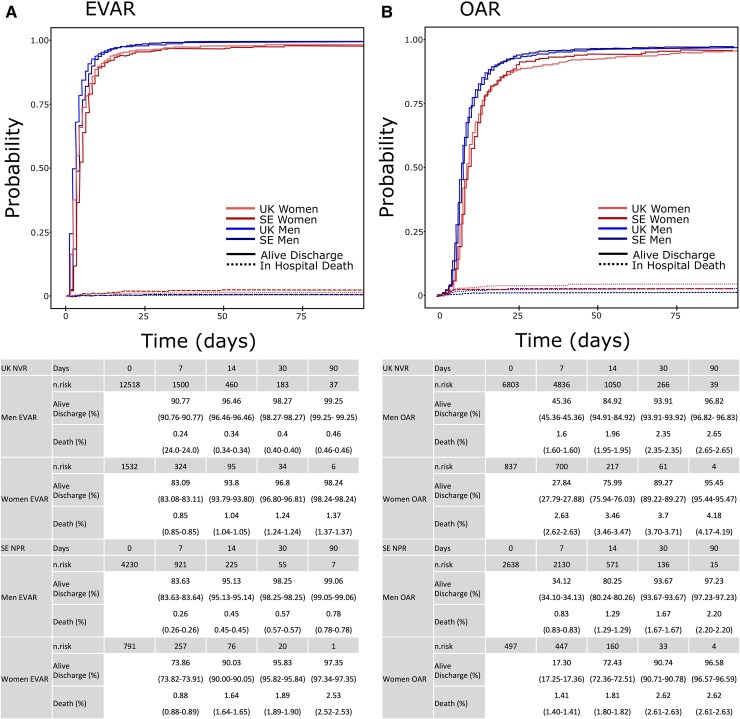
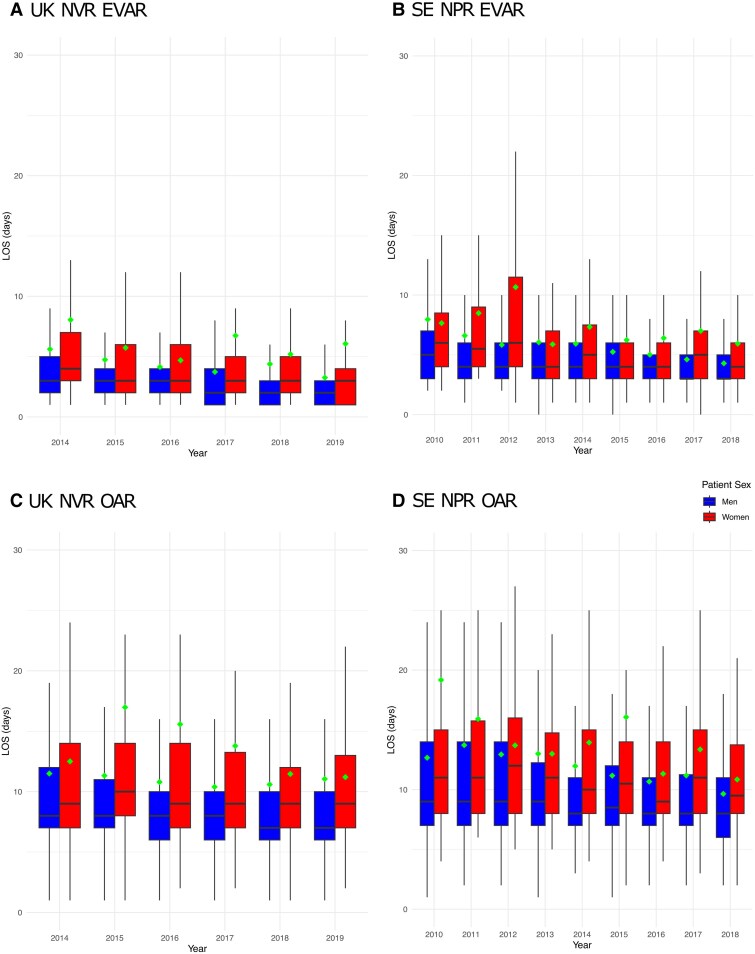
Results: A total of 29 751 AAA repairs (UK NVR: EVAR 12 518:1532; OAR 6803:837; SE NPR: EVAR 4234:792; OAR 2638:497, men:women) were assessed. For EVAR, the unadjusted rate of alive hospital discharge was ∼25% lower for women [UK NVR: hazard ratio (HR) 0.75 (0.71-0.80), P < .001; SE NPR: HR 0.75 (0.69-0.81), P < .001]. Following adjustment, the sex-specific HR narrowed but remained significant [UK NVR: HR 0.83 (0.79-0.88), P < .001; SE NPR: HR 0.83 (0.76-0.89), P < .001]. For OAR, the rate of alive hospital discharge was 23%-27% lower for women [UK NVR: HR 0.73 (0.67-0.78), P < .001; SE NPR: HR 0.77 (0.70-0.85), P < .001]. Following adjustment, the sex-specific HR narrowed [UK NVR: HR 0.82 (0.76-0.88), P < .001; SE NPR: HR 0.79 (0.72-0.88), P < .001] but remained significant.
Conclusions: Women have a 25% lower rate of alive discharge after aortic surgery, despite adjustment for pre/peri- and post-operative parameters. Efforts to increase the rate of alive hospital discharge for women should be sought.
期刊介绍:
The European Heart Journal is a renowned international journal that focuses on cardiovascular medicine. It is published weekly and is the official journal of the European Society of Cardiology. This peer-reviewed journal is committed to publishing high-quality clinical and scientific material pertaining to all aspects of cardiovascular medicine. It covers a diverse range of topics including research findings, technical evaluations, and reviews. Moreover, the journal serves as a platform for the exchange of information and discussions on various aspects of cardiovascular medicine, including educational matters.
In addition to original papers on cardiovascular medicine and surgery, the European Heart Journal also presents reviews, clinical perspectives, ESC Guidelines, and editorial articles that highlight recent advancements in cardiology. Additionally, the journal actively encourages readers to share their thoughts and opinions through correspondence.





 京公网安备 11010802042870号
京ICP备2023020795号-1
京公网安备 11010802042870号
京ICP备2023020795号-1

 分享
分享
 求助内容:
求助内容: 应助结果提醒方式:
 扫码关注我们
