Ke Li;Xiaogang Xiong;Yunjiang Lou;Shanda Wang;Yuping Huang;Longfei Jia
{"title":"利用全局动态编程算法实现单轴多点运动的时间最优速度规划","authors":"Ke Li;Xiaogang Xiong;Yunjiang Lou;Shanda Wang;Yuping Huang;Longfei Jia","doi":"10.1109/TII.2024.3456561","DOIUrl":null,"url":null,"abstract":"To solve the time-optimal problem of velocity planning, various optimization-based methods were proposed in the literature, but these existing methods typically have limitations on completeness and real-time performance. For the scenario of single-axis multipoint (SAMP) motion, this article proposes a global dynamic programming algorithm with local greedy strategies to solve the time-optimal velocity planning problem, which is important for the multiaxis synchronous velocity planning problem. The proposed method, which is called SAMP algorithm, transfers the problem into the splicing problem of interval endpoints and acceleration. Then, based on the assumptions of continuity and monotonicity of piecewise polynomial functions, it derives the optimal motion mapping in these different intervals. Finally, the SAMP algorithm obtains the global time-optimal solution by employing the global dynamic programming with a backtracking algorithm. Simulation and experiments demonstrate that the SAMP algorithm not only has time optimization but also shows good numerical efficiency.","PeriodicalId":13301,"journal":{"name":"IEEE Transactions on Industrial Informatics","volume":"21 1","pages":"643-652"},"PeriodicalIF":9.9000,"publicationDate":"2024-09-23","publicationTypes":"Journal Article","fieldsOfStudy":null,"isOpenAccess":false,"openAccessPdf":"","citationCount":"0","resultStr":"{\"title\":\"Time-Optimal Velocity Planning of Single-Axis Multipoint Motion With Global Dynamic Programming Algorithm\",\"authors\":\"Ke Li;Xiaogang Xiong;Yunjiang Lou;Shanda Wang;Yuping Huang;Longfei Jia\",\"doi\":\"10.1109/TII.2024.3456561\",\"DOIUrl\":null,\"url\":null,\"abstract\":\"To solve the time-optimal problem of velocity planning, various optimization-based methods were proposed in the literature, but these existing methods typically have limitations on completeness and real-time performance. For the scenario of single-axis multipoint (SAMP) motion, this article proposes a global dynamic programming algorithm with local greedy strategies to solve the time-optimal velocity planning problem, which is important for the multiaxis synchronous velocity planning problem. The proposed method, which is called SAMP algorithm, transfers the problem into the splicing problem of interval endpoints and acceleration. Then, based on the assumptions of continuity and monotonicity of piecewise polynomial functions, it derives the optimal motion mapping in these different intervals. Finally, the SAMP algorithm obtains the global time-optimal solution by employing the global dynamic programming with a backtracking algorithm. Simulation and experiments demonstrate that the SAMP algorithm not only has time optimization but also shows good numerical efficiency.\",\"PeriodicalId\":13301,\"journal\":{\"name\":\"IEEE Transactions on Industrial Informatics\",\"volume\":\"21 1\",\"pages\":\"643-652\"},\"PeriodicalIF\":9.9000,\"publicationDate\":\"2024-09-23\",\"publicationTypes\":\"Journal Article\",\"fieldsOfStudy\":null,\"isOpenAccess\":false,\"openAccessPdf\":\"\",\"citationCount\":\"0\",\"resultStr\":null,\"platform\":\"Semanticscholar\",\"paperid\":null,\"PeriodicalName\":\"IEEE Transactions on Industrial Informatics\",\"FirstCategoryId\":\"94\",\"ListUrlMain\":\"https://ieeexplore.ieee.org/document/10688377/\",\"RegionNum\":1,\"RegionCategory\":\"计算机科学\",\"ArticlePicture\":[],\"TitleCN\":null,\"AbstractTextCN\":null,\"PMCID\":null,\"EPubDate\":\"\",\"PubModel\":\"\",\"JCR\":\"Q1\",\"JCRName\":\"AUTOMATION & CONTROL SYSTEMS\",\"Score\":null,\"Total\":0}","platform":"Semanticscholar","paperid":null,"PeriodicalName":"IEEE Transactions on Industrial Informatics","FirstCategoryId":"94","ListUrlMain":"https://ieeexplore.ieee.org/document/10688377/","RegionNum":1,"RegionCategory":"计算机科学","ArticlePicture":[],"TitleCN":null,"AbstractTextCN":null,"PMCID":null,"EPubDate":"","PubModel":"","JCR":"Q1","JCRName":"AUTOMATION & CONTROL SYSTEMS","Score":null,"Total":0}
Time-Optimal Velocity Planning of Single-Axis Multipoint Motion With Global Dynamic Programming Algorithm
To solve the time-optimal problem of velocity planning, various optimization-based methods were proposed in the literature, but these existing methods typically have limitations on completeness and real-time performance. For the scenario of single-axis multipoint (SAMP) motion, this article proposes a global dynamic programming algorithm with local greedy strategies to solve the time-optimal velocity planning problem, which is important for the multiaxis synchronous velocity planning problem. The proposed method, which is called SAMP algorithm, transfers the problem into the splicing problem of interval endpoints and acceleration. Then, based on the assumptions of continuity and monotonicity of piecewise polynomial functions, it derives the optimal motion mapping in these different intervals. Finally, the SAMP algorithm obtains the global time-optimal solution by employing the global dynamic programming with a backtracking algorithm. Simulation and experiments demonstrate that the SAMP algorithm not only has time optimization but also shows good numerical efficiency.
期刊介绍:
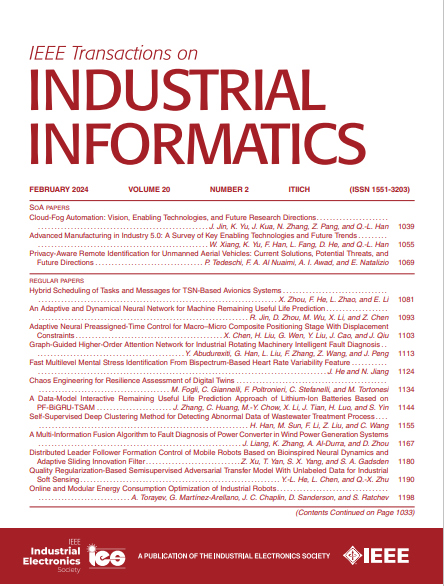
The IEEE Transactions on Industrial Informatics is a multidisciplinary journal dedicated to publishing technical papers that connect theory with practical applications of informatics in industrial settings. It focuses on the utilization of information in intelligent, distributed, and agile industrial automation and control systems. The scope includes topics such as knowledge-based and AI-enhanced automation, intelligent computer control systems, flexible and collaborative manufacturing, industrial informatics in software-defined vehicles and robotics, computer vision, industrial cyber-physical and industrial IoT systems, real-time and networked embedded systems, security in industrial processes, industrial communications, systems interoperability, and human-machine interaction.




 京公网安备 11010802042870号
京ICP备2023020795号-1
京公网安备 11010802042870号
京ICP备2023020795号-1

 分享
分享
 求助内容:
求助内容: 应助结果提醒方式:
 扫码关注我们
