{"title":"蛇石寄生深海热液喷口的渗透能量转换","authors":"Hye-Eun Lee, Tomoyo Okumura, Hideshi Ooka, Kiyohiro Adachi, Takaaki Hikima, Kunio Hirata, Yoshiaki Kawano, Hiroaki Matsuura, Masaki Yamamoto, Masahiro Yamamoto, Akira Yamaguchi, Ji-Eun Lee, Hiroya Takahashi, Ki Tae Nam, Yasuhiko Ohara, Daisuke Hashizume, Shawn Erin McGlynn, Ryuhei Nakamura","doi":"10.1038/s41467-024-52332-3","DOIUrl":null,"url":null,"abstract":"<p>Cells harvest energy from ionic gradients by selective ion transport across membranes, and the same principle is recently being used for osmotic power generation from salinity gradients at ocean-river interfaces. Common to these ionic gradient conversions is that they require intricate nanoscale structures. Here, we show that natural submarine serpentinite-hosted hydrothermal vent (HV) precipitates are capable of converting ionic gradients into electrochemical energy by selective transport of Na<sup>+</sup>, K<sup>+</sup>, H<sup>+</sup>, and Cl<sup>-</sup>. Layered hydroxide nanocrystals are aligned radially outwards from the HV fluid channels, constituting confined nanopores that span millimeters in the HV wall. The nanopores change the surface charge depending on adsorbed ions, allowing the mineral to function as a cation- and anion-selective ion transport membrane. Our findings indicate that chemical disequilibria originating from flow and concentration gradients in geologic environments generate confined nanospaces which enable the spontaneous establishment of osmotic energy conversion.</p>","PeriodicalId":19066,"journal":{"name":"Nature Communications","volume":"2 1","pages":""},"PeriodicalIF":15.7000,"publicationDate":"2024-09-25","publicationTypes":"Journal Article","fieldsOfStudy":null,"isOpenAccess":false,"openAccessPdf":"","citationCount":"0","resultStr":"{\"title\":\"Osmotic energy conversion in serpentinite-hosted deep-sea hydrothermal vents\",\"authors\":\"Hye-Eun Lee, Tomoyo Okumura, Hideshi Ooka, Kiyohiro Adachi, Takaaki Hikima, Kunio Hirata, Yoshiaki Kawano, Hiroaki Matsuura, Masaki Yamamoto, Masahiro Yamamoto, Akira Yamaguchi, Ji-Eun Lee, Hiroya Takahashi, Ki Tae Nam, Yasuhiko Ohara, Daisuke Hashizume, Shawn Erin McGlynn, Ryuhei Nakamura\",\"doi\":\"10.1038/s41467-024-52332-3\",\"DOIUrl\":null,\"url\":null,\"abstract\":\"<p>Cells harvest energy from ionic gradients by selective ion transport across membranes, and the same principle is recently being used for osmotic power generation from salinity gradients at ocean-river interfaces. Common to these ionic gradient conversions is that they require intricate nanoscale structures. Here, we show that natural submarine serpentinite-hosted hydrothermal vent (HV) precipitates are capable of converting ionic gradients into electrochemical energy by selective transport of Na<sup>+</sup>, K<sup>+</sup>, H<sup>+</sup>, and Cl<sup>-</sup>. Layered hydroxide nanocrystals are aligned radially outwards from the HV fluid channels, constituting confined nanopores that span millimeters in the HV wall. The nanopores change the surface charge depending on adsorbed ions, allowing the mineral to function as a cation- and anion-selective ion transport membrane. Our findings indicate that chemical disequilibria originating from flow and concentration gradients in geologic environments generate confined nanospaces which enable the spontaneous establishment of osmotic energy conversion.</p>\",\"PeriodicalId\":19066,\"journal\":{\"name\":\"Nature Communications\",\"volume\":\"2 1\",\"pages\":\"\"},\"PeriodicalIF\":15.7000,\"publicationDate\":\"2024-09-25\",\"publicationTypes\":\"Journal Article\",\"fieldsOfStudy\":null,\"isOpenAccess\":false,\"openAccessPdf\":\"\",\"citationCount\":\"0\",\"resultStr\":null,\"platform\":\"Semanticscholar\",\"paperid\":null,\"PeriodicalName\":\"Nature Communications\",\"FirstCategoryId\":\"103\",\"ListUrlMain\":\"https://doi.org/10.1038/s41467-024-52332-3\",\"RegionNum\":1,\"RegionCategory\":\"综合性期刊\",\"ArticlePicture\":[],\"TitleCN\":null,\"AbstractTextCN\":null,\"PMCID\":null,\"EPubDate\":\"\",\"PubModel\":\"\",\"JCR\":\"Q1\",\"JCRName\":\"MULTIDISCIPLINARY SCIENCES\",\"Score\":null,\"Total\":0}","platform":"Semanticscholar","paperid":null,"PeriodicalName":"Nature Communications","FirstCategoryId":"103","ListUrlMain":"https://doi.org/10.1038/s41467-024-52332-3","RegionNum":1,"RegionCategory":"综合性期刊","ArticlePicture":[],"TitleCN":null,"AbstractTextCN":null,"PMCID":null,"EPubDate":"","PubModel":"","JCR":"Q1","JCRName":"MULTIDISCIPLINARY SCIENCES","Score":null,"Total":0}
Osmotic energy conversion in serpentinite-hosted deep-sea hydrothermal vents
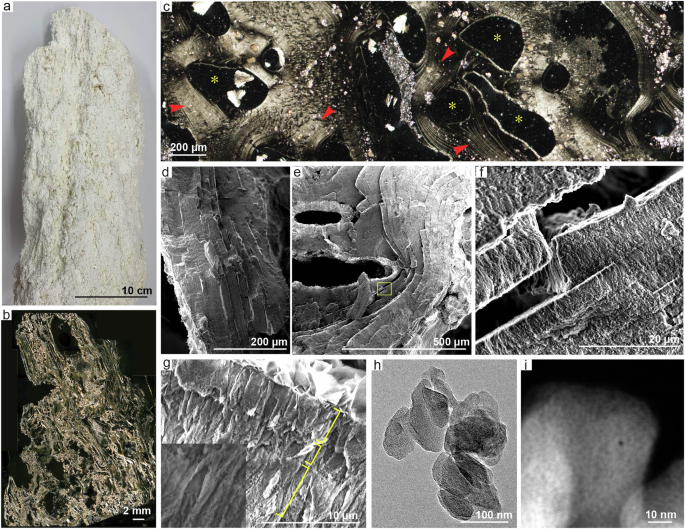
Cells harvest energy from ionic gradients by selective ion transport across membranes, and the same principle is recently being used for osmotic power generation from salinity gradients at ocean-river interfaces. Common to these ionic gradient conversions is that they require intricate nanoscale structures. Here, we show that natural submarine serpentinite-hosted hydrothermal vent (HV) precipitates are capable of converting ionic gradients into electrochemical energy by selective transport of Na+, K+, H+, and Cl-. Layered hydroxide nanocrystals are aligned radially outwards from the HV fluid channels, constituting confined nanopores that span millimeters in the HV wall. The nanopores change the surface charge depending on adsorbed ions, allowing the mineral to function as a cation- and anion-selective ion transport membrane. Our findings indicate that chemical disequilibria originating from flow and concentration gradients in geologic environments generate confined nanospaces which enable the spontaneous establishment of osmotic energy conversion.
期刊介绍:
Nature Communications, an open-access journal, publishes high-quality research spanning all areas of the natural sciences. Papers featured in the journal showcase significant advances relevant to specialists in each respective field. With a 2-year impact factor of 16.6 (2022) and a median time of 8 days from submission to the first editorial decision, Nature Communications is committed to rapid dissemination of research findings. As a multidisciplinary journal, it welcomes contributions from biological, health, physical, chemical, Earth, social, mathematical, applied, and engineering sciences, aiming to highlight important breakthroughs within each domain.




 京公网安备 11010802042870号
京ICP备2023020795号-1
京公网安备 11010802042870号
京ICP备2023020795号-1

 分享
分享
 求助内容:
求助内容: 应助结果提醒方式:
 扫码关注我们
