Xueru Shi, Yunpeng Zhong, Yongqiang Yang, Prof. Jiang Zhou, Prof. Xinxin Cao, Prof. Shuquan Liang
{"title":"用于高性能锌电池的阴离子锚定盐内聚合物固体电解质","authors":"Xueru Shi, Yunpeng Zhong, Yongqiang Yang, Prof. Jiang Zhou, Prof. Xinxin Cao, Prof. Shuquan Liang","doi":"10.1002/anie.202414777","DOIUrl":null,"url":null,"abstract":"<p>Solid polymer electrolytes hold promise for addressing key challenges in rechargeable zinc batteries (ZBs) utilizing aqueous electrolytes. However, achieving simultaneous high ionic conductivity, excellent mechanical strength, and a high cation transference number while effectively suppressing Zn dendrites remains challenging. Herein, we design a novel polymer-in-salt solid electrolyte (PISSE) composed of polyacrylonitrile (PAN), zinc chloride (ZnCl<sub>2</sub>), and niobium pentoxide with oxygen vacancies (Nb<sub>2</sub>O<sub>5-x</sub>) with high ionic conductivity. PAN polymer matrix provides the electrolyte good mechanical properties and solubility of Zn salt. The high concentration of ZnCl<sub>2</sub> effectively decouples the Zn<sup>2+</sup> from polymer chain segments and provides more ionic conduction amorphous region. Moreover, incorporating Nb<sub>2</sub>O<sub>5-x</sub> filler accelerates Zn<sup>2+</sup> desolvation by anchoring (Zn<sub>x</sub>Cl<sub>y</sub>)<sup>2x–y</sup> clusters and enhances the system's mechanical properties, achieving a superior Zn<sup>2+</sup> transference number (~0.93) and interfacial stability. Consequently, the optimized PISSE demonstrates exceptional stability during prolonged cycling periods, wide temperature range operation (−40 °C to 60 °C), remarkable flexibility, and compatibility with diverse electrode materials. This study provides valuable insights into the design of solid-state electrolytes based on ZBs and elucidates their multifunctional prospects.</p>","PeriodicalId":125,"journal":{"name":"Angewandte Chemie International Edition","volume":"64 2","pages":""},"PeriodicalIF":16.9000,"publicationDate":"2024-09-26","publicationTypes":"Journal Article","fieldsOfStudy":null,"isOpenAccess":false,"openAccessPdf":"","citationCount":"0","resultStr":"{\"title\":\"Anion-Anchored Polymer-in-Salt Solid Electrolyte for High-Performance Zinc Batteries\",\"authors\":\"Xueru Shi, Yunpeng Zhong, Yongqiang Yang, Prof. Jiang Zhou, Prof. Xinxin Cao, Prof. Shuquan Liang\",\"doi\":\"10.1002/anie.202414777\",\"DOIUrl\":null,\"url\":null,\"abstract\":\"<p>Solid polymer electrolytes hold promise for addressing key challenges in rechargeable zinc batteries (ZBs) utilizing aqueous electrolytes. However, achieving simultaneous high ionic conductivity, excellent mechanical strength, and a high cation transference number while effectively suppressing Zn dendrites remains challenging. Herein, we design a novel polymer-in-salt solid electrolyte (PISSE) composed of polyacrylonitrile (PAN), zinc chloride (ZnCl<sub>2</sub>), and niobium pentoxide with oxygen vacancies (Nb<sub>2</sub>O<sub>5-x</sub>) with high ionic conductivity. PAN polymer matrix provides the electrolyte good mechanical properties and solubility of Zn salt. The high concentration of ZnCl<sub>2</sub> effectively decouples the Zn<sup>2+</sup> from polymer chain segments and provides more ionic conduction amorphous region. Moreover, incorporating Nb<sub>2</sub>O<sub>5-x</sub> filler accelerates Zn<sup>2+</sup> desolvation by anchoring (Zn<sub>x</sub>Cl<sub>y</sub>)<sup>2x–y</sup> clusters and enhances the system's mechanical properties, achieving a superior Zn<sup>2+</sup> transference number (~0.93) and interfacial stability. Consequently, the optimized PISSE demonstrates exceptional stability during prolonged cycling periods, wide temperature range operation (−40 °C to 60 °C), remarkable flexibility, and compatibility with diverse electrode materials. This study provides valuable insights into the design of solid-state electrolytes based on ZBs and elucidates their multifunctional prospects.</p>\",\"PeriodicalId\":125,\"journal\":{\"name\":\"Angewandte Chemie International Edition\",\"volume\":\"64 2\",\"pages\":\"\"},\"PeriodicalIF\":16.9000,\"publicationDate\":\"2024-09-26\",\"publicationTypes\":\"Journal Article\",\"fieldsOfStudy\":null,\"isOpenAccess\":false,\"openAccessPdf\":\"\",\"citationCount\":\"0\",\"resultStr\":null,\"platform\":\"Semanticscholar\",\"paperid\":null,\"PeriodicalName\":\"Angewandte Chemie International Edition\",\"FirstCategoryId\":\"92\",\"ListUrlMain\":\"https://onlinelibrary.wiley.com/doi/10.1002/anie.202414777\",\"RegionNum\":1,\"RegionCategory\":\"化学\",\"ArticlePicture\":[],\"TitleCN\":null,\"AbstractTextCN\":null,\"PMCID\":null,\"EPubDate\":\"\",\"PubModel\":\"\",\"JCR\":\"Q1\",\"JCRName\":\"CHEMISTRY, MULTIDISCIPLINARY\",\"Score\":null,\"Total\":0}","platform":"Semanticscholar","paperid":null,"PeriodicalName":"Angewandte Chemie International Edition","FirstCategoryId":"92","ListUrlMain":"https://onlinelibrary.wiley.com/doi/10.1002/anie.202414777","RegionNum":1,"RegionCategory":"化学","ArticlePicture":[],"TitleCN":null,"AbstractTextCN":null,"PMCID":null,"EPubDate":"","PubModel":"","JCR":"Q1","JCRName":"CHEMISTRY, MULTIDISCIPLINARY","Score":null,"Total":0}
Anion-Anchored Polymer-in-Salt Solid Electrolyte for High-Performance Zinc Batteries
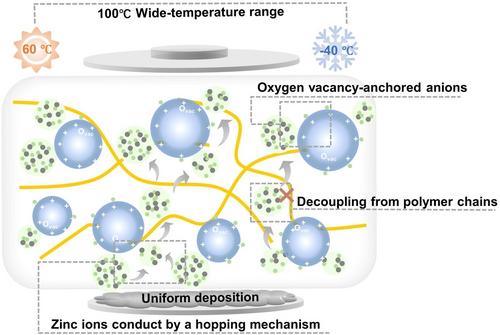
Solid polymer electrolytes hold promise for addressing key challenges in rechargeable zinc batteries (ZBs) utilizing aqueous electrolytes. However, achieving simultaneous high ionic conductivity, excellent mechanical strength, and a high cation transference number while effectively suppressing Zn dendrites remains challenging. Herein, we design a novel polymer-in-salt solid electrolyte (PISSE) composed of polyacrylonitrile (PAN), zinc chloride (ZnCl2), and niobium pentoxide with oxygen vacancies (Nb2O5-x) with high ionic conductivity. PAN polymer matrix provides the electrolyte good mechanical properties and solubility of Zn salt. The high concentration of ZnCl2 effectively decouples the Zn2+ from polymer chain segments and provides more ionic conduction amorphous region. Moreover, incorporating Nb2O5-x filler accelerates Zn2+ desolvation by anchoring (ZnxCly)2x–y clusters and enhances the system's mechanical properties, achieving a superior Zn2+ transference number (~0.93) and interfacial stability. Consequently, the optimized PISSE demonstrates exceptional stability during prolonged cycling periods, wide temperature range operation (−40 °C to 60 °C), remarkable flexibility, and compatibility with diverse electrode materials. This study provides valuable insights into the design of solid-state electrolytes based on ZBs and elucidates their multifunctional prospects.
期刊介绍:
Angewandte Chemie, a journal of the German Chemical Society (GDCh), maintains a leading position among scholarly journals in general chemistry with an impressive Impact Factor of 16.6 (2022 Journal Citation Reports, Clarivate, 2023). Published weekly in a reader-friendly format, it features new articles almost every day. Established in 1887, Angewandte Chemie is a prominent chemistry journal, offering a dynamic blend of Review-type articles, Highlights, Communications, and Research Articles on a weekly basis, making it unique in the field.




 京公网安备 11010802042870号
京ICP备2023020795号-1
京公网安备 11010802042870号
京ICP备2023020795号-1

 分享
分享
 求助内容:
求助内容: 应助结果提醒方式:
 扫码关注我们
