{"title":"1,2,3-三芳基偶氮烯作为偶氮烯嵌入式多环芳烃的前体","authors":"Justyna Biesaga , Sławomir Szafert , Bartłomiej Pigulski","doi":"10.1039/d4qo01459f","DOIUrl":null,"url":null,"abstract":"<div><div>A series of 1,2,3-triarylazulenes was obtained using new synthetic methodology and subsequently subjected to Scholl-type oxidation aiming for conjugated azulene-embedded polycyclic aromatic hydrocarbons (PAHs). The oxidation yielded either unexpected azulen-1(8a<em>H</em>)-ones or desired purely hydrocarbon azulene-embedded PAHs, depending on the substitution pattern. Different reaction pathways were rationalized using DFT calculations, leading to the observation that 2-pyrenyl substituents facilitate formation of the desired conjugated molecules. The fully hydrocarbon azulene-embedded PAHs exhibit a relatively small electrochemical energy gap below 2 eV and optical absorption reaching the near-infrared (NIR) region. These properties are attributed to their non-alternant topology and retained azulene-like electronic structure.</div></div>","PeriodicalId":94379,"journal":{"name":"Organic chemistry frontiers : an international journal of organic chemistry","volume":"11 21","pages":"Pages 6026-6035"},"PeriodicalIF":0.0000,"publicationDate":"2024-09-03","publicationTypes":"Journal Article","fieldsOfStudy":null,"isOpenAccess":false,"openAccessPdf":"","citationCount":"0","resultStr":"{\"title\":\"1,2,3-Triarylazulenes as precursors of azulene-embedded polycyclic aromatic hydrocarbons†‡\",\"authors\":\"Justyna Biesaga , Sławomir Szafert , Bartłomiej Pigulski\",\"doi\":\"10.1039/d4qo01459f\",\"DOIUrl\":null,\"url\":null,\"abstract\":\"<div><div>A series of 1,2,3-triarylazulenes was obtained using new synthetic methodology and subsequently subjected to Scholl-type oxidation aiming for conjugated azulene-embedded polycyclic aromatic hydrocarbons (PAHs). The oxidation yielded either unexpected azulen-1(8a<em>H</em>)-ones or desired purely hydrocarbon azulene-embedded PAHs, depending on the substitution pattern. Different reaction pathways were rationalized using DFT calculations, leading to the observation that 2-pyrenyl substituents facilitate formation of the desired conjugated molecules. The fully hydrocarbon azulene-embedded PAHs exhibit a relatively small electrochemical energy gap below 2 eV and optical absorption reaching the near-infrared (NIR) region. These properties are attributed to their non-alternant topology and retained azulene-like electronic structure.</div></div>\",\"PeriodicalId\":94379,\"journal\":{\"name\":\"Organic chemistry frontiers : an international journal of organic chemistry\",\"volume\":\"11 21\",\"pages\":\"Pages 6026-6035\"},\"PeriodicalIF\":0.0000,\"publicationDate\":\"2024-09-03\",\"publicationTypes\":\"Journal Article\",\"fieldsOfStudy\":null,\"isOpenAccess\":false,\"openAccessPdf\":\"\",\"citationCount\":\"0\",\"resultStr\":null,\"platform\":\"Semanticscholar\",\"paperid\":null,\"PeriodicalName\":\"Organic chemistry frontiers : an international journal of organic chemistry\",\"FirstCategoryId\":\"1085\",\"ListUrlMain\":\"https://www.sciencedirect.com/org/science/article/pii/S2052412924006314\",\"RegionNum\":0,\"RegionCategory\":null,\"ArticlePicture\":[],\"TitleCN\":null,\"AbstractTextCN\":null,\"PMCID\":null,\"EPubDate\":\"2024/9/27 0:00:00\",\"PubModel\":\"Epub\",\"JCR\":\"\",\"JCRName\":\"\",\"Score\":null,\"Total\":0}","platform":"Semanticscholar","paperid":null,"PeriodicalName":"Organic chemistry frontiers : an international journal of organic chemistry","FirstCategoryId":"1085","ListUrlMain":"https://www.sciencedirect.com/org/science/article/pii/S2052412924006314","RegionNum":0,"RegionCategory":null,"ArticlePicture":[],"TitleCN":null,"AbstractTextCN":null,"PMCID":null,"EPubDate":"2024/9/27 0:00:00","PubModel":"Epub","JCR":"","JCRName":"","Score":null,"Total":0}
1,2,3-Triarylazulenes as precursors of azulene-embedded polycyclic aromatic hydrocarbons†‡
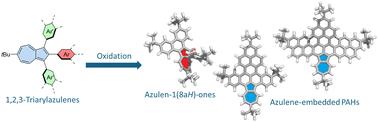
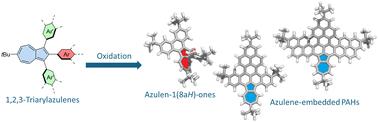
A series of 1,2,3-triarylazulenes was obtained using new synthetic methodology and subsequently subjected to Scholl-type oxidation aiming for conjugated azulene-embedded polycyclic aromatic hydrocarbons (PAHs). The oxidation yielded either unexpected azulen-1(8aH)-ones or desired purely hydrocarbon azulene-embedded PAHs, depending on the substitution pattern. Different reaction pathways were rationalized using DFT calculations, leading to the observation that 2-pyrenyl substituents facilitate formation of the desired conjugated molecules. The fully hydrocarbon azulene-embedded PAHs exhibit a relatively small electrochemical energy gap below 2 eV and optical absorption reaching the near-infrared (NIR) region. These properties are attributed to their non-alternant topology and retained azulene-like electronic structure.




 京公网安备 11010802042870号
京ICP备2023020795号-1
京公网安备 11010802042870号
京ICP备2023020795号-1

 分享
分享

 求助内容:
求助内容: 应助结果提醒方式:
 扫码关注我们
