Fathy Attia, Thien Tran, Vinh Bui, Bhanuprakash Valluri, Erda Deng, Gengyi Zhang, Narjes Esmaeili, Liang Huang, Haiqing Lin
{"title":"用于二氧化碳/N2 膜分离的聚(1,3-二氧戊环)醋酸酯底层聚合物","authors":"Fathy Attia, Thien Tran, Vinh Bui, Bhanuprakash Valluri, Erda Deng, Gengyi Zhang, Narjes Esmaeili, Liang Huang, Haiqing Lin","doi":"10.1021/acs.chemmater.4c01679","DOIUrl":null,"url":null,"abstract":"Cross-linked bottlebrush polymers based on poly(1,3-dioxolane) have emerged as an attractive platform for designing ether-oxygen-rich yet amorphous CO<sub>2</sub>-philic polymers for membrane CO<sub>2</sub>/N<sub>2</sub> separation. However, the brushes often have –OH end groups that reduce gas permeability, and their cross-linked nature prevents them from being fabricated into industrial thin-film composite (TFC) membranes. Herein, we design and synthesize high-molecular-weight and soluble bottlebrush polymers from poly(1,3-dioxolane) acrylate with an acetate brush end group (DXLAc) using reversible addition–fragmentation chain transfer polymerization and successfully fabricate them into TFC membranes for CO<sub>2</sub>/N<sub>2</sub> separation. The effects of the brush length and end groups on polymers’ physical and gas transport properties are investigated. Furthermore, the bottlebrush polymers were fabricated into membranes with defect-free selective layers as thin as 55 nm. The membranes exhibit CO<sub>2</sub> permeance of 1250–2150 GPU and CO<sub>2</sub>/N<sub>2</sub> selectivity of 71–34, surpassing Robeson’s upper bound, and show good stability when challenged with simulated flue gas. This work highlights that bottlebrush polymers with suitable brush lengths and end groups can incorporate high contents of polar groups and can be useful for developing scalable, high-performance membranes for various separations.","PeriodicalId":33,"journal":{"name":"Chemistry of Materials","volume":"66 1","pages":""},"PeriodicalIF":7.0000,"publicationDate":"2024-09-28","publicationTypes":"Journal Article","fieldsOfStudy":null,"isOpenAccess":false,"openAccessPdf":"","citationCount":"0","resultStr":"{\"title\":\"Bottlebrush Polymers of Poly(1,3-dioxolane) Acetate for Membrane CO2/N2 Separation\",\"authors\":\"Fathy Attia, Thien Tran, Vinh Bui, Bhanuprakash Valluri, Erda Deng, Gengyi Zhang, Narjes Esmaeili, Liang Huang, Haiqing Lin\",\"doi\":\"10.1021/acs.chemmater.4c01679\",\"DOIUrl\":null,\"url\":null,\"abstract\":\"Cross-linked bottlebrush polymers based on poly(1,3-dioxolane) have emerged as an attractive platform for designing ether-oxygen-rich yet amorphous CO<sub>2</sub>-philic polymers for membrane CO<sub>2</sub>/N<sub>2</sub> separation. However, the brushes often have –OH end groups that reduce gas permeability, and their cross-linked nature prevents them from being fabricated into industrial thin-film composite (TFC) membranes. Herein, we design and synthesize high-molecular-weight and soluble bottlebrush polymers from poly(1,3-dioxolane) acrylate with an acetate brush end group (DXLAc) using reversible addition–fragmentation chain transfer polymerization and successfully fabricate them into TFC membranes for CO<sub>2</sub>/N<sub>2</sub> separation. The effects of the brush length and end groups on polymers’ physical and gas transport properties are investigated. Furthermore, the bottlebrush polymers were fabricated into membranes with defect-free selective layers as thin as 55 nm. The membranes exhibit CO<sub>2</sub> permeance of 1250–2150 GPU and CO<sub>2</sub>/N<sub>2</sub> selectivity of 71–34, surpassing Robeson’s upper bound, and show good stability when challenged with simulated flue gas. This work highlights that bottlebrush polymers with suitable brush lengths and end groups can incorporate high contents of polar groups and can be useful for developing scalable, high-performance membranes for various separations.\",\"PeriodicalId\":33,\"journal\":{\"name\":\"Chemistry of Materials\",\"volume\":\"66 1\",\"pages\":\"\"},\"PeriodicalIF\":7.0000,\"publicationDate\":\"2024-09-28\",\"publicationTypes\":\"Journal Article\",\"fieldsOfStudy\":null,\"isOpenAccess\":false,\"openAccessPdf\":\"\",\"citationCount\":\"0\",\"resultStr\":null,\"platform\":\"Semanticscholar\",\"paperid\":null,\"PeriodicalName\":\"Chemistry of Materials\",\"FirstCategoryId\":\"88\",\"ListUrlMain\":\"https://doi.org/10.1021/acs.chemmater.4c01679\",\"RegionNum\":2,\"RegionCategory\":\"材料科学\",\"ArticlePicture\":[],\"TitleCN\":null,\"AbstractTextCN\":null,\"PMCID\":null,\"EPubDate\":\"\",\"PubModel\":\"\",\"JCR\":\"Q2\",\"JCRName\":\"CHEMISTRY, PHYSICAL\",\"Score\":null,\"Total\":0}","platform":"Semanticscholar","paperid":null,"PeriodicalName":"Chemistry of Materials","FirstCategoryId":"88","ListUrlMain":"https://doi.org/10.1021/acs.chemmater.4c01679","RegionNum":2,"RegionCategory":"材料科学","ArticlePicture":[],"TitleCN":null,"AbstractTextCN":null,"PMCID":null,"EPubDate":"","PubModel":"","JCR":"Q2","JCRName":"CHEMISTRY, PHYSICAL","Score":null,"Total":0}
Bottlebrush Polymers of Poly(1,3-dioxolane) Acetate for Membrane CO2/N2 Separation
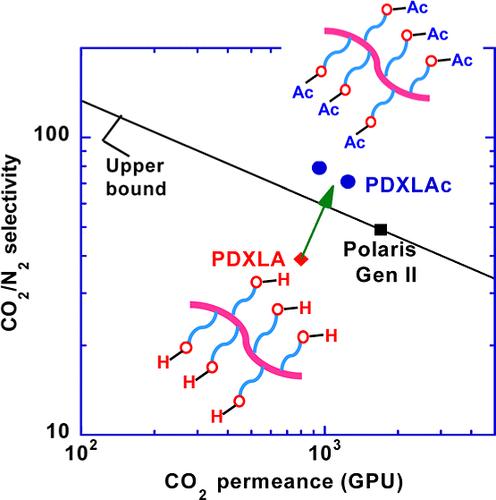
Cross-linked bottlebrush polymers based on poly(1,3-dioxolane) have emerged as an attractive platform for designing ether-oxygen-rich yet amorphous CO2-philic polymers for membrane CO2/N2 separation. However, the brushes often have –OH end groups that reduce gas permeability, and their cross-linked nature prevents them from being fabricated into industrial thin-film composite (TFC) membranes. Herein, we design and synthesize high-molecular-weight and soluble bottlebrush polymers from poly(1,3-dioxolane) acrylate with an acetate brush end group (DXLAc) using reversible addition–fragmentation chain transfer polymerization and successfully fabricate them into TFC membranes for CO2/N2 separation. The effects of the brush length and end groups on polymers’ physical and gas transport properties are investigated. Furthermore, the bottlebrush polymers were fabricated into membranes with defect-free selective layers as thin as 55 nm. The membranes exhibit CO2 permeance of 1250–2150 GPU and CO2/N2 selectivity of 71–34, surpassing Robeson’s upper bound, and show good stability when challenged with simulated flue gas. This work highlights that bottlebrush polymers with suitable brush lengths and end groups can incorporate high contents of polar groups and can be useful for developing scalable, high-performance membranes for various separations.
期刊介绍:
The journal Chemistry of Materials focuses on publishing original research at the intersection of materials science and chemistry. The studies published in the journal involve chemistry as a prominent component and explore topics such as the design, synthesis, characterization, processing, understanding, and application of functional or potentially functional materials. The journal covers various areas of interest, including inorganic and organic solid-state chemistry, nanomaterials, biomaterials, thin films and polymers, and composite/hybrid materials. The journal particularly seeks papers that highlight the creation or development of innovative materials with novel optical, electrical, magnetic, catalytic, or mechanical properties. It is essential that manuscripts on these topics have a primary focus on the chemistry of materials and represent a significant advancement compared to prior research. Before external reviews are sought, submitted manuscripts undergo a review process by a minimum of two editors to ensure their appropriateness for the journal and the presence of sufficient evidence of a significant advance that will be of broad interest to the materials chemistry community.




 京公网安备 11010802042870号
京ICP备2023020795号-1
京公网安备 11010802042870号
京ICP备2023020795号-1

 分享
分享
 求助内容:
求助内容: 应助结果提醒方式:
 扫码关注我们
